
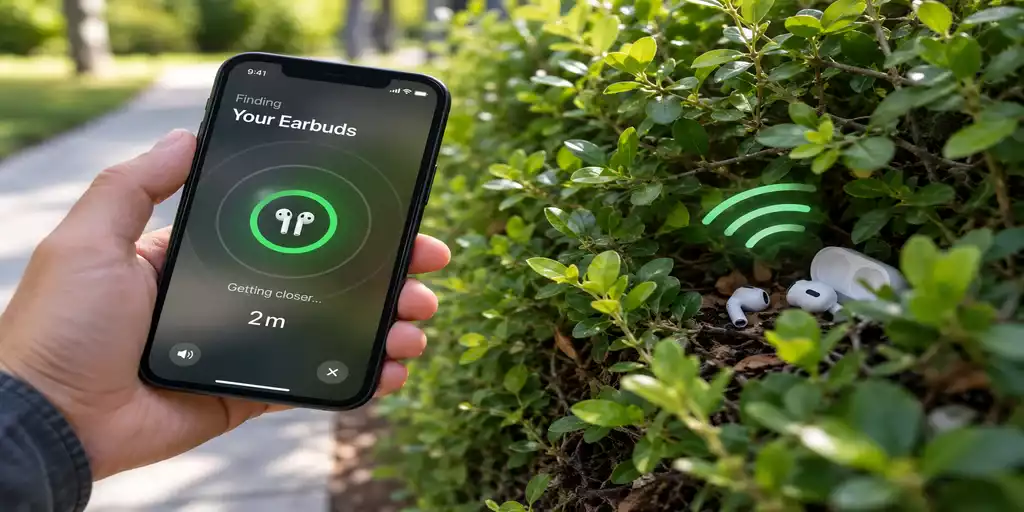
A lost Bluetooth device can often be found if it is still turned on and supports wireless connectivity. The easiest way depends on the type of device. Headphones, speakers, keyboards, and other accessories can be found using a Bluetooth scanner, while devices such as AirPods and Galaxy Buds may have their own location services.
How Bluetooth device search works
Bluetooth is a short-range wireless communication technology. When a device is turned on and its Bluetooth connection is active, it can transmit a signal that can be detected by a nearby phone or other Bluetooth device.
A Bluetooth scanner can use the received signal strength to determine whether you are getting closer to or moving away from the device. Typically, the signal gets stronger as you get closer to the device.
This makes Bluetooth convenient for finding items lost somewhere nearby, but it’s not the same as GPS tracking. A standard Bluetooth connection does not allow you to determine the device’s exact geographic location.
Finding a lost Bluetooth device using a Bluetooth scanner
If you’ve lost a Bluetooth-enabled accessory and don’t have a dedicated tracking service, a Bluetooth scanner is one of the simplest solutions.
First, turn on Bluetooth on your phone and launch a Bluetooth scanner app. There are many such apps, and there’s no point in describing each one—they all work in a very similar way. The app will display the nearest devices that can currently be detected.
If you know the name of the missing device, find it in the list. Then walk around the room, keeping an eye on the signal strength.
For example, if you’ve lost your Bluetooth headphones somewhere in the house, start with the room where you last used them. Move slowly around the room and check the signal in different spots. When the signal gets stronger, search that area more thoroughly.
However, the displayed distance should not be considered an exact measurement. The Bluetooth signal strength is affected by walls, furniture, the device’s orientation, radio interference, and the position of your phone.
Find Android devices and Bluetooth accessories
Android devices can be located using Google Find Hub, while Samsung Galaxy smartphones, tablets, and compatible accessories can also be found through Samsung Find or SmartThings Find.
For a lost Android phone or tablet, open Google Find Hub and select the device from your list. Depending on the device and its status, you can view its location, play a sound, secure it, or perform other available actions.
Samsung Galaxy devices have additional options through Samsung’s finding services. These can be used for Galaxy smartphones, tablets, watches, and compatible Galaxy Buds. Depending on the model, you may be able to see the last known location, search for the device nearby, or play a sound.
For Galaxy Buds and other ordinary Bluetooth accessories, a Bluetooth scanner can be useful when the device is nearby. However, a scanner only detects a Bluetooth signal; it cannot locate a device that is switched off or outside its detection range.
Google Find Hub and Samsung’s finding services can provide more information than a standard Bluetooth scan because supported devices can use an internet connection or a finding network to report their location.
Find an Apple device
Apple devices can be located using the Find My service. It can be used to find an iPhone, iPad, Apple Watch, Mac, AirPods, and other compatible devices associated with your Apple Account.
Open the Find My app on another Apple device and select the missing device under Devices. If the device can currently report its location, it will be displayed on the map. Depending on the device, you can also play a sound to help find it nearby.
If the device is not currently connected to the internet, Find My may show its last known location. Supported devices can also use the Find My network, which allows nearby Apple devices to detect and anonymously report their location.
For AirPods, select them in Find My to see their location and, when supported, play a sound or use nearby-finding features. The available options depend on the AirPods model and whether the earbuds or charging case still have power.
If the device cannot be found, you can enable Lost Mode for supported products. This locks the device and can display contact information so that someone who finds it can get in touch with you.
Find My works differently from a normal Bluetooth scanner. A Bluetooth scanner is useful for finding a device that is nearby, while Find My can locate supported Apple devices over a much greater distance through Apple’s finding infrastructure.
Bluetooth Trackers for items you often lose
Special Bluetooth trackers are available for items that are easily lost. Examples include Apple’s AirTag and Samsung’s Galaxy SmartTag. These devices are specifically designed to help you locate your belongings and work with compatible devices.
In simple terms, the tracker continuously broadcasts a Bluetooth signal containing its unique identifier. Nearby Apple and Android devices can periodically scan for Bluetooth devices. When a compatible device detects the tracker, it sends information about the tracker to a dedicated server. The owner can then use their account to determine the tracker’s location.
Because there are millions of Apple and Android smartphones in use, a tracker can often be detected by a nearby device even when it is far from its owner.
The main disadvantage is that you need to prepare in advance by purchasing and registering the tracker. Once attached to an item, however, it provides a way to locate that item if it is lost.
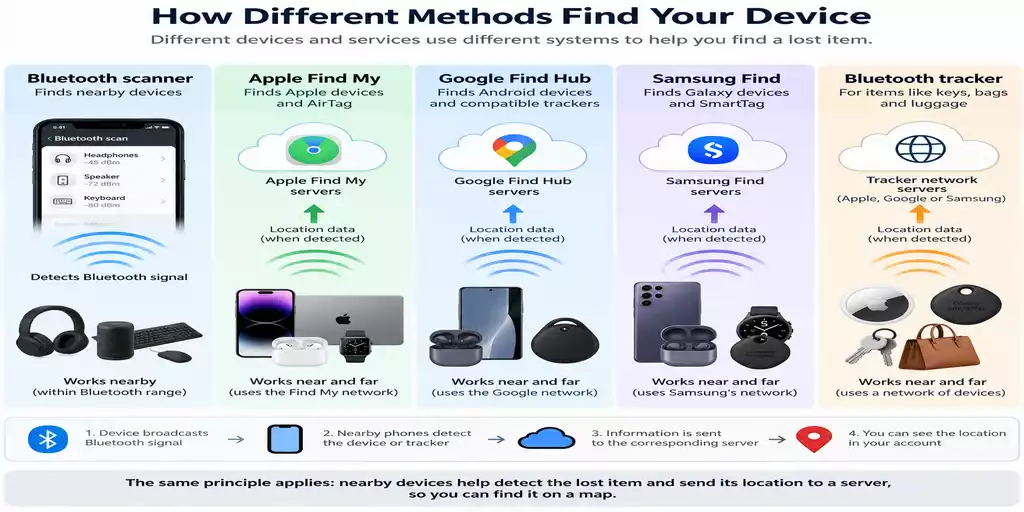
A comparison of methods for searching for Bluetooth devices in a table.
| Method | Best for | Works at a distance? | Requires special support? |
|---|---|---|---|
| Bluetooth scanner | Nearby Bluetooth accessories | No | No |
| Apple Find My | Apple devices and AirPods | Yes, for supported devices | Yes |
| Samsung Find | Galaxy devices and supported accessories | Yes, for supported devices | Yes |
| Google Find Hub | Android devices and supported trackers | Yes, for supported devices | Yes |
| Bluetooth tracker | Keys, bags, luggage and other items | Yes, through the appropriate network | Yes |