
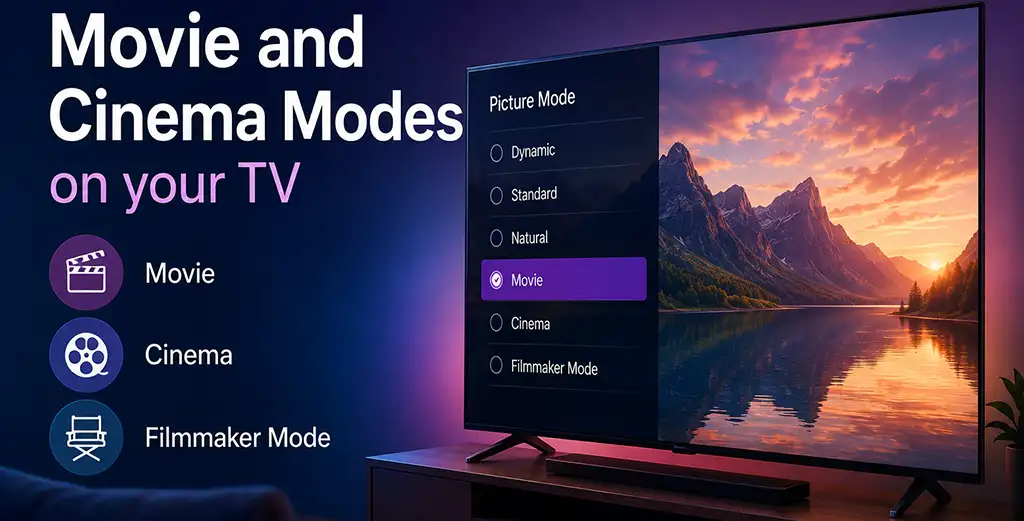
Movie mode is one of the oldest and most enduring preset picture modes, dating back to the 1980s. Despite its more than 40-year history, many users have never really considered what this mode does, why it is needed, or how it affects the picture. As a result, many people simply never use it.
TV manufacturers generally describe Movie mode as a setting designed for comfortable, extended viewing. It is intended to provide a more natural and balanced picture that is easier to watch for several hours, making it particularly suitable for movies and TV shows.
What makes “Cinema” mode special?
“Cinema” mode is designed to produce a more natural and balanced picture, especially when watching TV in a dark or dimly lit room. Compared to brighter picture presets, such as “Standard” or “Dynamic,” this mode typically uses a lower overall picture brightness, a warmer color temperature, and less aggressive image processing. Brightness, contrast, sharpness, and other processing parameters are generally adjusted to produce an image that looks closer to how movies and TV shows were originally edited.
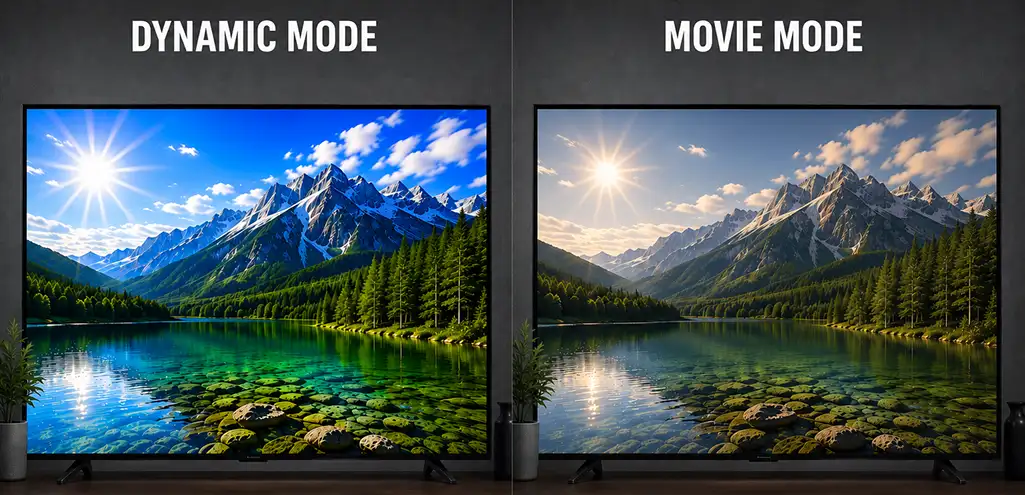
One of the most noticeable differences is color temperature. “Cinema” mode typically uses a warmer white balance, so whites may appear slightly yellowish or reddish compared to the cooler shades of white in “Standard” or “Dynamic” modes. This may seem unusual at first, especially if you’re used to a very bright and cool picture. However, a warmer white point is closer to the reference settings typically used when calibrating professional displays for film and television production.
In addition, the level of artificial image processing is usually reduced in “Cinema” mode. Features such as excessive sharpness, dynamic contrast, artificial color enhancement, and aggressive motion processing may be toned down or disabled. This helps preserve fine details and prevents the image from looking overprocessed. However, on some TVs, the exact settings vary significantly depending on the manufacturer and even the specific model.
This mode is particularly well-suited for watching movies and TV shows in the evening or at night. Lower picture brightness can make extended viewing more comfortable, while a warmer color temperature can create a more relaxing viewing experience. Therefore, “Cinema” mode is a good choice for streaming services, Blu-ray movies, and home theater systems.
There’s another important reason to use “Cinema” mode: many movies and TV shows are produced and mastered using professional reference monitors with a relatively warm and precisely calibrated image. As a result, “Cinema” mode often comes much closer to the intended look of the original content than the brighter picture presets designed to grab attention in a store.
Does “Cinema” mode have any drawbacks?
“Cinema” mode isn’t ideal for all viewing conditions. In a brightly lit room, the picture may appear too dim, especially if a lot of daylight is falling on the screen. In such conditions, “Standard” mode may be more comfortable, as the higher brightness makes the picture easier to see.
It may also take some time to get used to the warmer color temperature. A white object that looks neutral in “Standard” mode may appear slightly yellowish or reddish in “Cinema” mode. This doesn’t necessarily mean the image is incorrect; it’s often the result of using a warmer white point.
On TVs with limited contrast or basic local dimming, dark scenes may also appear less impressive. Details in the shadows may be harder to make out if the room is very bright or if the panel has a relatively low black level. In some cases, the lower overall brightness of the image may make the picture appear “flatter” compared to more “aggressive” settings.
Therefore, “Cinema” mode is not always the optimal setting for every situation. Its primary goal is not to make the image brighter or more dramatic, but to provide a more natural reproduction that closely matches how movies and TV content are intended to look.
How to enable movie mode on your TV
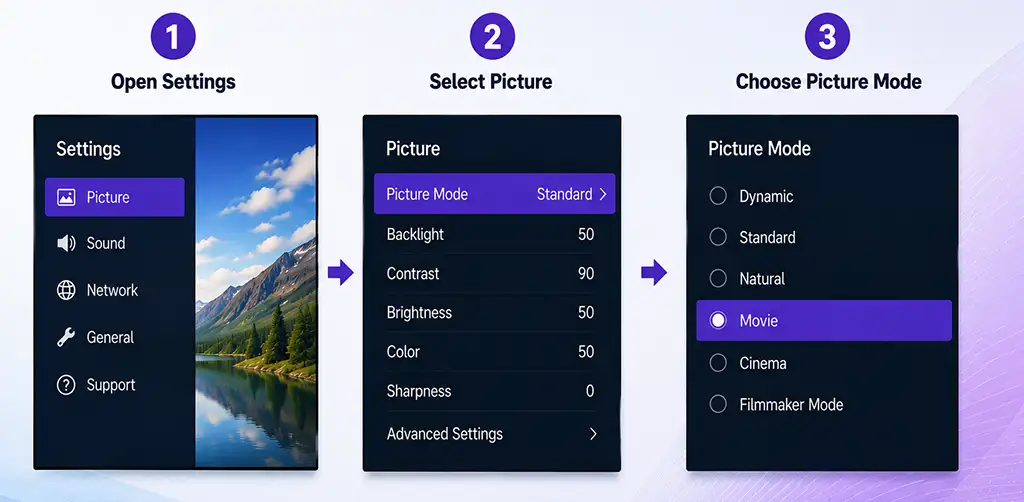
On most modern TVs, Movie mode is available as one of the standard picture presets. To enable it, open the Picture or Display settings, select Picture Mode, and choose Movie, Cinema, or Filmmaker Mode, depending on the TV brand and model.
Some TVs are also equipped with an ambient light sensor that automatically adjusts the screen brightness based on the lighting conditions in the room. This can make viewing more comfortable by increasing brightness during the day and reducing it in darker surroundings. However, the ambient light sensor affects only the screen brightness and does not automatically switch the TV to Movie mode.