
When choosing a TV, start by selecting the right screen size. The distance between the TV and your viewing position plays an important role in viewing comfort.
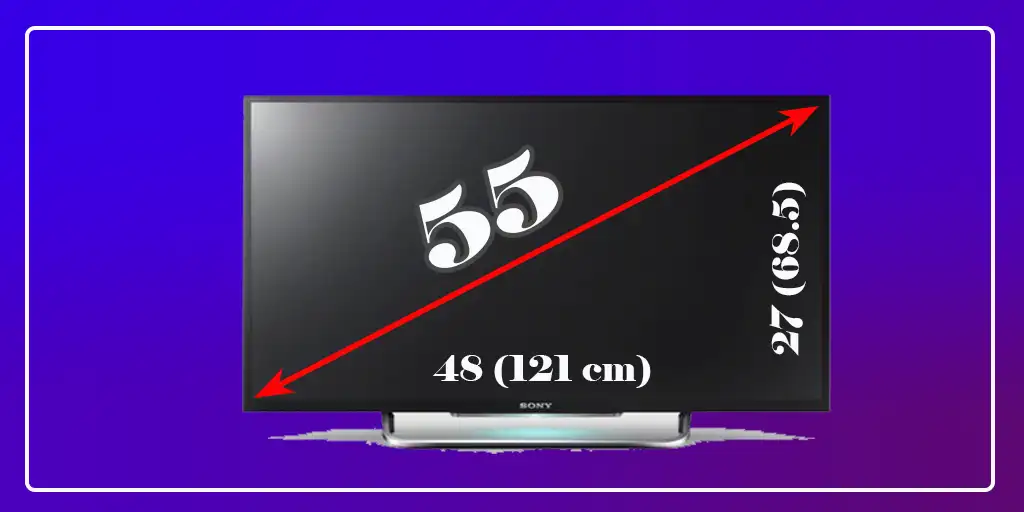
A TV’s screen size is measured by its diagonal, which is the distance between two opposite corners of the screen. The diagonal is measured in inches, the standard unit used for TV sizes. Keep in mind that the screen diagonal is not the same as the TV’s width.
Manufacturers round the actual screen size to the nearest whole inch. For example, screens with an actual diagonal of 54.5 inches, 54.6 inches, or 55.4 inches are all sold as 55-inch TVs.
The TV’s overall dimensions are larger than the screen because they include the surrounding frame (bezel). The bezel width depends on the display technology:
- LED TVs usually have slightly wider bezels.
- OLED TVs typically have very thin bezels.
Modern TVs use a 16:9 aspect ratio, which means the screen is 16 units wide for every 9 units of height. The actual width and height increase with the screen size, but the aspect ratio remains the same. The 16:9 format has been the standard for television broadcasts, movies, and streaming content for more than 20 years.
Width, height and thickness of a 55-inch TV
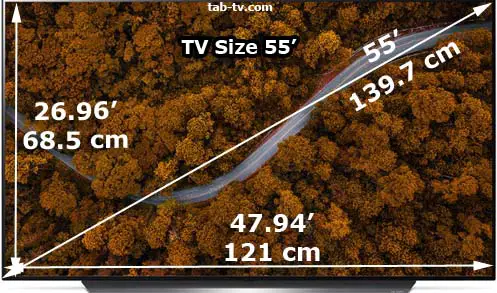
The table below lists all possible sizes for a 55-inch TV in various units of measurement, including accessories such as a stand. If you plan to mount the TV on the wall, there are many different mounts available. Some TV models support a mount that ensures minimal clearance between the wall and the TV, but in this case, you’ll need to create a small recess behind the TV to hide the cables (such as HDMI or antenna cables) and the power outlet.
55-inch TV size chart
| Parameter | Size | Note |
|---|---|---|
| Diagonal | 55 inches (139.7 cm) | Measured from one corner of the screen to the opposite corner. |
| Width (screen) | 48 inches (122 cm) | Excludes the frame. |
| Width (with frame) | 48.1–48.6 inches (122.1–123.4 cm) | Depends on the TV model. |
| Height (screen) | 27 inches (68.5 cm) | Excludes the frame. |
| Height (with frame) | 27.7–28.5 inches (70–71 cm) | Includes the frame around the screen. |
| Height (with stand) | 29–31 inches (73–78 cm) | Includes the stand or central pedestal. |
| Thickness (LED/QLED) | 1.6–3.2 inches (4–8 cm) | Varies based on the panel construction. |
| Thickness (OLED) | 1–2 inches (2.5–5 cm) | Slimmer models thanks to OLED technology. |
| Dimensions in feet | Diagonal: 4.58 ft; width: 4 ft; height: 2.33 ft | For convenience in the imperial measurement system. |
The thickness of modern TVs primarily depends on the screen design, particularly in LED models. For instance, Vizio TVs are noticeably thicker compared to QLED and OLED TVs. In contemporary designs, the overall thickness is often influenced by the need to accommodate ports and, most importantly, built-in speakers. Achieving high-quality sound requires speakers of sufficient size, making it challenging to produce excellent audio with extremely compact speakers. Below is a side view comparison of LED, QLED, and OLED TV models to illustrate this difference.
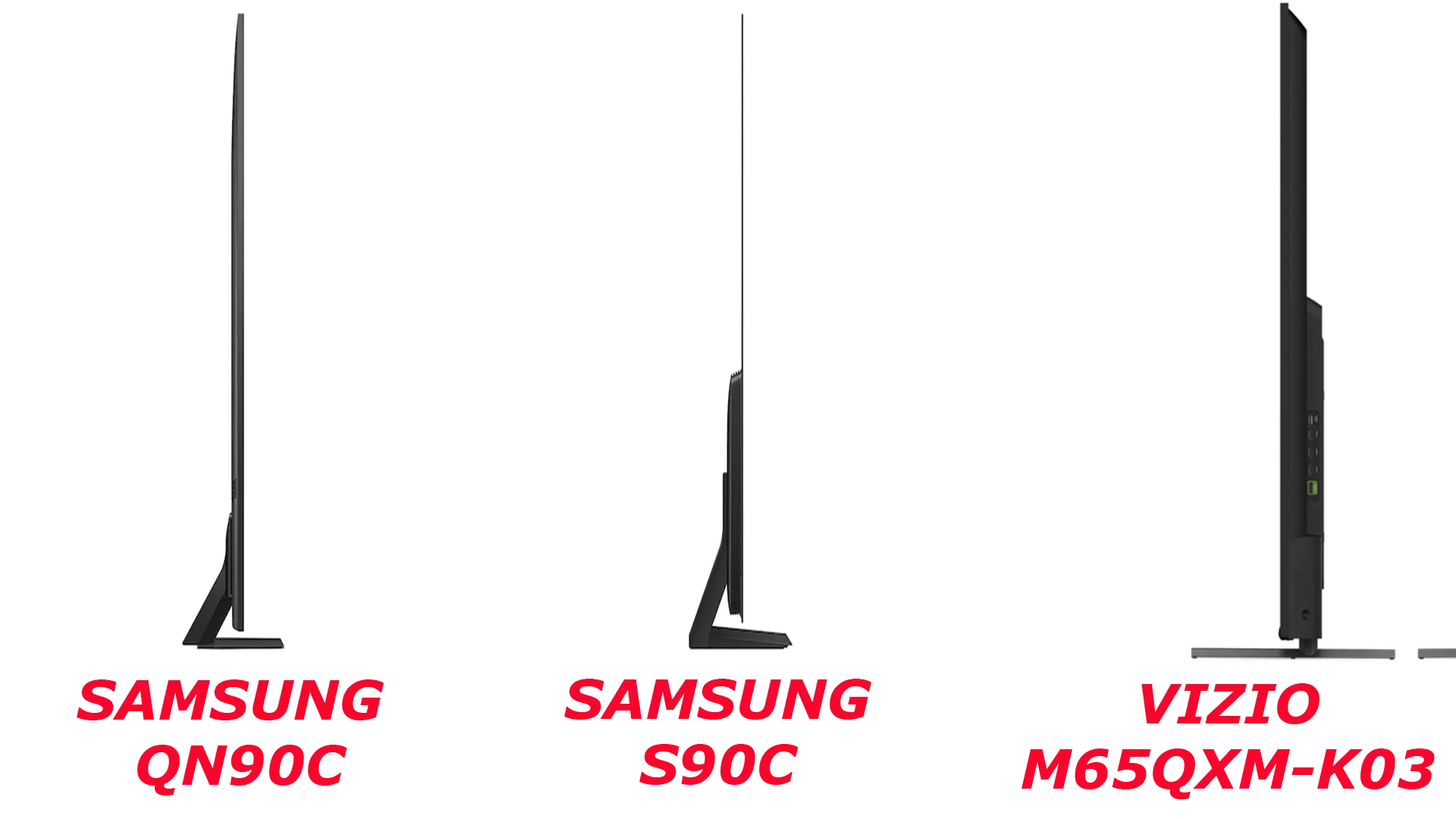
Actual sizes of 55-inch TVs
While working on this article, I compared TVs from different brands and lines. After collecting the necessary information, I decided to present the results of my research in the form of a table. In this table I have collected the sizes of some Samsung, LG and Vizio 2024 TVs.
| Model | Parameter | Inches (WxHxD) | Millimeters (WxHxD) | Notes |
|---|---|---|---|---|
| Samsung UN55DU7200FXZA | Set Size without Stand | 48.6 x 28 x 2.4 | 1234.1 x 710.8 x 60.3 | TV dimensions without the stand. |
| Set Size with Stand | 48.6 x 28.6 x 9.3 | 1234.1 x 726 x 237 | Includes the stand dimensions. | |
| Package Size | 54.6 x 32.6 x 6.2 | 1386 x 828 x 158 | Dimensions of the packaged product. | |
| Samsung QN55Q70DAFXZA | Set Size without Stand | 48.5 x 27.9 x 1 | 1231.9 x 708.9 x 25.4 | TV dimensions without the stand. |
| Set Size with Stand | 48.5 x 30.5 x 10.1 | 1231.9 x 774.7 x 256.5 | Includes the stand dimensions. | |
| Package Size | 55.1 x 33.3 x 5.8 | 1400 x 846.6 x 147.3 | Dimensions of the packaged product. | |
| Samsung QN55QN85DBFXZA | Set Size without Stand | 48.3 x 27.7 x 1.8 | 1227.5 x 703.9 x 45.7 | TV dimensions without the stand. |
| Set Size with Stand | 48.3 x 30.2 x 9.6 | 1227.5 x 768.4 x 243.8 | Includes the stand dimensions. | |
| Package Size | 56.9 x 32.6 x 6.5 | 1445.9 x 828.6 x 165.1 | Dimensions of the packaged product. | |
| Samsung QN55S95DAFXZA | Set Size without Stand | 48.2 x 27.8 x 0.4 | 1225.5 x 705.1 x 10.2 | TV dimensions without the stand. |
| Set Size with Stand | 48.2 x 30.4 x 10.5 | 1225.5 x 773.1 x 266.7 | Includes the stand dimensions. | |
| Package Size | 56.4 x 32.2 x 6.5 | 1432.3 x 818.3 x 165.1 | Dimensions of the packaged product. | |
| LG 55QNED85TUA | Set Size without Stand | 48.7 x 28.2 x 1.2 | 1237.8 x 715.3 x 30.5 | TV dimensions without the stand. |
| Set Size with Stand | 48.7 x 30.8 x 10.1 | 1237.8 x 782.9 x 257.5 | Includes the stand dimensions. | |
| Package Size | 53.5 x 31.9 x 6.0 | 1358.9 x 810.5 x 152.4 | Dimensions of the packaged product. | |
| LG OLED55C4AUA | Set Size without Stand | 48.1 x 27.7 x 1.8 | 1221.9 x 703.9 x 45.7 | TV dimensions without the stand. |
| Set Size with Stand | 48.1 x 29.8 x 9.1 | 1221.9 x 756.9 x 231.1 | Includes the stand dimensions. | |
| Package Size | 55.9 x 32.9 x 7.4 | 1420.9 x 836.1 x 187.9 | Dimensions of the packaged product. | |
| Vizio M55Q6-L4 | Set Size without Stand | 48.3 x 27.8 x 3.3 | 1226.8 x 706.1 x 83.8 | TV dimensions without the stand. |
| Set Size with Stand | 48.3 x 30.2 x 11.4 | 1226.8 x 767.1 x 289.6 | Includes the stand dimensions. | |
| Package Size | 48.3 x 30.2 x 11.4 | 1226.8 x 767.1 x 289.6 | Dimensions of the packaged product. | |
| Vizio V4K55M-0801 | Set Size without Stand | 48.3 x 28.1 x 3.2 | 1228.1 x 713.0 x 81.3 | TV dimensions without the stand. |
| Set Size with Stand | 48.3 x 30.4 x 10.9 | 1228.1 x 774.2 x 277.1 | Includes the stand dimensions. | |
| Package Size | 48.3 x 30.4 x 10.9 | 1228.1 x 774.2 x 277.1 | Dimensions of the packaged product. |
Conclusions on the dimensions of 55-inch TVs
- Thewidth and height of the TVs are similar within the 55-inch diagonal (about 122 cm (48 inches) in width and 71 cm (28 inches) in height).
- OLED TVs have a minimum depth, ranging from 3.05 cm (1.2 inches) to 4.57 cm (1.8 inches), which is significantly smaller than LED and QLED to 8.38 cm (3.3 inches).
- QLED TVs have the smallest depth among traditional LED technologies 2.54 cm (1 inch) to 4.57 cm (1.8 inches), making them slightly thinner than LED.
- LED TVs have the greatest thickness due to the use of standard LED panels 5.08 cm (2 inches) – 8.38 cm (3.3 inches).