
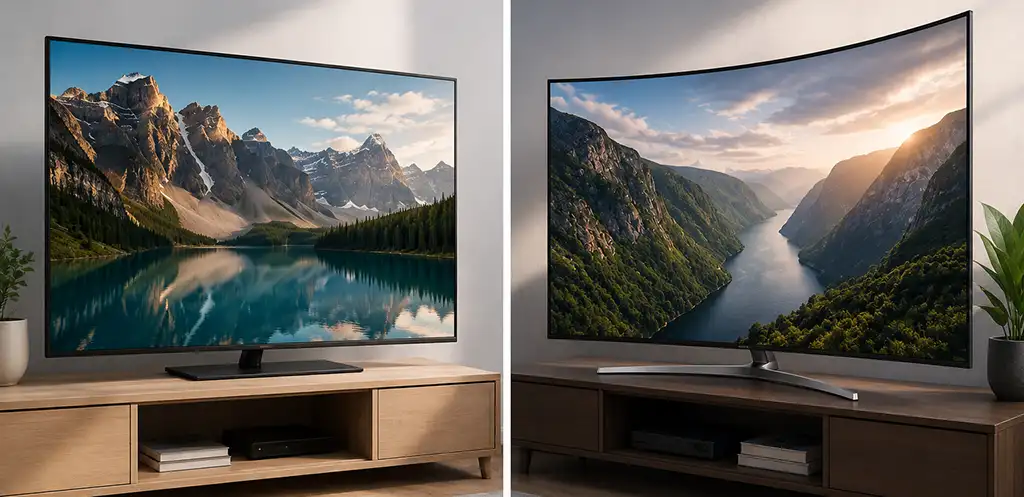
Flat-screen TVs are the industry standard. They provide a consistently comfortable viewing experience from virtually anywhere in the room and are easy to set up—they can be placed on a stand or mounted on the wall.
Curved TVs were popular in the mid-2010s. Their screens are slightly curved toward the viewer, which was intended to create a more immersive viewing experience. However, the benefits are only noticeable when viewed from a short distance and strictly in the center of the screen. These TVs are impractical for wall mounting, as the curve creates a large gap between the wall and the edge of the TV.
Key differences between TVs
| Feature | Flat TV | Curved TV |
|---|---|---|
| Viewing Angles | Better | Worse when viewed from the side |
| Wall Mounting | Easier | Less convenient |
| Reflections | Less distortion from reflections | Reflections may be more noticeable |
| Immersion | Standard | Slightly better when viewed from the center |
| Model Availability | Very wide selection | Virtually unavailable |
Flat-screen TVs and curved TVs differ from one another in several key ways. A flat-screen TV offers better viewing angles not only for viewers sitting directly in front of the screen but also for those watching from the side. Curved TVs are comfortable to watch only if you are sitting directly in front of the screen; when viewed from the side, the image becomes significantly distorted.
Flat-screen TVs are also easier to mount on a wall, as they fit snugly against the surface. Curved models are not suitable for wall mounting.
Flat-screen TVs dominate the market and are available in a wide range of sizes, technologies, and price categories. Curved TVs have virtually disappeared from the consumer market, and very few new models are being released today. The reason lies in very low demand and the increasing size of TV screens—the larger the TV, the greater its curvature, which makes such a TV impractical.
Features of the Production of Flat-Screen and Curved TVs
Many people believe that manufacturing curved TVs requires specially made curved panels, but this is not the case. Flat and curved TVs generally use the same screens. Since the curvature of a curved TV is relatively small, the panel can be bent during the TV’s assembly process without a significant risk of damage.
As a result, the panel itself is initially manufactured as a flat panel. However, not every panel is suitable for this purpose. Curved TVs typically use higher-quality panels made from stronger and more flexible glass that can withstand the necessary bending process while maintaining structural integrity.
OLED panels offer even greater flexibility. Since they do not rely on a rigid backlight structure, they can be bent more than conventional LCD panels.
One area where curved TVs really stand out is the backlighting system. To achieve uniform brightness across the entire curved screen, manufacturers typically opt for direct LED backlighting.