

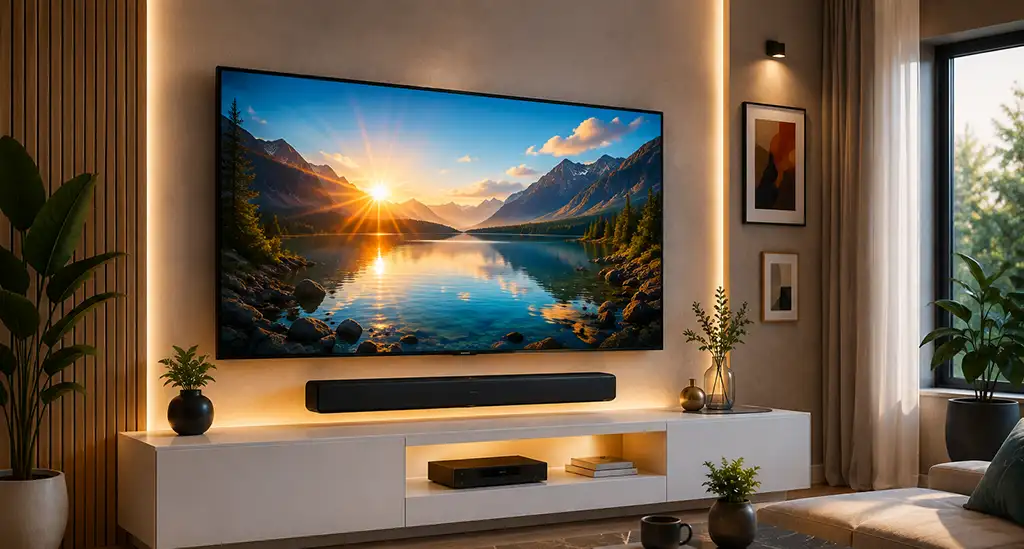
A home theater system and a soundbar are both designed to improve the audio experience when watching movies and TV shows, but they use different approaches.
A traditional home theater system usually consists of an AV receiver or amplifier and multiple speakers. Depending on the configuration, it may include front, center, surround, and subwoofer speakers. Earlier all-in-one home theater systems could also include a built-in DVD or Blu-ray player.
A soundbar is a compact audio system that combines multiple speakers and audio processing in a single enclosure. Modern soundbars can connect to a TV and other devices through HDMI, optical audio, Bluetooth, or Wi-Fi. Some models also support Dolby Atmos, DTS:X, wireless subwoofers, and additional rear speakers.
The main difference is therefore the system’s design. A traditional home theater uses several separate speakers positioned around the room, while a soundbar concentrates most of the audio hardware in a single unit and is designed to take up much less space.
The development of streaming services and large-screen TVs has also changed the role of both technologies. Physical media players have become less important, while TVs, streaming devices, AV receivers, and soundbars have increasingly become the center of a modern home entertainment system.
1960–1990
In the 1960s and 1970s, stereo systems became increasingly popular. Two-channel stereo allowed listeners to hear sound from the left and right sides, creating a wider and more realistic soundstage than a single speaker could provide.
A major milestone in the development of surround sound was the introduction of Dolby Surround, followed later by Dolby Pro Logic. These technologies enabled compatible audio systems to reproduce surround sound effects through additional audio channels and speakers.
However, during this period, home theater systems remained primarily a product for enthusiasts. The equipment was often expensive, complicated to install, and difficult to integrate with a standard television.
1990–2000
The introduction of Dolby Digital and DTS made discrete multichannel digital audio widely available for home entertainment. The 5.1-channel configuration became an important standard for movie soundtracks.
A typical 5.1 system consisted of a left speaker, a right speaker, a center speaker, two surround speakers, and a subwoofer. This configuration allowed viewers to experience directional sound effects at home that were similar to those used in movie theaters.
The development of home theater systems was also driven by the emergence of digital media capable of storing multichannel audio. This allowed high-quality surround sound to be recorded and reproduced at home, bringing the home viewing experience closer to that of a cinema.
2000–2015
The 2000s brought significant changes to both television technology and home theater systems.
Large flat-screen televisions became increasingly common, while screen sizes continued to grow. As a result, watching movies at home began to feel increasingly similar to the experience of watching them in a movie theater.
During the same period, manufacturers began developing more compact alternatives to traditional home theater systems. These products helped pave the way for the rapid growth of modern soundbars.
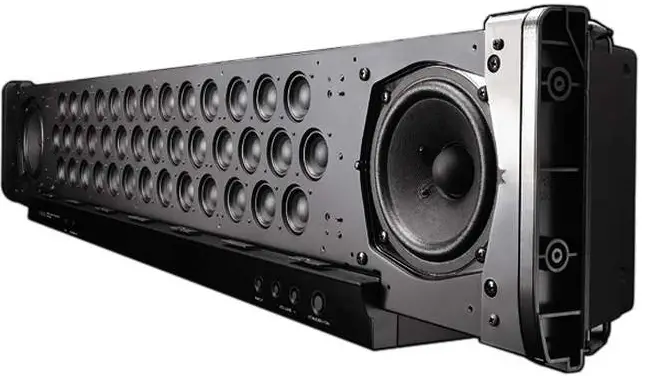
One example of an early approach to creating surround-sound-like audio from a compact device was Yamaha’s Digital Sound Projector technology. Products such as the Yamaha YSP-4000 used multiple small speakers and digital signal processing to create the impression that sound was coming from different directions without requiring a conventional multi-speaker setup.
2015–Present Day
By the mid-2010s, the way people watched movies and TV shows was changing rapidly.
Streaming services were becoming increasingly popular, reducing the importance of physical media such as DVDs and Blu-ray discs for many consumers. As a result, all-in-one home theater systems with built-in disc players gradually became obsolete.
At the same time, soundbars became increasingly popular because they were much easier to install than traditional home theater systems. A soundbar could be placed beneath a TV and connected with a single cable, while more advanced models could also be paired with wireless subwoofers and rear speakers.
Soundbars also became significantly more sophisticated. Instead of simply reproducing stereo sound, many models began offering virtual surround sound and support for modern multichannel audio formats.
Modern soundbars are far more advanced than the basic TV speakers they were originally designed to replace. Many now support HDMI eARC, Dolby Atmos, DTS:X, Wi-Fi, Bluetooth, and wireless subwoofers. Some systems can also be expanded with dedicated rear speakers to create a more complete surround sound experience.
Dolby Atmos has further changed the way manufacturers approach immersive audio. Instead of limiting surround sound to speakers positioned around the listener horizontally, Atmos can create the impression that sounds are coming from above, including directly overhead.
Nevertheless, traditional home theater systems have not disappeared. Enthusiasts and users looking for more powerful and precise surround sound can still choose an AV receiver with separate speakers and a subwoofer. Such systems remain an important choice for dedicated home cinema setups and for viewers who prioritize audio quality and flexibility over simplicity and compactness.
Home Theater System or Soundbar
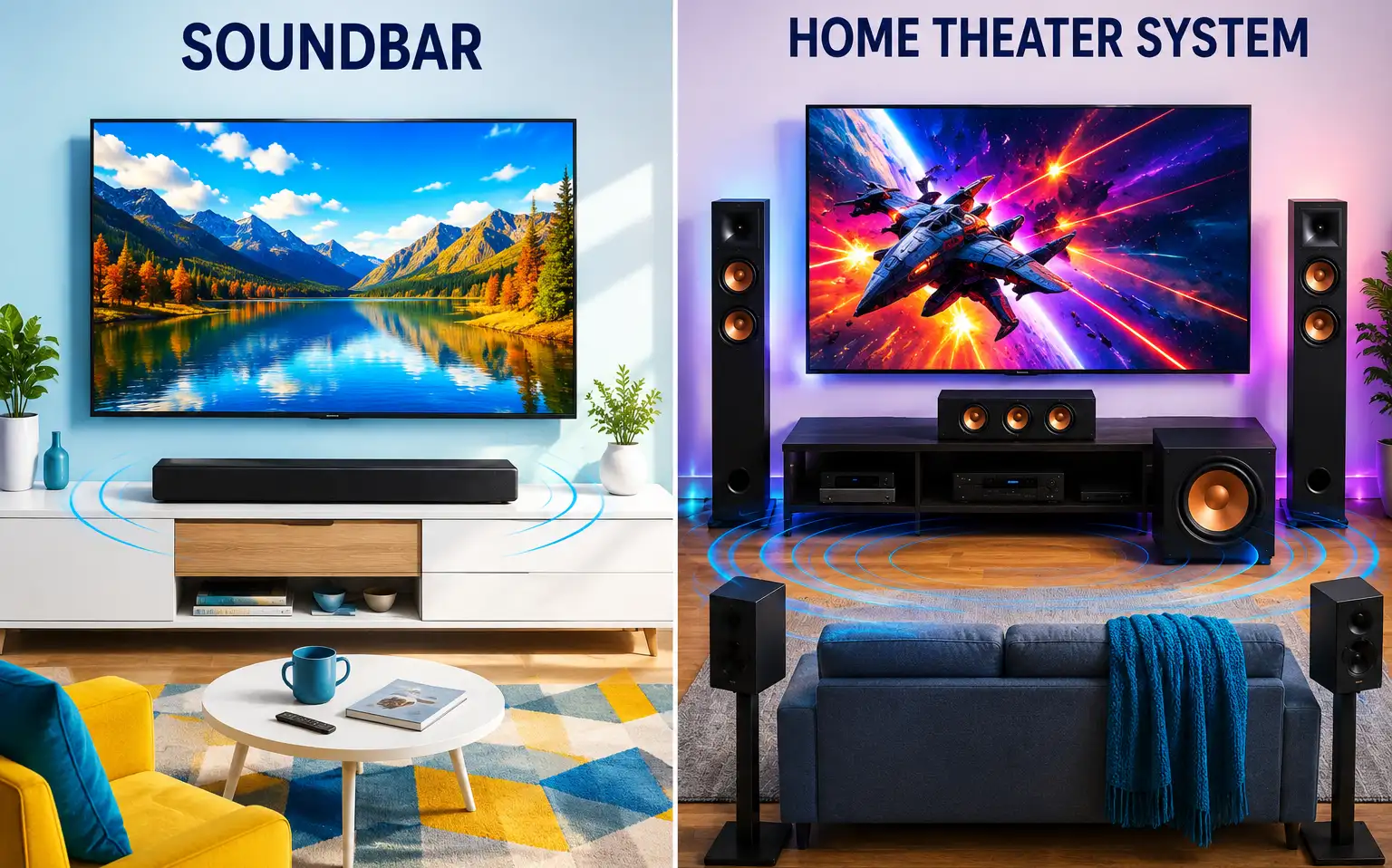
The choice between a home theater system and a soundbar largely depends on the user’s priorities.
A traditional home theater system is better suited for those who want powerful and more precise surround sound and have enough space to set up multiple speakers. It also offers greater flexibility, as individual components can be upgraded separately.
A soundbar is more convenient for those who want to improve their TV’s sound without installing a full-fledged speaker system. It takes up less space, requires fewer cables, and is generally easier to set up.
Modern soundbars can also deliver surprisingly realistic sound, especially when paired with a wireless subwoofer and rear speakers. However, a properly configured system with separate speakers still provides better sound source localization and a more immersive sense of surround sound.