

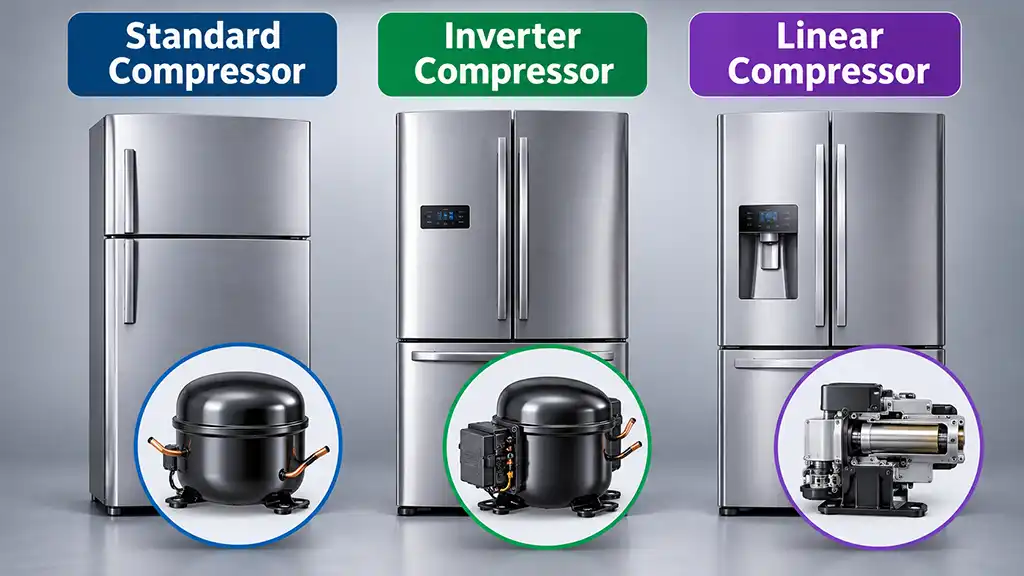
When researching refrigerators, you often come across terms such as “inverter,” “linear compressor,” and “digital inverter.” These terms may sound similar, but they describe different compressor designs and control technologies. Although all three serve the same purpose of circulating refrigerant through the cooling system, they differ in how they operate and regulate cooling capacity. Let’s take a closer look at each type and understand how a refrigerator works.
Types of Refrigerator Compressors
Modern refrigerators mainly use three types of compressors: standard (on/off), inverter, and linear. The main differences lie in their operating principles, mechanical designs, and methods of controlling cooling capacity.
Standard (on/off) compressor. This is the traditional type of compressor, which operates at a fixed speed. It either runs at full power or switches off completely, depending on the temperature inside the refrigerator. This design has been used since 1926 and remains a common solution in refrigeration equipment.
Inverter compressor. Unlike a standard compressor, an inverter model can vary its rotational speed depending on the cooling demand. It uses an electronic inverter circuit to adjust the frequency and voltage of the electrical supply to the compressor motor, thereby controlling its rotational speed. This allows the compressor to operate continuously at different speeds instead of repeatedly switching on and off. Inverter technology became widely used in household refrigerators during the 2000s.
Linear compressor. This compressor has a different mechanical design. Instead of using a conventional crankshaft and connecting rod, it moves a piston back and forth using an electromagnetic drive. A spring provides the return force, creating a reciprocating motion. LG is particularly well known for using and marketing linear compressors in its refrigerators.
How a Refrigerator Works
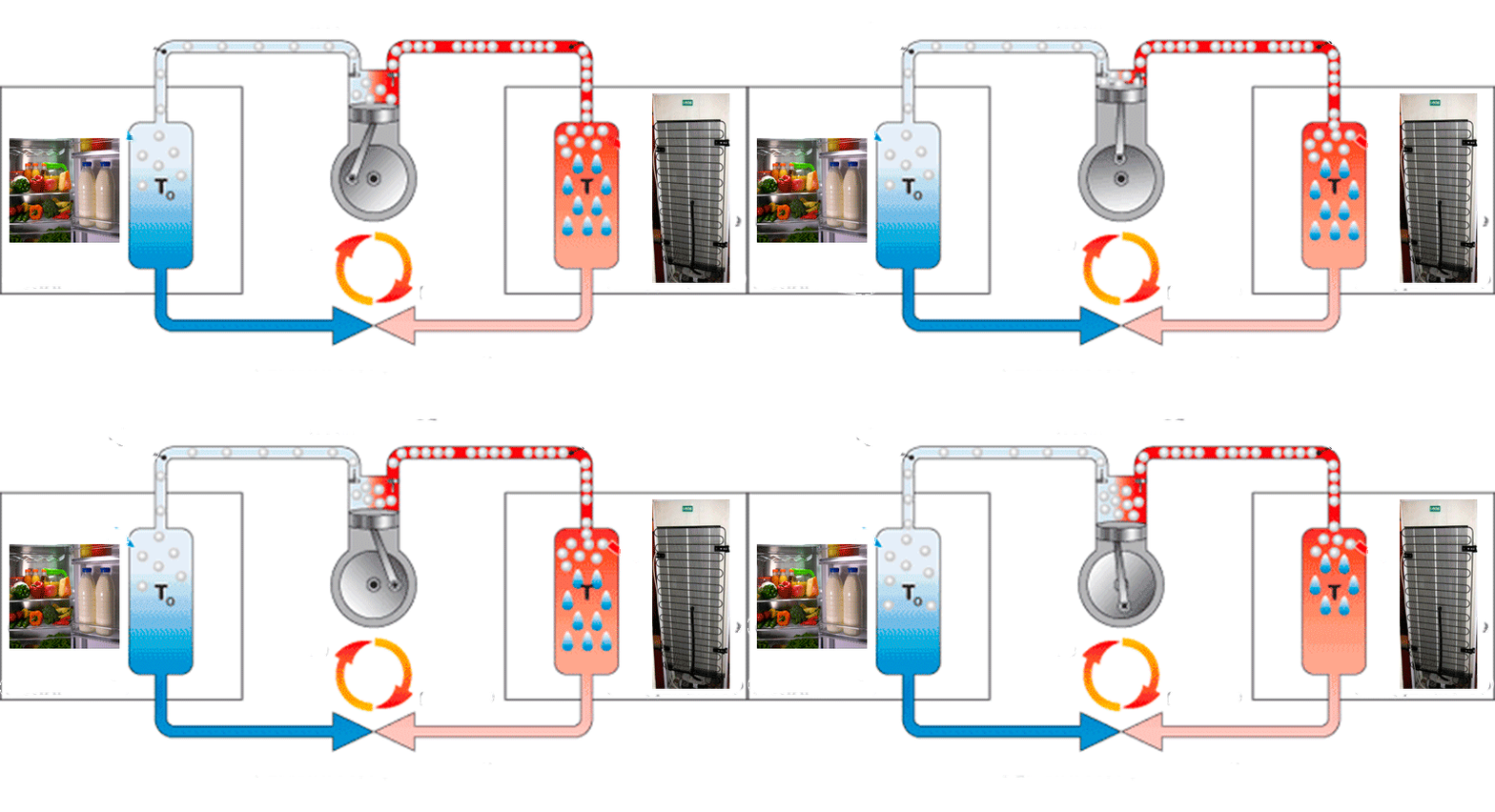
A refrigerator does not actually produce cold. Instead, it removes heat from inside the compartment and transfers it to the surrounding room. This is why the rear or side walls of a refrigerator can become warm while the interior remains cold. The process is based on the circulation of a refrigerant, a special substance that can easily change between liquid and gaseous states, absorbing heat during evaporation and releasing it during condensation.
The compressor draws in refrigerant gas and compresses it, increasing its pressure and temperature. This is similar to what happens when air heats up as you inflate a bicycle tire with a pump. The hot, high-pressure gas then flows into the condenser, usually located at the back of the refrigerator or built into its walls, where it releases heat into the room and condenses into a liquid.
The liquid refrigerant then passes through a capillary tube or expansion valve, where its pressure drops. It enters the evaporator inside the refrigerator, expands, and absorbs heat from the compartment as it evaporates. The resulting gas returns to the compressor, and the cycle begins again. This process continues automatically, removing heat from the refrigerator compartment and maintaining the selected temperature, as illustrated in the diagram below.
Standard Compressor (On/Off)
The standard compressor is the traditional design used in refrigerators for decades. Its operating principle is simple: it either runs at full capacity or switches off completely.
When the temperature inside the refrigerator rises above the set level, the compressor switches on and starts cooling the compartment. Once the required temperature is reached, it switches off. This cycle repeats whenever cooling is needed.
Most household refrigerators use a reciprocating (piston) compressor. An electric motor rotates a crankshaft, which converts rotational motion into the back-and-forth movement of a piston. Rotary compressors are also used, but they have a different mechanical design.
| Advantages | Disadvantages | Lifespan |
|---|---|---|
| Simple, proven design | High starting current | 20–30 years |
| Low purchase and repair costs | More noticeable noise | Depends on build quality and operating conditions |
| Fewer electronic components | Greater temperature fluctuations | |
| Higher electricity consumption than inverter models |
Inverter Compressor (Digital Inverter)
An inverter compressor differs from a conventional compressor mainly in how its motor is controlled. Instead of operating at a fixed speed and repeatedly switching on and off, it can vary its rotational speed to match the refrigerator’s cooling demand.
An electronic inverter controller adjusts the frequency of the electrical supply to the compressor motor, changing its rotational speed. When more cooling is needed, the compressor speeds up; when the required temperature is reached, it slows down and maintains cooling at a lower speed. This reduces frequent starts and stops and helps maintain a more stable temperature inside the refrigerator.
| Advantages | Disadvantages |
|---|---|
| Lower energy consumption. Generally more efficient than conventional compressors. | More expensive repairs. The electronic inverter board can fail and is costly to replace. |
| Quieter operation. Fewer starts and stops and lower operating speeds reduce noise. | Sensitivity to power surges. Voltage fluctuations can damage electronic components. |
| More stable temperature. Variable-speed operation reduces temperature fluctuations. | Higher purchase price. Refrigerators with inverter compressors generally cost more. |
| Smoother operation. Gradual speed adjustment reduces repeated startup stress. |
Actual energy savings vary by model and operating conditions. Manufacturers often advertise savings of around 20–30%, but this figure should not be treated as universal.
What Does Digital Inverter Mean?
Digital Inverter is a name Samsung uses for its inverter compressor technology. It does not describe a separate type of compressor; the underlying principle is the same as that of other inverter compressors, although control systems and implementations may differ between manufacturers.
An inverter compressor also does not necessarily run continuously. It can switch off when cooling is not required, but under normal operating conditions it can spend much more time running at low speed rather than repeatedly starting and stopping.
Linear Compressor
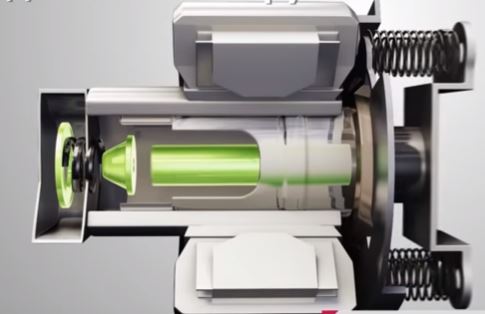
A linear compressor has a different mechanical design from conventional and inverter compressors. This technology is particularly associated with LG, which has actively promoted linear compressors in its refrigerators.
In a conventional reciprocating compressor, an electric motor rotates a crankshaft, which moves the piston back and forth through a connecting rod. A linear compressor uses a different approach: an electromagnetic drive moves the piston directly in a straight line, while springs provide the return force. This eliminates the crankshaft and connecting rod used in conventional designs.
The compressor adjusts its cooling capacity by changing the piston’s stroke length rather than the rotational speed of a motor. This allows it to vary its output according to cooling demand.
| Advantages | Disadvantages |
|---|---|
| Fewer mechanical components. No crankshaft or connecting rod is required. | Limited long-term data. The technology has a shorter history of widespread use than conventional compressors. |
| Reduced mechanical friction. The simpler drive mechanism eliminates some friction points. | Potential spring wear. Springs are subjected to repeated mechanical stress during operation. |
| Quiet operation. LG promotes the technology as producing less noise than conventional designs. | Repair difficulties. Specialized parts and qualified technicians may be harder to find, depending on the market. |
| Energy efficiency. LG claims improved energy efficiency compared with conventional compressors. | Uncertain long-term reliability. Independent comparative failure statistics are limited. |
| Extended warranty. LG offers compressor warranties of up to 10 years in some countries. | Warranty limitations. Coverage and conditions vary by country and model. |
Are Linear Compressors Reliable?
There is not enough publicly available independent data to establish whether linear compressors are more or less reliable than conventional and inverter models. Manufacturer claims about durability and efficiency should therefore be treated with caution, but the opposite claim that linear compressors are inherently unreliable is also not supported by sufficient evidence.
Comparing the Compressor Types
The three compressor technologies differ mainly in their mechanical construction and methods of controlling cooling capacity.
| Feature | Standard | Inverter | Linear |
|---|---|---|---|
| Mechanical design | Reciprocating or rotary | Reciprocating or rotary | Linear electromagnetic drive |
| Capacity control | On/off | Motor speed | Piston movement |
| Energy consumption | Generally higher | Generally lower | Depends on implementation |
| Noise | Noticeable starts and stops | Generally quieter | Designed for quiet operation |
| Repair costs | Generally lower | Medium to high | Potentially higher |
| Track record | Very long | Long | Shorter |