
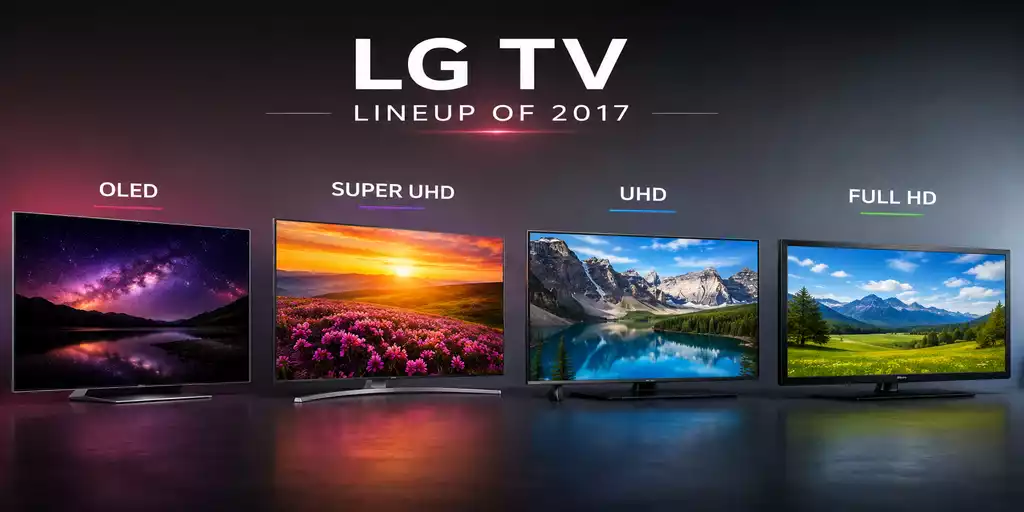
In 2017, LG offered a wide range of TVs, from premium OLED models to more affordable UHD and Full HD options. Each series featured its own technologies and improvements, catering to different needs and budgets. The lineup included models for viewers who wanted exceptional picture quality as well as those looking for a reliable TV at a reasonable price. In this article, we’ll take a closer look at the main series, features, and models that made up LG’s 2017 TV lineup.
LG OLED TVs 2017
| Series | Models | Position in the 2017 lineup |
|---|---|---|
| W7 | W7V, W7P | Premium SIGNATURE, ultra-thin wall-mounted OLED |
| G7 | G7V, G7P | Premium SIGNATURE OLED with advanced audio |
| E7 | E7V, E7P | Premium OLED with integrated soundbar |
| C7 | C7V, C7P | Mainstream 4K OLED |
| B7 | B7A, B7V, B7P | More affordable 4K OLED |
| EG9 | EG9A7V | Full HD OLED model |
In 2017, LG offered a wide range of OLED TVs, from premium SIGNATURE models to more affordable 4K and Full HD options. OLED technology provided excellent picture quality with deep blacks, high contrast, wide viewing angles, and fast response times. Each pixel could produce its own light and switch off completely, eliminating the backlight bleed common on LCD TVs.
The flagship LG SIGNATURE W7 featured an ultra-thin OLED display designed to mount on the wall like a picture. Its electronics and speakers were placed in a separate soundbar, which also supported Dolby Atmos®. The G7 and E7 were other premium models with high-quality built-in audio systems and support for 4K, HDR, Dolby Vision, and Dolby Atmos®.
The C7 offered a more conventional design while retaining the main advantages of LG’s OLED technology, making it one of the most popular models in the lineup. The B7 was positioned as a more affordable 4K OLED option. LG also offered the EG9A7V, a Full HD OLED model with a resolution of 1920 × 1080 pixels.
The 2017 OLED TVs supported 4K Ultra HD, HDR10, Dolby Vision, and HLG, depending on the model and region. LG also introduced Active HDR, which helped optimize HDR content for different scenes. Smart TV functions were provided by webOS 3.5, with access to streaming services, applications, HDMI inputs, and other connected devices.
The main models included B7A, B7V, B7P, C7V, C7P, E7V, E7P, G7V, G7P, W7V, W7P, and EG9A7V. The letters at the end of the model numbers indicated different regional versions, so specifications and available screen sizes could vary between countries.
LG Super UHD 4K Series
In 2017, LG’s Super UHD 4K TVs represented the company’s premium LCD lineup below OLED. These models used Nano Cell, LG’s technology for improved LCD panels. It was similar in purpose to the QLED technology used by Samsung at the time, with a focus on improving color reproduction, color purity, brightness, and viewing angles.
The SJ950 series was the flagship Super UHD lineup, combining Nano Cell technology with a very slim design, 4K resolution, HDR, and Dolby Vision. The SJ850 series offered many of the same picture technologies at a lower price, while the SJ800 series was positioned as a more affordable Super UHD option.
LG used different model numbers for different markets. In Europe, the main models used three-digit numbers such as SJ950, SJ850, and SJ800, often with a regional suffix. In the United States, the corresponding models generally used four-digit numbers such as SJ9500, SJ8500, and SJ8000.
| Series | European models | U.S. models | Key characteristics |
|---|---|---|---|
| SJ950 | SJ950V, SJ950, SJ955V, SJ957V | SJ9500, SJ9570 | Premium Super UHD, Nano Cell, 4K, HDR, Dolby Vision, slim design |
| SJ850 | SJ850V, SJ850, SJ857V | SJ8500, SJ850A, SJ8570, SJ857A | Super UHD, Nano Cell, 4K, HDR, Dolby Vision, wide viewing angles |
| SJ800 | SJ800V, SJ800 | SJ8000 | Super UHD, Nano Cell, 4K, HDR, Dolby Vision |
LG UHD and Full HD TVs 2017
In 2017, LG offered a broad range of UHD 4K and Full HD TVs for buyers who wanted a more affordable alternative to OLED and Super UHD models. UHD TVs provided a resolution of 3840 × 2160 pixels, while Full HD models used 1920 × 1080 pixels.
The UHD range included the UJ7700 and lower-positioned UJ models. These TVs supported 4K resolution, HDR, and LG’s webOS smart TV platform. The UJ7700 was one of the higher-end regular UHD models in the U.S. lineup, while the UJ6500 and UJ6300 series offered more affordable alternatives.
Full HD models were aimed at everyday viewing and included the LJ5500, LJ5100, and LJ5000 series in the U.S. The LJ5500 featured webOS 3.5 and Full HD resolution, while the LJ5100 and LJ5000 were simpler models with fewer smart features.
| Series | European models | U.S. models | Key characteristics |
|---|---|---|---|
| UJ7700 / UJ750 | UJ750V, UJ750 | UJ7700 | 4K UHD, HDR, Dolby Vision, webOS, higher-positioned UHD model |
| UJ701 | UJ701V, UJ701 | — | 4K UHD, HDR, smart TV features |
| UJ670 / UJ675 | UJ670V, UJ670, UJ675V | — | 4K UHD, HDR, webOS |
| UJ6500 / UJ6570 | UJ650V, UJ650, UJ657V | UJ6500, UJ6570, UJ657A | 4K UHD, HDR, smart TV features |
| UJ6540 | UJ654V | UJ6540 | 4K UHD, HDR, webOS |
| UJ6300 | UJ630V, UJ630 | UJ6300 | 4K UHD, HDR, more affordable model |
| LJ62 | LJ624V, LJ625V | — | Full HD, smart TV features |
| LJ61 | LJ614V, LJ615V, LJ610V | — | Full HD, smart TV features |
| LJ59 | LJ594V, LJ590V | — | Full HD, basic smart TV features |
| LJ55 | LJ550V and regional variants | LJ5500 | Full HD 1080p, webOS 3.5, Color Master Engine |
| LJ51 | LJ515V, LJ5150, LJ510V | LJ5100 | Full HD, simpler design and features |
| LJ50 | LJ500V, LJ500U, LJ500B, LJ500M | LJ5000 | Full HD, basic LED TV |