
Inside a modern TV, a system-on-a-chip (SoC) combines several components, including the CPU, GPU, video decoders, and specialized image processing units. Each component performs a different task. The CPU runs the operating system and applications, while the GPU renders the menus, animations, and other elements of the user interface. Video decoders handle video playback, and dedicated image processing hardware improves the picture before it reaches the screen.
For buyers, three things are important. The processor and available memory affect how smoothly a Smart TV operates. Picture quality depends primarily on the display technology and panel characteristics, as well as the hardware and software used for image processing. The GPU has a much smaller role in video enhancement than specialized processing units.
What Does the CPU Do in a TV?
A modern Smart TV is essentially a small computer. Its CPU handles the main tasks of the operating system, including Tizen, webOS, Google TV, Roku, and VIDAA. It launches streaming apps, manages menus, runs voice assistants, handles network functions, installs firmware updates, and communicates with connected devices.
However, a TV processor differs from a laptop or desktop processor in several ways:
- System-on-a-chip (SoC). The CPU, GPU, video decoders, and specialized processing units are usually integrated into a single chip. The CPU portion is most often based on ARM architecture and includes multiple processing cores.
- Low power consumption. TVs have relatively thin enclosures and usually lack active cooling. Their processors are designed to provide sufficient performance while keeping power consumption and heat generation low.
- General-purpose tasks. The CPU handles operating system operations, application execution, background processes, and communication between different system components. Its performance affects app launch times and menu responsiveness.
- Multitasking. Multiple CPU cores allow the operating system to distribute workloads across several processing units. This helps the TV run applications, process network data, and respond to remote control commands simultaneously.
What Does the GPU Do in a TV?
The GPU handles the graphics of the Smart TV platform. It renders menus, app tiles, animations, pop-up panels, images, and web content. Most TVs use energy-efficient integrated graphics, such as ARM Mali or similar GPU architectures.
The GPU has several important characteristics:
- Designed for the interface, not gaming. It handles smooth menu animations and simple games, but its graphics performance is significantly lower than that of a dedicated PC graphics card or a modern gaming console.
- Parallel processing. A GPU performs many graphics operations simultaneously. This allows it to render numerous screen elements and pixels in parallel, which is important for smooth interface animations.
- Limited role in video processing. Dedicated hardware decoders handle video playback, while specialized processing units perform most image enhancement tasks. General-purpose GPU cores may assist with certain graphics and image processing operations, but they are not the main components responsible for picture quality.
- Shared memory. The GPU usually shares system memory with the CPU and other components of the SoC. If available memory is insufficient, overall system performance may suffer, resulting in slower menus, application switching, and other operations.
Specialized Image Processing Units in a TV
Picture quality depends on the display technology, panel characteristics, backlighting system in LCD TVs, and the hardware and software used to process the image.
Before video reaches the screen, it passes through several processing stages. These operations are handled by dedicated hardware blocks within the TV’s SoC.
- Hardware video decoders. These decode compressed video streams in formats such as H.264, HEVC (H.265), VP9, and AV1. Hardware decoding reduces the workload on the CPU and allows the TV to play high-resolution video more efficiently. Software decoding may also be available for certain formats, depending on the processor and operating system.
- Upscaling. Video in Full HD or lower resolutions is scaled to fit a 4K or 8K display. Upscaling algorithms analyze the original image and adjust edges, textures, and details to produce a sharper picture.
- HDR and color processing. Dedicated processing blocks handle tone mapping and color adjustments. They adapt the brightness and color characteristics of HDR content to the capabilities of the display panel.
- Motion processing and noise reduction. Motion interpolation (MEMC) generates additional frames to make movement appear smoother. Noise reduction algorithms remove unwanted image artifacts, particularly in low-quality or heavily compressed video.
- Neural Processing Unit (NPU). Some TV processors include an NPU, a dedicated unit designed to accelerate certain computational tasks. It can be used for scene recognition, image enhancement, audio analysis, and other functions that rely on machine learning.
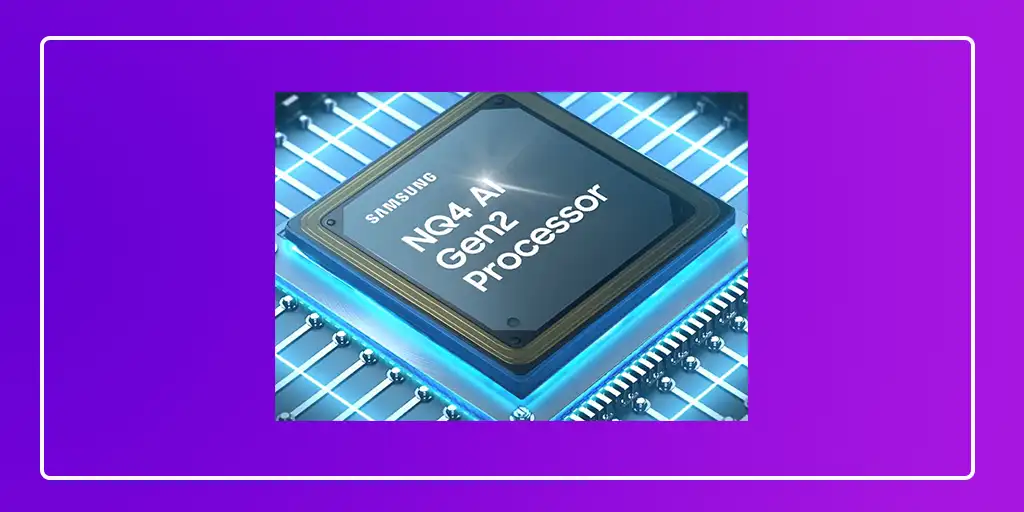
Manufacturers give their image processing platforms proprietary names, such as Sony Cognitive Processor XR, LG α (Alpha) processors, and Samsung Neural Quantum Processor. These names describe proprietary processing technologies and platforms rather than technical specifications such as CPU core counts or clock speeds. For meaningful comparisons, buyers should look at independent reviews and actual performance tests of specific TV models.
TV Processor Names by Brand
Most TV manufacturers use proprietary names for their image processing platforms. These names generally refer to a combination of dedicated processing hardware, specialized processing units, and image enhancement algorithms. They do not indicate technical specifications such as the number of CPU cores or clock speed.
The table below lists the processor names used in 2026 TV lineups. Different models from the same manufacturer may use different processor versions, so always check the specifications of the particular TV model.
| Brand | Processors (2026 lineups) |
|---|---|
| Samsung | NQ8 AI Gen3, NQ4 AI Gen3, NQ4 AI Gen2, NQ4 AI |
| LG | α11 AI Processor Gen3, α8 AI Processor Gen3 |
| Sony | XR Processor (Cognitive Processor XR) |
| Hisense | Hi-View AI Engine, Hi-View AI Engine RGB |
| TCL | TSR AI Pro Processor, TSR AI Processor, AiPQ Processor |
| Panasonic | HCX Pro AI Processor MK II |
| Philips | P5 AI (10th Generation), P5 AI Dual Engine, P5 (7th Generation) |
Many TV manufacturers, particularly those producing affordable models, use system-on-chips (SoCs) from third-party suppliers. One of the largest suppliers is MediaTek, whose Pentonic family includes processors for different TV categories.
Samsung presents its processors as proprietary developments, while Philips can combine its P5 image processing technology with a MediaTek SoC.
MediaTek TV Processors
MediaTek supplies SoCs for a wide range of televisions, from affordable 4K models to premium 8K TVs. Its Pentonic family includes several processor platforms with different CPU, GPU, video decoding, and image processing capabilities.
| MediaTek chip | Class | Key features |
|---|---|---|
| S900 (MT9950) | Flagship 8K TVs | Quad-core Cortex-A73 CPU, Mali-G52 MC2 GPU, 96-bit LPDDR4 memory, 8K video decoding, MEMC 4K120 |
| Pentonic 2000 | Flagship 8K TVs | 8K120 support, hardware VVC (H.266) decoding, integrated processing unit, advanced image processing |
| Pentonic 1000 | Premium 4K TVs | Quad-core Cortex-A73 CPU, Mali-G57 MC2 GPU, 64-bit LPDDR4/4X memory, MEMC 4K120, 4K144 VRR |
| Pentonic 800 | Premium 4K TVs | Quad-core Cortex-A73 CPU, Mali-G57 GPU, integrated processing unit, MEMC and TCON, 4K120 motion processing, display support up to 165 Hz |
| Pentonic 700 | Premium 4K TVs | Integrated processing unit, 4K120 MEMC and TCON, support for 4K displays up to 144 Hz with VRR |
| MT9612 | Mainstream 4K TVs | Quad-core Cortex-A55 CPU, Mali-G52 2EE MC1 GPU, 64-bit DDR3 memory, 4K60 video decoding and MEMC |
| MT9602 | Entry-level 4K TVs | Quad-core Cortex-A53 CPU, Mali-G52 2EE MC1 GPU, 48-bit DDR3 memory, 4K60 hardware video decoding |
The Pentonic processors are designed for different TV categories. Higher-end models support more advanced display technologies, higher refresh rates, and additional image processing capabilities. Entry-level chips provide the basic computing and video playback functions needed for mainstream Smart TVs.