

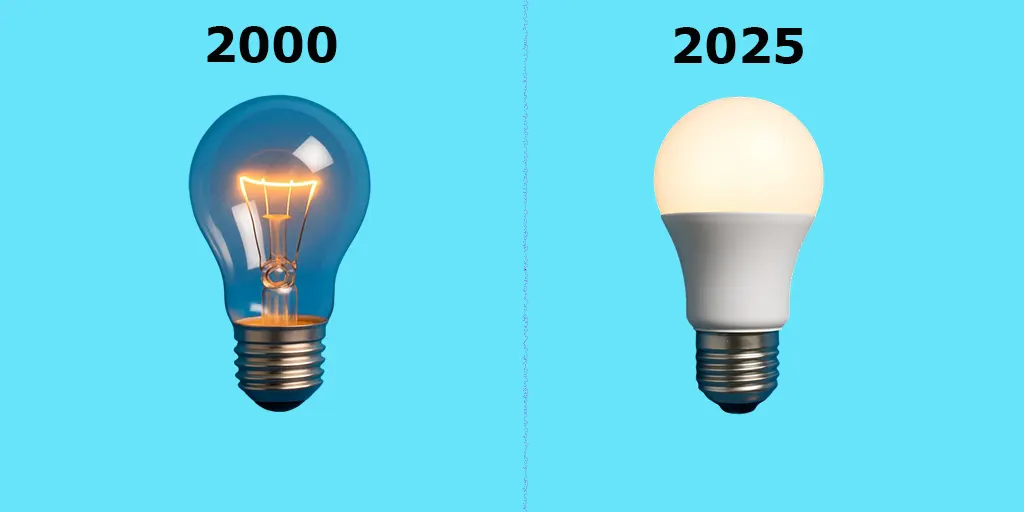
LED bulbs have become the most popular choice for lighting thanks to their energy efficiency and versatility, ranging from standard bulbs and LED strips to full ceiling fixtures. Nowadays, there are even smart bulbs that can be controlled via an app. Let’s take a brief look back at the history.
Nominal service life of LED lamps
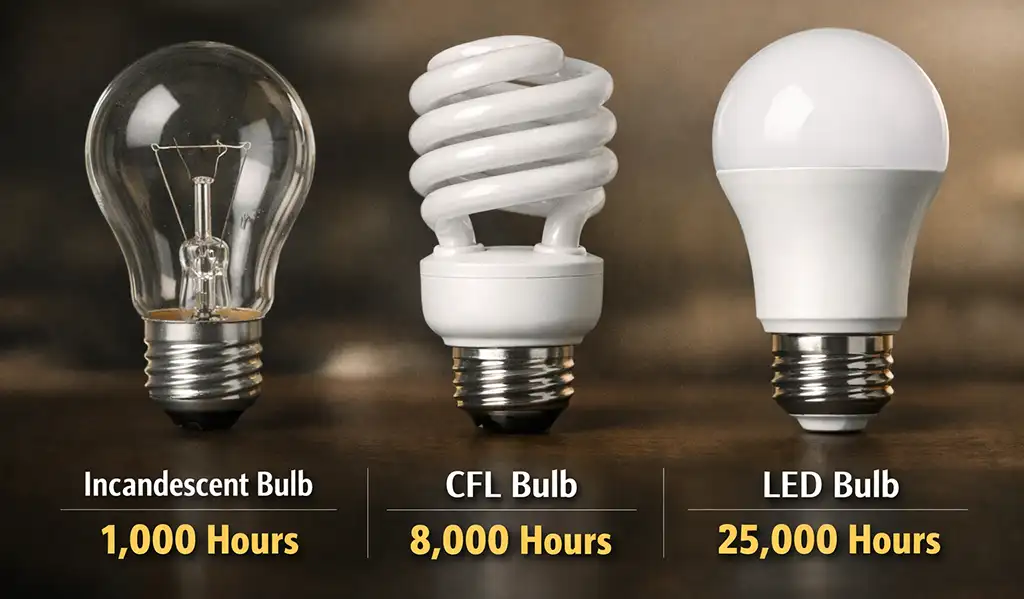
The first bulbs were incandescent bulbs with a lifespan of about 1,000 hours. This was not a natural limitation but the result of a cartel agreement among manufacturers in the 1930s. This standard became widely accepted, even though it is technically possible to produce incandescent bulbs with a lifespan of 10,000 hours or more. Later, fluorescent lamps appeared. They were already in use in the 1970s, but in the 1990s and 2000s manufacturers learned to make them compact, roughly the size of a standard incandescent bulb. Despite their higher efficiency and lower energy consumption, about four times less, fluorescent lamps had serious drawbacks, including a decrease in brightness over time and the need for special disposal due to hazardous materials such as mercury.
Today, most lamps are LED lamps. They have clear advantages. They are inexpensive, more durable, and most importantly consume about ten times less electricity. But how long can an LED lamp actually last?
Manufacturers typically claim a lifespan of around 10,000 to 20,000 hours, which is quite long. In reality, however, this figure can vary significantly. The key factor is build quality. Some bulbs may start flickering after just a month of use due to overheating, or may simply stop working. This depends on the quality of the materials used. This is quite natural, since even incandescent bulbs, despite decades of production, could last only a few hundred hours or, in other cases, several thousand.
Brightness and lifespan of LED bulbs
LED bulbs are known for their longevity, but it is also important to consider brightness. Early LED bulbs suffered from degradation of internal materials, which led to a noticeable decrease in brightness after only a few hundred hours of operation.
Modern LEDs have improved in this regard. Recently, it is rare to encounter bulbs whose brightness noticeably decreases after a few hundred hours of use. The main issue remains the quality of materials. There are cases where low quality plastic cracks, the protective cover peels off, and the LEDs burn out. This is a natural process, but overall most bulbs do last thousands of hours without a noticeable loss of brightness.