
HP manufactures printers for a wide range of users, from home and personal use to small offices and large enterprises. To make it easier to choose the right device, the company organizes its printers into different product lines and series, each designed for specific printing tasks and user requirements.
The printers can be grouped in two ways. The first is by their intended use, such as home, office, or business environments. The second is by the printing technology they use, either inkjet or laser. Within these categories, HP offers several printer series, each with its own features and capabilities. Below is an overview of the main HP printer categories and series.
HP Printers by series
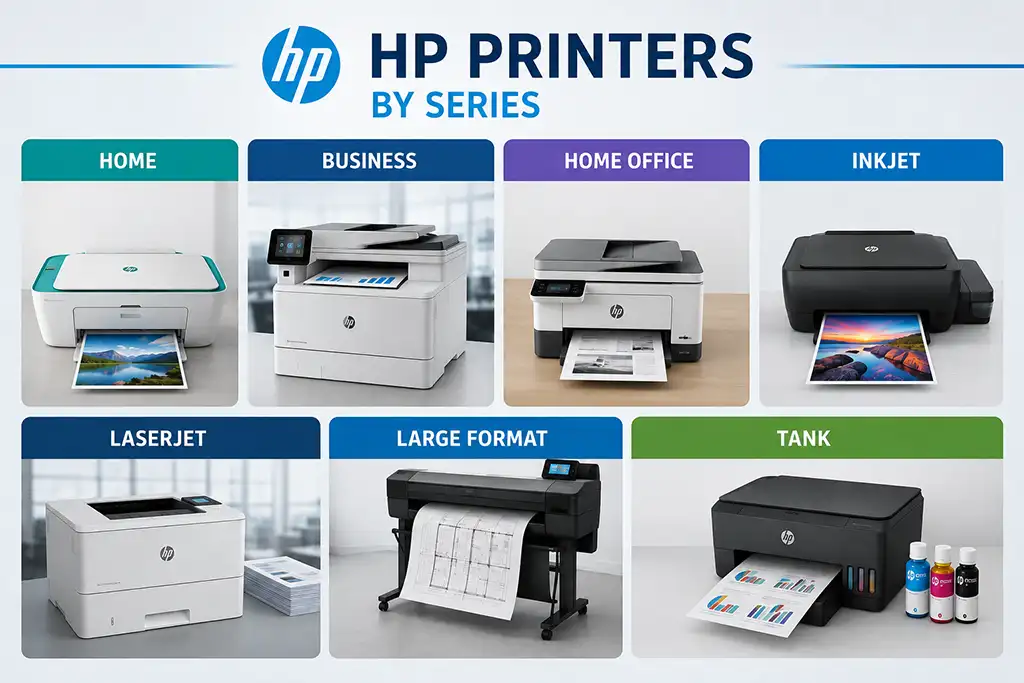
HP organizes its printers into several series, each designed for different users and printing requirements.
Home Printers are intended for personal and family use. They are designed to handle everyday printing tasks, including documents, school assignments, and photos. These models are compact, easy to use, and provide a good balance between print quality, functionality, and affordability.
Business Printers are developed for professional environments where productivity, reliability, and security are essential. They offer higher print speeds, support larger workloads, and include features that help improve efficiency in offices of all sizes.
Home Office Printers combine the compact size and ease of use of home printers with many of the advanced features found in business models. They are designed for remote workers and small offices, providing reliable performance for regular document printing, scanning, and copying without the higher capacity of enterprise devices.
Inkjet Printers use liquid ink to produce high-quality documents and vibrant color images. They are available across home, home office, and business product lines and are well suited for users who print a combination of text documents, graphics, and photographs.
LaserJet Printers use laser printing technology to deliver fast, precise, and cost-effective document printing. They are primarily intended for offices and businesses with medium to high print volumes, offering sharp text, reliable operation, and a lower cost per page for black-and-white printing.
Large Format Printers are designed to print on media significantly larger than standard paper sizes. They are commonly used for architectural drawings, engineering plans, posters, banners, technical graphics, and professional photography, where high resolution and accurate color reproduction are essential.
Tank Printers, also known as Smart Tank or Ink Tank printers, feature refillable high-capacity ink reservoirs instead of traditional cartridges. They are intended for users who print large volumes of documents or photos and want to minimize printing costs while maintaining high print quality. These printers are popular for both home and small office use because of their low cost per page and extended printing capacity.
Who Makes HP Printers
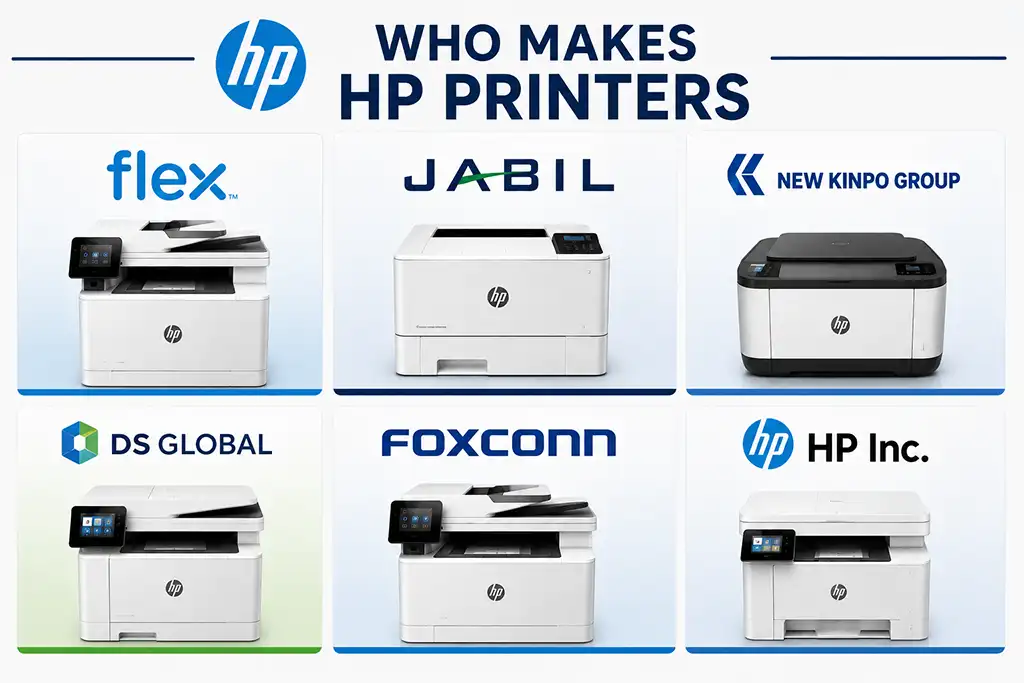
HP designs and develops its own printers, including their hardware, firmware, print technologies, and software. However, like most major electronics companies, HP relies on a global network of contract manufacturers (EMS), Original Equipment Manufacturers (OEMs), and Original Design Manufacturers (ODMs) to assemble and manufacture many of its printer models. Production is distributed across multiple countries, allowing HP to optimize manufacturing costs, supply chains, and regional distribution.
Among the largest manufacturing partners is Flex Ltd. (formerly Flextronics), one of the world’s leading electronics manufacturing companies. Flex produces a variety of HP printers and large-format printing equipment at facilities in countries such as Brazil, China, Malaysia, Mexico, and Singapore. The Brazilian factories primarily serve the South American market, while facilities in Asia manufacture printers for global distribution.
Jabil Inc. is another major manufacturing partner. The company assembles HP printers in China, Mexico, and several other locations. In addition to manufacturing, Jabil operates logistics and distribution centers that support HP’s worldwide supply chain, including deliveries to the European market.
New Kinpo Group, headquartered in Thailand, is one of HP’s long-term ODM partners. The company manufactures numerous consumer inkjet printers and multifunction devices and has also participated in the production of some industrial and commercial printing systems.
DS Global, a South Korean company specializing in printing technologies, contributes both engineering expertise and manufacturing capabilities. The company operates research and development facilities in South Korea and manufacturing operations in Vietnam, where several HP printer models are assembled.
Hon Hai Precision Industry (Foxconn) has also manufactured selected HP printer models. While Foxconn is best known for producing smartphones and computers, it has periodically assembled HP printers and related devices at several of its manufacturing facilities in Asia.
Although most production is outsourced, HP Inc. continues to manufacture certain products at its own facilities, particularly for specialized commercial and industrial printing systems. The company also oversees final product validation, quality control, firmware development, and testing to ensure that printers meet HP’s standards regardless of where they are assembled.
Today, HP printer manufacturing is spread across several countries, including China, Vietnam, Thailand, Malaysia, Mexico, Brazil, Singapore, and India. The specific manufacturing location depends on the printer series, regional demand, and supply chain requirements. As with many global electronics manufacturers, production locations may change over time as HP adjusts its manufacturing strategy and works with different contract manufacturing partners.