

Updated October 2026
In recent years, Samsung Neo Quantum processors have evolved into a family of AI-based chips. In 2021, the company announced that the processor in its flagship 8K TVs uses 16 neural networks. By 2026, that number had grown—for example, the NQ4 AI Gen3 features 128 of them. The processor names have also changed, and Samsung now specifies the capabilities of the neural processing unit (NPU), graphics processing unit (GPU), and central processing unit (CPU) separately. The 2026 lineup includes several processor platforms, including NQ8 AI Gen3, NQ4 AI Gen3, NQ4 AI Gen2, NQ4 AI Processor, Micro RGB AI Engine Pro, and Micro RGB AI Engine. However, both the stated number of neural networks and the processor names are primarily marketing terms. Samsung does not disclose the number of cores or provide detailed technical specifications for the processors.
Samsung TV Processors by Year
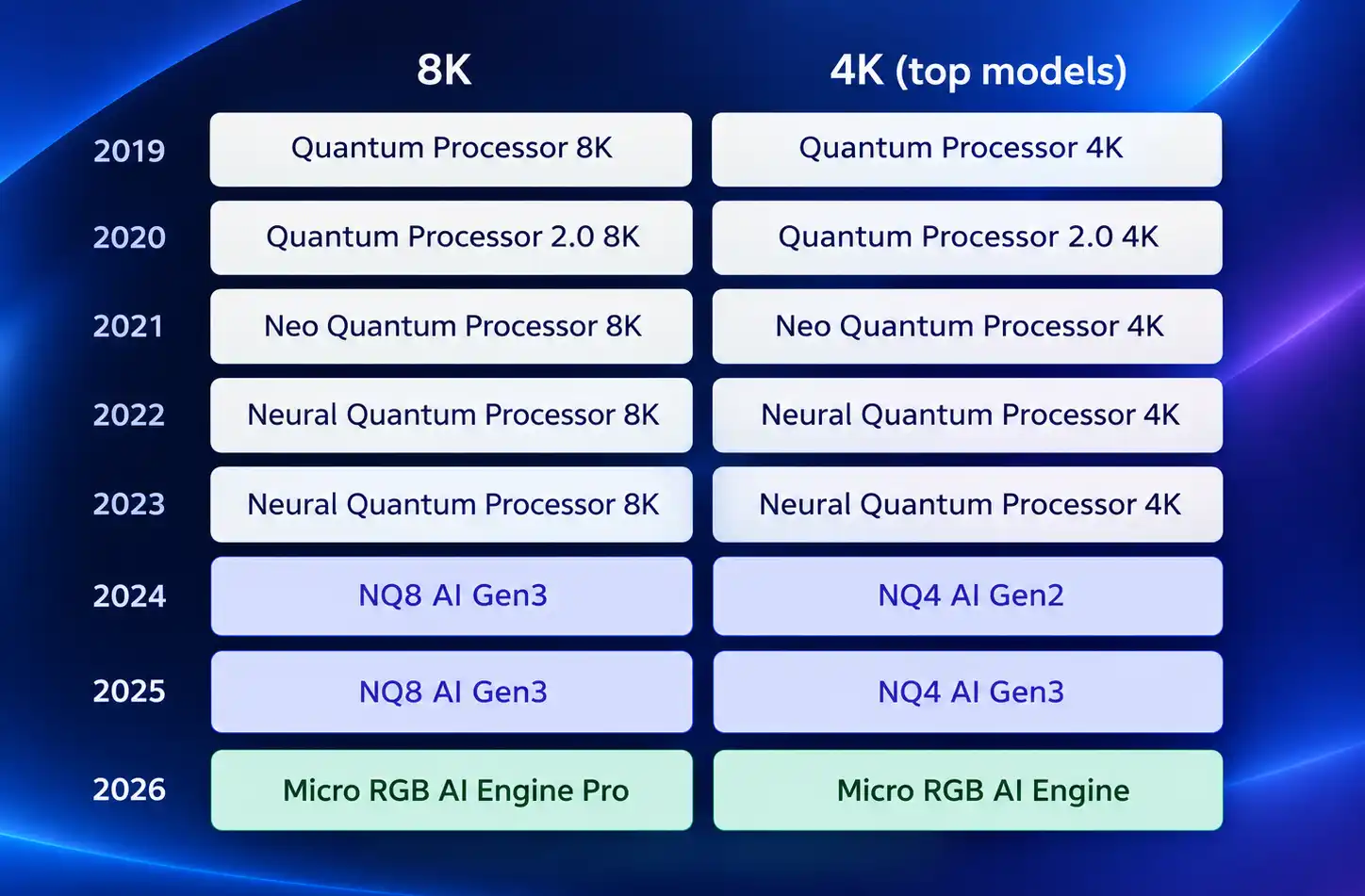
The Neo Quantum Processor debuted in Samsung’s Neo QLED TVs in 2021, replacing the Quantum Processor used in the company’s 2020 models. Samsung stated that the new processor used up to 16 neural network models to enhance image quality on 4K and 8K screens.
Over the following years, Samsung changed its processor naming conventions and began providing more information about their hardware. In 2022, the company announced support for up to 20 neural networks. In 2024, Samsung explicitly confirmed that the NQ8 AI Gen3 included a neural processing unit (NPU). According to the company, its NPU was twice as fast as the one in the previous generation, while the number of neural networks had increased eightfold.
Neo Quantum and its successors are digital processors designed to handle image processing. The word “Quantum” is part of Samsung’s marketing terminology, which the company has used for its TV processors since 2018. It does not refer to quantum computing. Samsung does not disclose detailed chip specifications, including their architecture, core counts, or the amount of memory dedicated to image processing.
Neural network upscaling relies on pre-trained models that run directly on the TV. Training typically involves large datasets containing pairs of low-quality images and their high-quality originals. Once trained, a model analyzes video frames and enhances them in real time. Samsung describes its AI features as processing and improving low-resolution content on the fly.
| Processor | Year | TV lineups |
|---|---|---|
| Micro RGB AI Engine Pro | 2026 | Micro RGB |
| Micro RGB AI Engine | 2026 | Micro RGB |
| NQ8 AI Gen3 | 2025, 2026 | Neo QLED 8K |
| NQ8 AI Gen2 | 2024 | Neo QLED 8K |
| NQ4 AI Gen3 | 2026 | OLED, The Frame Pro |
| NQ4 AI Gen3 | 2025 | OLED, Neo QLED 4K |
| NQ4 AI Gen2 | 2026 | Neo QLED 4K, Mini LED, The Frame |
| NQ4 AI Gen2 | 2025 | OLED, Neo QLED 4K |
| NQ4 AI Gen2 | 2024 | OLED, Neo QLED 4K, QLED |
| NQ4 AI Processor | 2026 | Neo QLED 4K |
| Q4 AI Processor | 2025 | QLED |
| Crystal Processor 4K | 2026 | Crystal UHD |
| Crystal Processor 4K | 2024, 2025 | QLED, Crystal UHD |
| Neural Quantum Processor 8K | 2022, 2023 | Neo QLED 8K |
| Neural Quantum Processor 4K | 2022, 2023 | OLED, Neo QLED 4K |
| Neo Quantum Processor 8K | 2021 | Neo QLED 8K |
| Neo Quantum Processor 4K | 2021 | Neo QLED 4K |
| Quantum Processor 4K | 2019, 2021, 2023 | QLED |
| Quantum Processor 2.0 8K | 2020 | QLED 8K |
| Quantum Processor 2.0 4K | 2020 | QLED 4K |
| Quantum Processor 8K | 2019 | QLED 8K |
2019-2020: Quantum Processor.
In 2019–2020, Samsung used Quantum Processors in its QLED TVs. Neo QLED had not yet been introduced, and Samsung had not yet returned to OLED TVs.
2021: the “Neo” prefix.
With the arrival of Neo QLED on Mini LED came the Neo Quantum Processor 8K and 4K. Regular QLED models (for example the Q70A) stayed on the Quantum Processor 4K, so for the first time the processors were split by tier.
2022-2023: Neural Quantum Processor.
The name changed to Neural Quantum Processor 8K and 4K, with an emphasis on neural networks. In 2022 Samsung returned to OLED with the S95B, which got the same Neural Quantum Processor 4K as the flagship Neo QLED 4K models. Simpler QLED models, such as the Q80C in 2023, stayed on the Quantum Processor 4K.
2024: the switch to NQ AI.
The model names were changed to NQ8 AI and NQ4 AI, with the generation number included. The flagship 8K QN900D model was named NQ8 AI Gen2. All OLED TVs (S95D, S90D), Neo QLED 4K models, and the QLED Q80D were powered by the NQ4 AI Gen2 processor. Lower-priced QLED and Crystal UHD models switched to the Crystal Processor 4K.
2025: Gen3 for top 4K models.
The NQ4 AI Gen3 went to the best 4K models: the OLED S95F and S90F and the Neo QLED QN90F. The remaining OLED and Neo QLED 4K models stayed on the NQ4 AI Gen2. The QLED Q8F and Q7F got a separate Q4 AI Processor, and 8K kept the NQ8 AI Gen3.
2026: Gen3 in OLED, separate processors for Micro RGB.
The NQ4 AI Gen3 is now in the OLEDs S99H, S95H and S90H and in The Frame Pro (128 neural networks). The entry-level OLED S85H, the Neo QLED QN80H, the Mini LED M80H and the regular The Frame got the NQ4 AI Gen2, and the QN70H got the simpler NQ4 AI Processor. 8K stayed on the NQ8 AI Gen3. The new Micro RGB lineup got its own processors: the Micro RGB AI Engine Pro (R95H) and the Micro RGB AI Engine (R85H).