

HEVC (High-Efficiency Video Coding), also known as H.265, is a modern, state-of-the-art video compression standard designed to store and transmit high-quality video using significantly less data. Simply put, a codec is a technology that compresses video, allowing files to take up less space and be streamed over the Internet.
HEVC was created as the successor to the older H.264 (AVC) standard. The main advantage of HEVC is its ability to encode 4K video with high compression, which allows for video streaming over the Internet. As a result, HEVC is widely used for high-resolution content, especially for 4K and Ultra HD video, where file sizes and streaming bandwidth requirements would otherwise be extremely large.
What do 2K HEVC 60P and 4K HEVC 60P mean?
When you see designations such as 2K HEVC 60P or 4K HEVC 60P, they describe the video’s resolution, codec, and frame rate.
2K HEVC 60P refers to video encoded using the HEVC codec with a resolution of approximately 2048 × 1080 pixels and a frame rate of 60 frames per second. The letter “P” stands for progressive scan, in which the entire frame is displayed at once, providing smoother motion compared to interlaced formats.
4K HEVC 60P refers to video encoded using HEVC with a resolution of 3840 × 2160 pixels and played back at 60 frames per second. This format is typically used for ultra-high-definition content, such as modern streaming video and UHD Blu-ray movies.
HEVC Codec Support in Windows
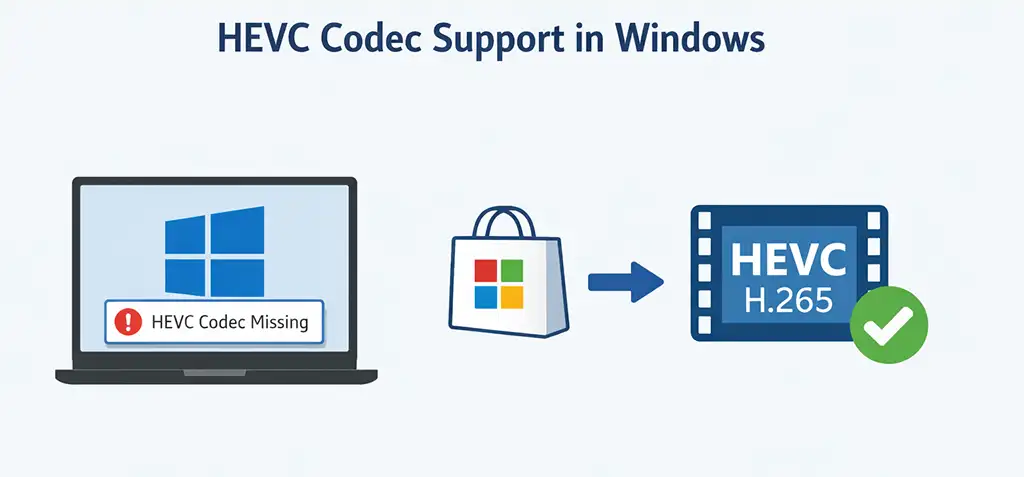
On Windows computers, HEVC support depends on the software being used. Some media players include this codec, while others rely on the Windows codec.
The standard Windows Media Player does not always include built-in HEVC decoding. When attempting to open a video encoded in the H.265 format, the system may display a message stating that the required codec is missing. In this case, Windows offers to install the HEVC Video Extensions, which can be obtained through the Microsoft Store.
After installing this extension, the system gains built-in HEVC support, allowing compatible applications to play H.265 video files normally. The extension is inexpensive and integrates with Windows, so supported applications can use it automatically.
Another approach is to install a third-party media player that already includes its own codecs. Popular players, such as VLC Media Player, or codec packs, such as the K-Lite Codec Pack, include built-in HEVC decoding, allowing you to play H.265 videos without installing additional codec packs.
HEVC Codec Support in macOS
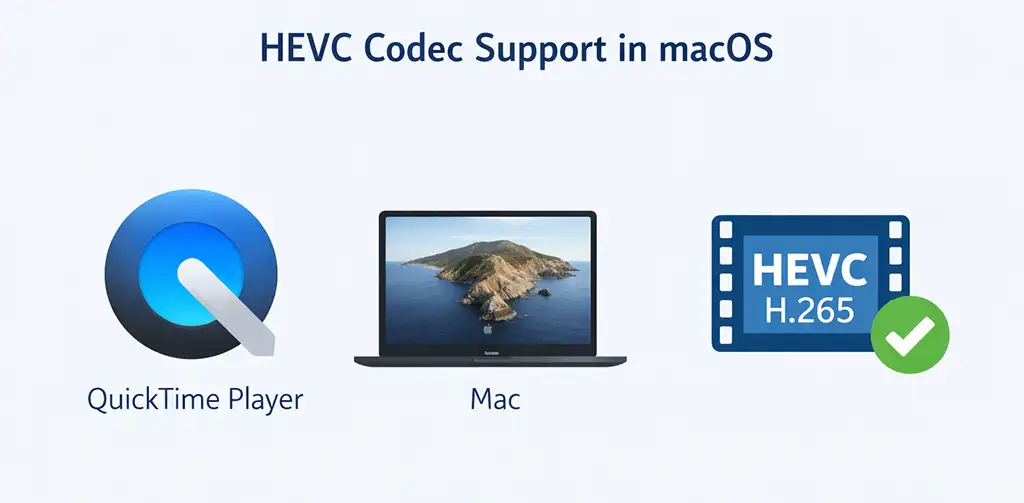
On Apple computers, HEVC support is built directly into the operating system. Starting with macOS High Sierra (10.13), the system includes built-in support for the H.265 codec.
This means that applications such as QuickTime Player and the Safari browser can play HEVC videos without installing any additional software. Modern Macs also support hardware decoding of HEVC video, allowing the computer to process video without using CPU resources.
As a result, users on macOS systems generally do not need to install any additional codecs.