

Choosing a new refrigerator requires more than simply comparing prices and brands. The right model should fit your kitchen, provide enough storage space, use energy efficiently, and offer features that are genuinely useful.
There are several reasons to replace an old refrigerator. Older appliances may become less efficient over time because of worn door seals, aging components, poor insulation, or other mechanical problems. Frequent breakdowns can also make continued repairs expensive and inconvenient. In some cases, replacing an old refrigerator with a newer, more efficient model can be a more practical solution.
Modern refrigerators also offer improved cooling systems, more precise temperature control, humidity-controlled compartments, and various convenience features. Changes in family size or lifestyle may create a need for more storage space or a different compartment layout. A kitchen renovation can also be a good reason to replace a refrigerator with a model that better matches the new design.
Measure your kitchen first
Before choosing a refrigerator, measure the available space carefully. Check the width, height, and depth of the opening, and remember that the refrigerator needs sufficient clearance for ventilation and for opening the doors.
Also consider the path into your home. A refrigerator may fit perfectly in the kitchen but still be difficult to move through a doorway, hallway, or elevator.
The door design is important as well. Make sure the doors can open fully without hitting a wall, cabinet, or kitchen island.
Choose the right refrigerator type
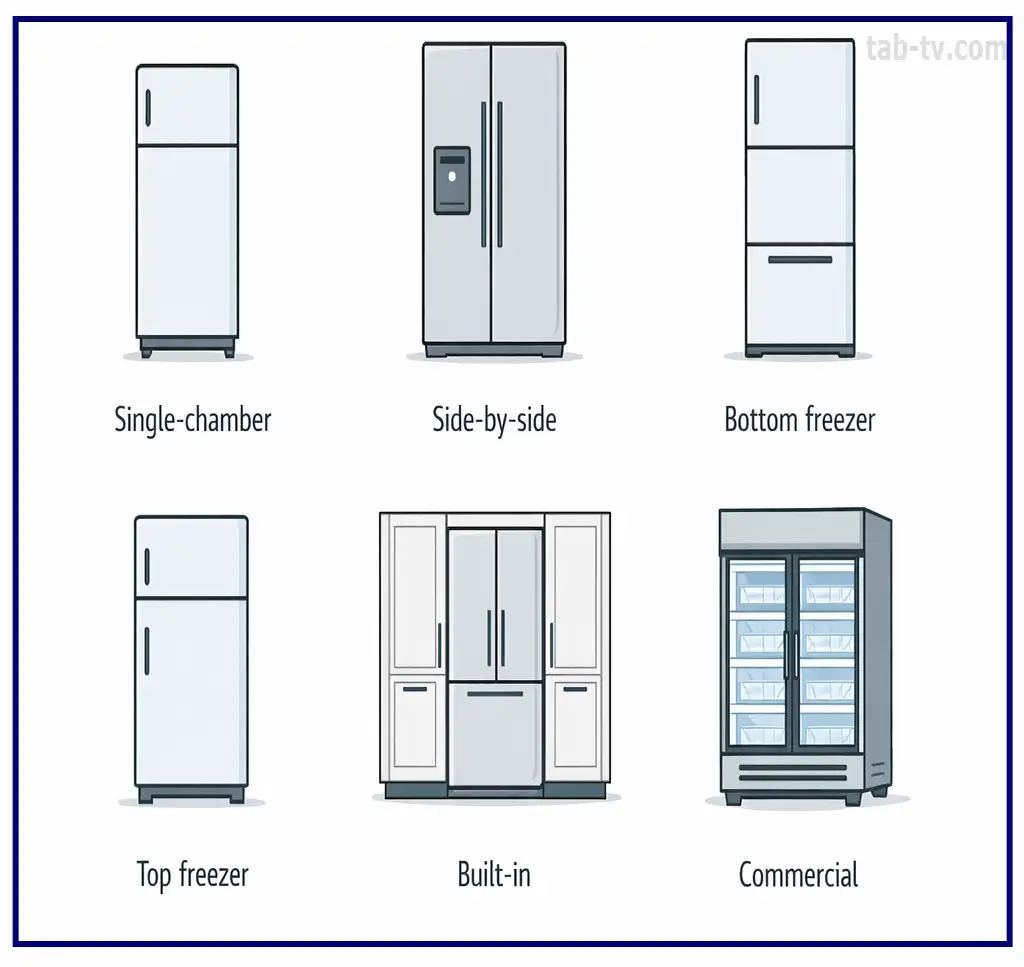
There are several common refrigerator designs, and each has advantages and disadvantages.
Top-freezer refrigerators are a traditional design with the freezer above the refrigerator compartment. They are usually simple and practical, but the freezer is at eye level while the main refrigerator compartment is lower.
Bottom-freezer refrigerators place the freezer at the bottom and the main refrigerator compartment at eye level. This is convenient for people who frequently use fresh food and do not want to bend down to reach the refrigerator compartment.
Side-by-side refrigerators have the refrigerator and freezer compartments positioned vertically next to each other. They provide a large amount of storage and often include water and ice dispensers. However, the individual compartments can be relatively narrow.
French-door refrigerators combine a wide refrigerator compartment at the top with one or more freezer drawers at the bottom. This design provides convenient access to fresh food and is popular in larger kitchens.
Single-compartment refrigerators are compact and may include only a small freezer compartment. They are useful where kitchen space is limited or when a large storage capacity is not required.
Built-in refrigerators are designed to be installed into kitchen cabinetry. They provide a cleaner appearance and can be an excellent choice for modern kitchens, although installation is more demanding and the usable capacity may be smaller than that of a freestanding refrigerator of similar external dimensions.
Choose the right capacity
The refrigerator should provide enough storage space for your household without taking up unnecessary kitchen space.
A larger refrigerator is not automatically better. Extra capacity increases the physical size of the appliance and may also increase energy consumption. Consider how often you shop, how much fresh and frozen food you normally store, and whether you regularly prepare meals at home.
Families that buy food in large quantities may benefit from a larger refrigerator or a separate freezer. For a smaller household, a compact model may be more practical.
No Frost and Cooling Systems
The No Frost system is one of the most useful features of a modern refrigerator. It circulates cold air inside the freezer compartment, reducing frost buildup and eliminating the need for regular manual defrosting during normal use. However, all food items must be properly wrapped, as they will lose moisture quickly.
More advanced refrigerators may feature separate cooling zones, multiple evaporators, or independent temperature controls. These systems help maintain more stable conditions in different compartments.
However, additional cooling technologies do not automatically make one refrigerator better than another. Overall design, insulation, temperature stability, and reliability are also important.
Compressor Type
Many modern refrigerators use inverter compressors. Unlike traditional compressors that mainly operate by switching on and off, an inverter compressor can adjust its operating speed according to the cooling demand.
This can help reduce energy consumption and operating noise, particularly when the refrigerator does not need maximum cooling capacity. However, actual energy efficiency depends on the entire refrigerator design, not only on the type of compressor.
For this reason, compare the refrigerator’s official energy consumption rather than choosing a model solely because it has an inverter compressor.
Check Energy Consumption
Energy consumption is particularly important because a refrigerator operates continuously.
When comparing models, look at the energy information provided for the specific appliance rather than relying only on marketing terms such as “energy efficient.”
A larger refrigerator may naturally consume more electricity than a smaller one, even if both use modern technology. The best choice is a model that provides the required storage capacity without being unnecessarily large.
Pay Attention to Noise Level
Because a refrigerator operates 24 hours a day, noise can become noticeable, especially in an open-plan kitchen or studio apartment.
Check the manufacturer’s specified noise level before buying. A difference that appears small on paper can be noticeable in a quiet room.
If low noise is important to you, do not rely only on the compressor type. The fans, cooling system, cabinet construction, and installation conditions also affect the actual sound level.
Water and Ice Dispensers
Water and ice dispensers can be convenient, especially for families who frequently consume chilled water or ice.
However, these systems include additional components, such as water lines, valves, filters, pumps, and ice-making mechanisms. More components mean more potential points of failure and additional maintenance costs, especially when the ice-making system is in use.
If you rarely use these features, a simpler refrigerator without a dispenser may be a more practical choice.
Choosing a Brand
A brand’s reputation can be helpful when comparing refrigerators, but the brand name alone does not guarantee the reliability of a specific model.
Contract manufacturing is also widely used in the refrigerator industry. A company may design and sell refrigerators under its own brand, while the production of some models may be fully outsourced. There are dozens of refrigerator brands, both international and local. The most well-known refrigerator brands include:
| # | Brand | Country / owner | Short description |
|---|---|---|---|
| 1 | Whirlpool | 🇺🇸 USA — Whirlpool Corporation | One of the best-known American appliance brands, offering a wide range of refrigerators from basic to premium models. |
| 2 | Samsung | 🇰🇷 South Korea — Samsung Electronics | Major electronics manufacturer known for modern refrigerator designs, French-door and Side-by-Side models, smart features, and advanced cooling systems. |
| 3 | LG | 🇰🇷 South Korea — LG Electronics | Large Korean electronics and appliance manufacturer. Its refrigerators are known for inverter compressors, modern cooling systems, and premium features. |
| 4 | Bosch | 🇩🇪 Germany — BSH Hausgeräte | German appliance brand positioned mainly in the mid-range and premium segments, with an emphasis on build quality, efficiency, and integrated kitchen appliances. |
| 5 | Siemens | 🇩🇪 Germany — BSH Hausgeräte | German premium appliance brand owned by BSH. Its refrigerators are primarily designed for modern kitchens and integrated appliance systems. |
| 6 | GE | 🇺🇸 USA — Haier Group | Originally an American appliance brand, now owned by China’s Haier Group. GE refrigerators include mainstream and premium models for the North American market. |
| 7 | Frigidaire | 🇺🇸 USA — Electrolux Group | American appliance brand with a long history in refrigeration. It focuses mainly on practical and affordable household appliances. |
| 8 | Electrolux | 🇸🇪 Sweden — Electrolux AB | Swedish home-appliance manufacturer offering refrigerators and other appliances, with a strong presence in Europe and other international markets. |
| 9 | KitchenAid | 🇺🇸 USA — Whirlpool Corporation | Premium-oriented American appliance brand owned by Whirlpool, particularly well known for kitchen appliances and higher-end refrigerator models. |
| 10 | Miele | 🇩🇪 Germany — Miele & Cie. KG | German family-owned premium appliance manufacturer. Its refrigerators are positioned at the high end of the market and emphasize design, quality, and long-term use. |
| 11 | Liebherr | 🇩🇪 Germany — Liebherr Group | German-Swiss group specializing in refrigeration and other technical equipment. Liebherr is particularly well known for premium refrigerators and freezers. |
| 12 | Haier | 🇨🇳 China — Haier Group | One of the world’s largest appliance manufacturers. Haier offers refrigerators across different price segments and owns several major appliance brands. |
| 13 | Hisense | 🇨🇳 China — Hisense Group | Large Chinese electronics and appliance manufacturer producing refrigerators for global markets, generally offering competitive features at moderate prices. |
| 14 | Beko | 🇹🇷 Turkey — Arçelik | Turkish appliance brand with a strong presence in Europe. It focuses mainly on affordable and mid-range household appliances. |
| 15 | Toshiba | 🇯🇵 Japan — Toshiba Lifestyle Products / Midea Group | Japanese-origin brand used for refrigerators and other appliances. Toshiba’s consumer appliance business is now connected with China’s Midea Group. |
| 16 | Sharp | 🇯🇵 Japan — Foxconn / Hon Hai | Japanese-origin electronics brand. Its refrigerators are sold in various markets, while the ownership and manufacturing structure differs by product and region. |
It is important to evaluate a specific model—its technical specifications, warranty, availability of service, and long-term user experience—rather than choosing based solely on the brand.