
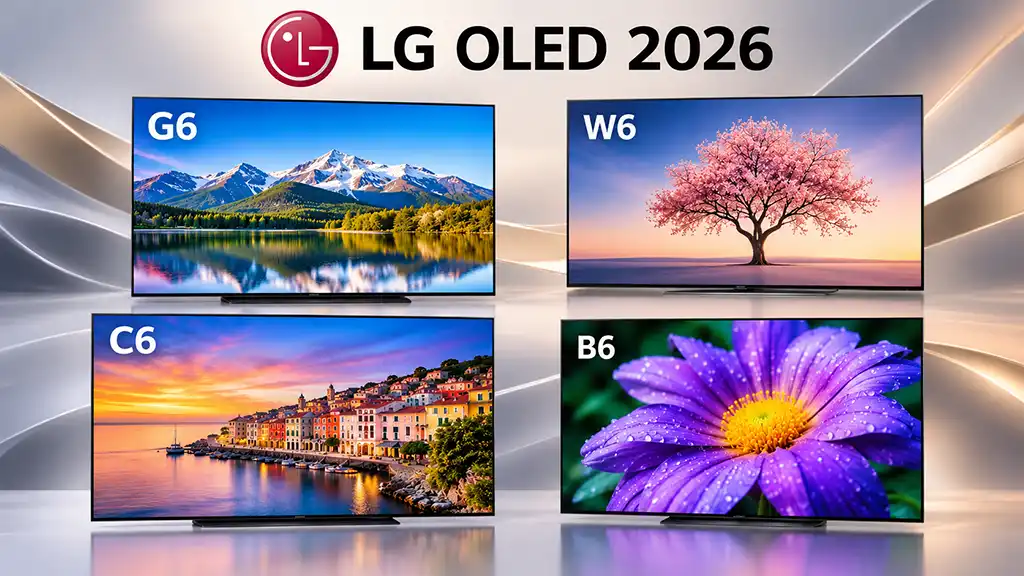
LG’s 2026 OLED lineup has four series: G6, C6 (sold as the C6 and the C6H), B6 and W6. Together they cover diagonals from 42 to 97 inches.
- G6 is the top series for picture quality. It comes in 48″ (select regions), 55″, 65″, 77″, 83″ and 97″.
- C6 is the main mid-range series. LG split it into two versions: the C6 in 42″, 48″, 55″ and 65″, and the C6H in 77″ and 83″.
- B6 is the entry-level series. It comes in 48″, 55″, 65″, 77″ and 83″.
- W6 is the Wallpaper series, a wall-mounted TV with a wireless connection box. It returns after a four-year gap, and the first Wallpaper TV appeared in 2017. It comes in 77″ and 83″.
What’s New in 2026
Panels. The G6 and W6 use the Primary RGB Tandem 2.0 panel, which LG markets as Hyper Radiant Color. The panel has separate red, green and blue emission layers. LG says the brightest models with this panel reach up to 3.9 times the brightness of the B6.
The new panel is used only in some sizes. In the G6 line it is in the 55″, 65″, 77″ and 83″ models, while the 48″ and 97″ versions do not have Hyper Radiant Color Tech. In the C-series only the 77″ and 83″ C6H models have it, and the 42″ to 65″ C6 models use a conventional WOLED panel. The W6 uses the same panel as the G6.
Processors. The W6, G6 and C6 run on the Alpha 11 Gen 3 processor, and the B6 uses the Alpha 8 Gen 3. LG says the Alpha 11 Gen 3 has a 50% faster CPU, a 70% faster GPU and a 5.6 times faster NPU than the Alpha 8 Gen 3.
LG OLED 2026 Comparison by Model and Size
| Model | Diagonals | Key specs |
|---|---|---|
| LG OLED evo W6 (Wallpaper) | 77″, 83″ | Primary RGB Tandem 2.0 panel; about 9.9 mm thick; wireless Zero Connect Box for all inputs, placed up to 10 m from the panel (the panel and the box each need their own power connection); Alpha 11 Gen 3 |
| LG OLED evo G6 | 48″ (select regions), 55″, 65″, 77″, 83″, 97″ | 48″: 4K 165 Hz; up to 2.1x brighter than a standard OLED; no Hyper Radiant Color Tech 55″, 65″, 77″, 83″: Primary RGB Tandem 2.0; Hyper Radiant Color; Brightness Booster Ultra; Reflection Free Premium; 4K 165 Hz; Alpha 11 Gen 3 97″: 4K 120 Hz; Brightness Booster; no Hyper Radiant Color Tech and no tandem build |
| LG OLED evo C6 | 42″, 48″, 55″, 65″ | 42″: conventional 4K WOLED; no Brightness Booster; Wi-Fi 5 48″, 55″, 65″: conventional 4K WOLED; Brightness Booster Standard; Wi-Fi 5 |
| LG OLED evo C6H | 77″, 83″ | Primary RGB Tandem 2.0; Hyper Radiant Color; Brightness Booster Pro (up to 3.2x brighter than a standard OLED); Wi-Fi 6E |
| LG OLED B6 | 48″, 55″, 65″, 77″, 83″ | 4K 120 Hz WOLED; Alpha 8 Gen 3; Perfect Black and Perfect Color; no extra brightness technology |
General Features of the Entire Series
Gaming
- Variable refresh rate. All series support Nvidia G-SYNC and AMD FreeSync Premium, plus HGiG HDR mode and Auto Low Latency Mode. LG lists a response time of under 0.1 ms.
- Refresh rate. The G6, C6 and W6 support 4K at up to 165 Hz (the C6 raises this from 144 Hz on the C5). The 97″ G6 is limited to 120 Hz. The B6 has a native 120 Hz panel with VRR up to 144 Hz.
- Dolby Vision Gaming. The G6, C6 and B6 support Dolby Vision for gaming at 4K 120 Hz.
- Game Optimizer and Game Dashboard. These menus let you change refresh rate, latency and picture mode while a game is running.
- Game portal. webOS has a gaming hub that collects cloud gaming services and apps in one place. LG TVs also have an Xbox app with Xbox Cloud Gaming through Game Pass Ultimate.
- Bluetooth controllers. LG states that the G6 and C6 support ultra-low latency Bluetooth controllers, with input delay of under 3 ms.
LG advertises built-in 4K 120 Hz HDR cloud gaming through Nvidia GeForce NOW on the G6 and C6, and describes it as a first for TVs. The service runs on Nvidia Blackwell servers with GeForce RTX 5080 performance and requires a GeForce NOW Ultimate subscription.
Connections, Audio and Video Formats
- HDMI. The G6 and C6 have four HDMI 2.1 ports. The G6 ports run at 48 Gbps and support VRR, ALLM, QMS and eARC. The 2026 models stay on HDMI 2.1 and do not use HDMI 2.2.
- HDR formats. All models support Dolby Vision, HDR10 and HLG. The G6 and C6 do not support HDR10+, and LG has said it has no plans to add Dolby Vision 2 to them.
- Picture modes. The B6 has Filmmaker Mode and AI HDR remastering. The Alpha 11 processor in the G6 and C6 adds AI-based optimization of color, brightness and contrast, and conversion of SDR picture to an HDR-like image.
All models support Dolby Atmos and eARC. The G6 does not support DTS. The G6 supports Chromecast and Apple AirPlay 2, and the B6 has Bluetooth 5.3.
webOS 26 and AI
The 2026 models run webOS 26. It adds an AI Hub with Multi AI search that uses both Microsoft Copilot and Google Gemini. Copilot handles voice queries and search, and Gemini generates custom art in the Gallery+ section. Other features in the hub include an AI Concierge, AI Voice ID with a personal profile page, and AI Picture and Sound Wizards. A feature called In This Scene shows cast information and related content while you watch.
LG Shield is the security layer of webOS, covering privacy, data security and system integrity. The C6 also carries the UL Eyesafe RPF 40 certification for reduced blue light.
LG W6
The W6 is a wall-mounted TV 9.9 mm thick that uses the same screen and processing as the G6. All inputs connect to a separate Zero Connect Box, which sends the picture to the panel wirelessly. The panel and the box each need their own power connection. The W6 is sold in 77″ and 83″.
Source devices such as game consoles, media players, PCs and streaming devices must be connected to the Zero Connect Box by cable, not to the TV panel. The box can be placed up to 10 meters from the panel. LG states that the box should be installed lower than the receiver on the TV, and that placing it inside a cabinet may cause signal interference, depending on the material and thickness of the cabinet. The wireless link supports 4K at up to 165 Hz, but only with games or PC inputs that support 165 Hz.
LG G6
The G6 is the top series of the 2026 OLED range. It is sold in three variants that differ in panel, brightness and refresh rate: the 55″, 65″, 77″ and 83″ models, the 97″ model, and the 48″ model.
55″, 65″, 77″ and 83″. These models have the Primary RGB Tandem 2.0 panel with Hyper Radiant Color Tech, the Brightness Booster Ultra setting and a 165 Hz refresh rate (native 120 Hz panel with VRR up to 165 Hz). They are the only G6 sizes with the Reflection Free Premium anti-glare certification. They also carry the ClearMR 10000 certification. ClearMR is a VESA program that evaluates how much motion blur a display produces, and 10000 is the grade LG lists for these models. They have motion sensors, which LG limits to the W6 and G6.
97″. This model has a 120 Hz refresh rate (VRR up to 120 Hz), Brightness Booster instead of Brightness Booster Ultra, and no Hyper Radiant Color Tech or tandem layer. LG lists ClearMR 10000 only for the sizes from 48″ to 83″, so the 97″ does not have it. LG’s spec sheet lists its power consumption at 280.5 W, compared with 116.4 W for the 55″ model.
48″. It is sold only in some regions. It supports 165 Hz and ClearMR 10000, but LG rates its brightness at up to 2.1 times a standard OLED, against up to 3.9 times for the 55″ to 83″ models.
LG C6 and C6H
LG split the C-series into two versions this year, and they cover different sizes, so they do not compete directly.
C6 (42″, 48″, 55″, 65″). It uses a conventional WOLED panel of the same type as the C5. Brightness Booster Standard is used on the 48″, 55″ and 65″ models. The 42″ model has no Brightness Booster at all, and the 42″ and 48″ sizes are also dimmer than the larger C6 sizes because the pixels are packed more tightly. The 42″ size is the one the series offers for use as a TV and desktop monitor at the same time. The C6 models up to 65″ have Wi-Fi 5.
C6H (77″, 83″). It uses the Primary RGB Tandem 2.0 panel with Hyper Radiant Color and Brightness Booster Pro, which LG rates at up to 3.2 times the brightness of a standard OLED. It has Wi-Fi 6E instead of Wi-Fi 5. LG made the C6H available only in the two largest sizes.
LG B6
The B6 replaces the B5 as LG’s lowest-priced OLED. It is sold in 48″, 55″, 65″, 77″ and 83″, and in two variants, the B6 and the B6E. Both use a 4K 120 Hz WOLED panel.
Compared with the C6 and G6, the B6 differs in three ways. It has the Alpha 8 Gen 3 processor instead of the Alpha 11 Gen 3. It uses a conventional panel without the brightness technology of the evo series, so its brightness is lower. It keeps the Perfect Black and Perfect Color certifications, and LG’s own comparison puts the brightest premium models at up to 3.9 times the B6.