
The Samsung H6400 is a Full HD LED TV released in 2014. Although it is an older model, many of these TVs are still in use. Adjusting the picture settings can help produce a more natural image and make the TV more comfortable to watch.
The settings below are a good starting point for the Samsung H6400. They should not be considered professional calibration values because the ideal settings depend on the individual TV, the room lighting, and the type of content being watched.
Recommended picture settings
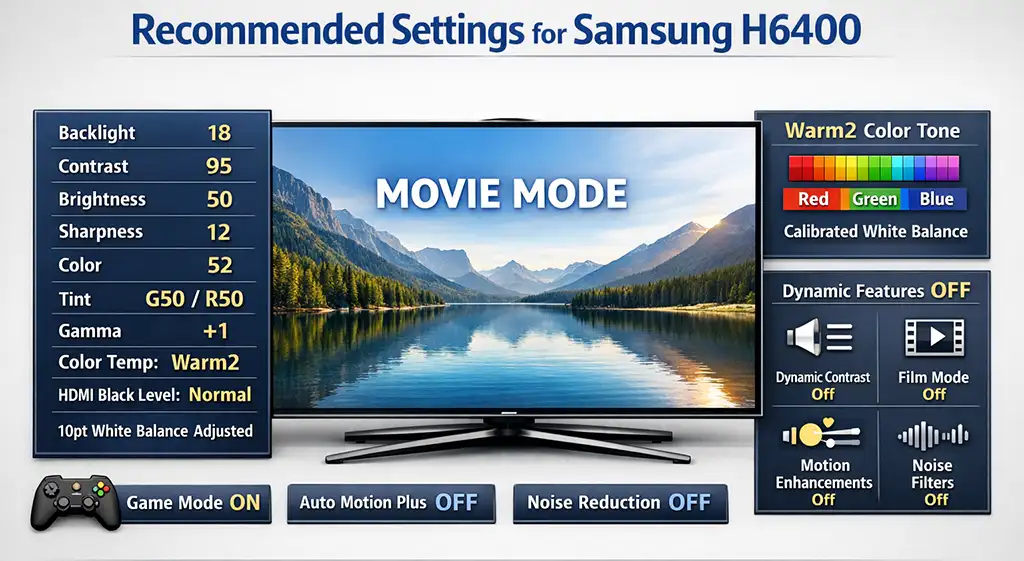
For general TV viewing, movies, and streaming video, start with the Movie picture mode and use the following settings:
| Setting | Recommended value |
|---|---|
| Picture Mode | Movie |
| Backlight | 18 |
| Contrast | 95 |
| Brightness | 50 |
| Sharpness | 12 |
| Color | 52 |
| Tint | G50/R50 |
| Dynamic Contrast | Off |
| Black Tone | Off |
| Flesh Tone | 0 |
| RGB Only Mode | Off |
| Color Space | Auto |
| Gamma | +1 |
| Color Temperature | Warm2 |
| Digital Clean View | Off |
| MPEG Noise Filter | Off |
| HDMI Black Level | Normal |
| Film Mode | Off |
| Auto Motion Plus | Off |
| LED Motion Plus | Off |
| xvYCC | Off |
These values are intended as a starting point, not as settings that every H6400 owner must use without modification.
How to adjust the picture
The most important settings are Backlight, Contrast, Brightness, Sharpness, Color, Color Temperature, and Gamma.
Backlight controls the intensity of the TV’s LED backlight. It is the setting to adjust first when the entire screen is too bright or too dark. If you watch TV in a dark room, you may want to reduce the value. In a bright room, increasing it can make the picture easier to see.
Contrast controls the level of the brighter parts of the picture. A value of 95 is a reasonable starting point for the H6400. If bright areas lose detail, reduce Contrast slightly.
Brightness affects the darker parts of the image. The recommended starting value is 50. If black areas look gray, do not immediately reduce Brightness; first check the source and HDMI black-level settings.
Sharpness controls edge enhancement rather than adding real detail to the image. A value of 12 is a starting point, but you can reduce it if you see halos or artificial outlines around objects and text.
Color controls color intensity. The recommended value is 52, while Tint G50/R50 leaves the green/red balance centered. Large changes to Tint are normally unnecessary if skin tones already look natural.
For Color Temperature, Warm2 gives the picture a warmer appearance. It may initially look yellowish if you are accustomed to a cooler setting, but warmer tones are often more comfortable for movie and television viewing.
Gamma +1 slightly changes the brightness of midtones and darker areas. If the picture looks too dark in your room, you can experiment with this setting, but large changes are usually unnecessary.
Additional picture processing
The H6400 includes several processing options that change the picture rather than simply controlling its basic brightness or color.
For the recommended setup, leave Dynamic Contrast, Black Tone, noise reduction, Auto Motion Plus, and LED Motion Plus turned off. These features can be useful in certain situations, but they are not necessary for a basic, natural-looking picture.
Noise reduction can be useful with poor-quality or heavily compressed video. If you are watching an old or low-quality source and see a lot of visible noise, you can try enabling it. With a good-quality digital source, however, additional processing may remove some fine detail.
Auto Motion Plus is a matter of preference. It makes motion appear smoother, which can be useful for sports, but some viewers find that it makes movies look unnaturally smooth. Turning it off preserves the original motion characteristics of the source.
HDMI Black Level should match the video range used by the connected device. If an HDMI source looks washed out or excessively dark, check this setting on both the TV and the external device instead of trying to correct the problem with the Brightness control.
For gaming, Game Mode is generally preferable because it reduces some of the TV’s image processing and can make controls feel more responsive.
White Balance and calibration
The original H6400 settings may include detailed 20-point White Balance values. These should not be copied blindly to every H6400.
White Balance calibration is particularly dependent on the individual panel. Two televisions of the same model can require different adjustments, especially after years of use.
For normal viewing, there is usually no reason to manually change the 20-point White Balance. If you want to calibrate the TV accurately, the correct approach is to measure the actual screen and adjust it accordingly.
The basic settings in the table above are therefore more useful for most owners than a detailed calibration table copied from another television.
Settings for different viewing conditions
You do not need a completely different picture configuration for every situation.
If the TV is too bright in a dark room, reduce Backlight. If the picture is too dim in a bright room, increase Backlight. There is usually no need to change Brightness or Contrast just because the room lighting has changed.
For movies and normal television viewing, Movie mode with the settings above is a good starting point.
For gaming, use Game Mode and adjust the Backlight to suit the room. Keep unnecessary motion processing disabled unless you specifically prefer the effect.
The most important thing is not to treat these values as absolute. The H6400 is now an older television, and its panel, backlight condition, connected devices, and viewing environment all affect the final picture.