

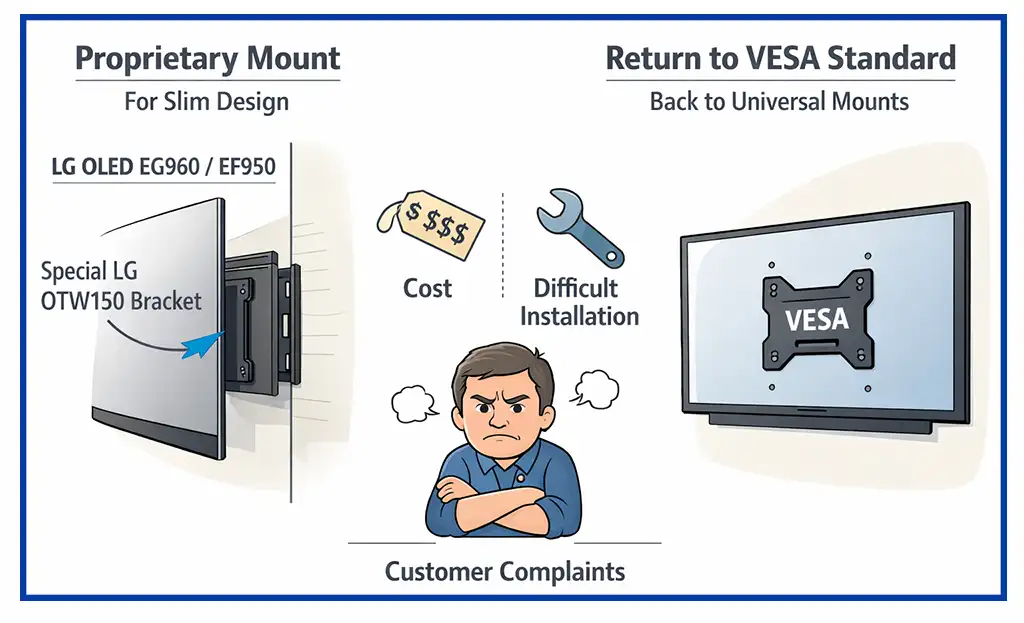
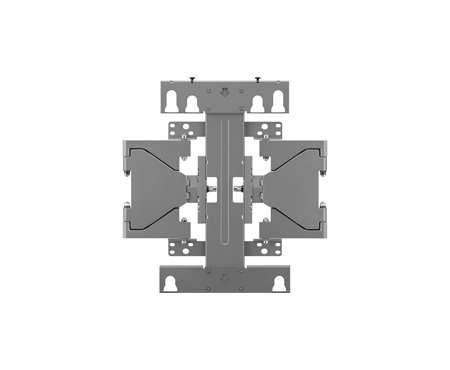
When LG introduced OLED models such as the LG OLED EG960 and LG OLED EF950, the company also unveiled a new mounting concept. Due to their exceptionally thin construction, LG decided to move away from the widely accepted VESA standard. Instead of traditional universal mounting holes, these televisions required a proprietary wall bracket — the LG OTW150.
This decision was closely tied to the design philosophy behind the TVs. LG aimed to position the screen as close to the wall as possible to highlight its ultra-slim profile and premium appearance. Standard VESA mounts could not provide the same near-flush installation or the precise structural support needed for such a thin OLED panel.
Cost and Installation limitations
Although technically justified, this solution was not welcomed by all buyers. The OTW150 was the only compatible mounting option in both the European and American markets. Its official price on LG’s U.S. website was around $138, while major retailers typically offered it for approximately $100. For customers purchasing high-end OLED TVs, the required additional bracket increased the overall installation cost.
The absence of third-party alternatives further limited consumer choice. Owners who already had VESA-compatible mounts could not reuse them, which created additional inconvenience. Installation also required more careful handling compared to standard systems, making the process less flexible and sometimes more complicated.
Customer reaction and return to the standard
Customer response was largely negative. Complaints focused on the added expense, reduced flexibility, and the departure from a universal mounting standard that had long simplified TV installation. Many users viewed the proprietary mounting system as an unnecessary complication, particularly for a premium product category.
In response to the feedback, LG returned to supporting the universal VESA mounting standard in subsequent OLED generations. The experience with the EG960 and EF950 series demonstrated that the market was not ready to abandon established mounting solutions. Although LG was not the only company to experiment with proprietary mounts, such systems ultimately did not gain widespread adoption.