
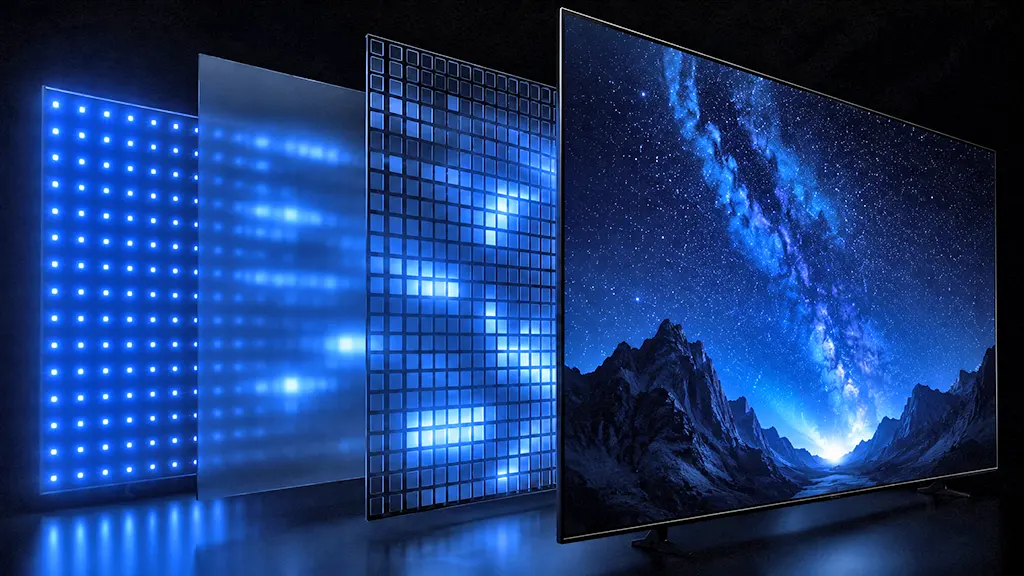
The backlight in LCD displays—or, as they are also known, LED displays with IPS or VA panels—is one of the key components of the display. TV manufacturers often create their own names for the backlighting technologies used in their TVs, although in reality there are only two main types of LCD backlighting.
In the first type, the backlight LEDs are positioned along the edges of the display, although the LED strips themselves are actually mounted beneath the screen. In this design, backlight control is very limited. In practice, there are only two backlight zones: the left and right sides of the screen. As a result, these TVs provide virtually no local dimming.
In the second type, the backlight LEDs are positioned behind the entire display. Special lenses are used to distribute the light evenly across the screen. Standard displays may contain only a few dozen LEDs, whereas Mini LED displays use much smaller LEDs, allowing several hundred to be installed. More recently, displays with pixel-level backlighting have also appeared. This makes it possible to divide the backlight into many independently controlled zones.
In 2019, Samsung began using labels such as “Direct Full Array 8×3” and “Direct Full Array 16×3” to describe the backlighting used in some of its TV models. The term “Direct Full Array” indicates that the LEDs are positioned behind the entire screen, but many users have wondered what the additional designations “8×3” and “16×3” actually mean.
In reality, “Direct Full Array” is no different from the previously used designation “Samsung Full Array Backlight.” It is simply a marketing term introduced by Samsung. Since there are relatively few significant technological changes in modern TVs, manufacturers often rebrand existing technologies with new names to attract attention and increase sales. It is also common for companies to register new marketing terms for technologies that have already existed for many years.
Direct Full Array
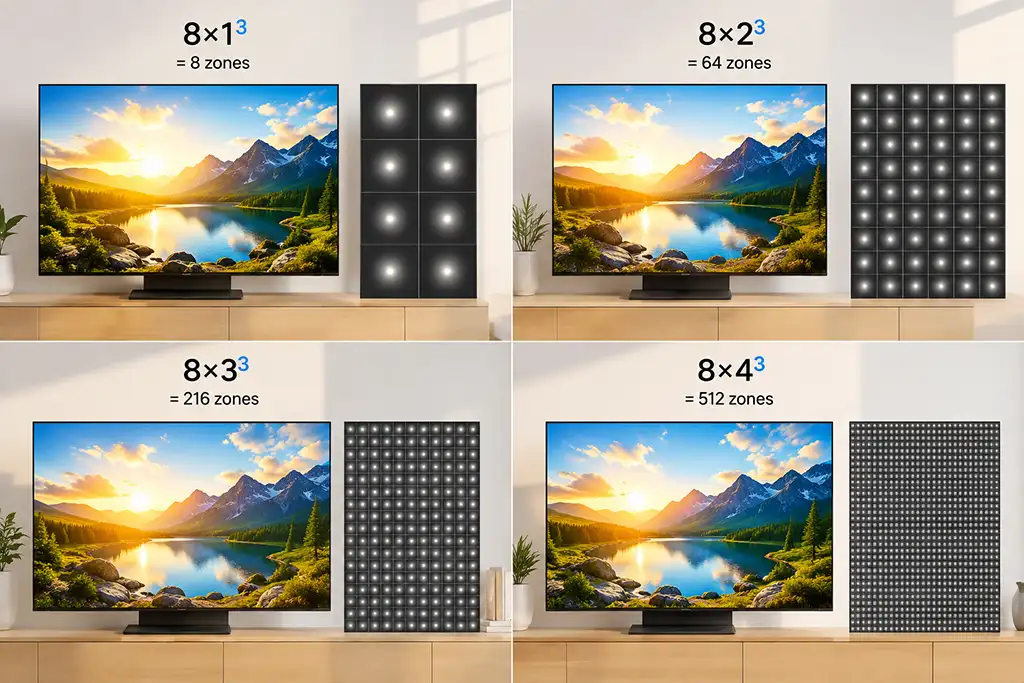
The Direct Full Array 8× designation refers to the number of independently controlled backlight zones. However, instead of stating the number of zones directly, Samsung presents it as part of a formula. This approach allows the company to create and register a unique marketing name rather than simply listing a technical specification.
The designation can be interpreted as follows:
- 8 × 1³ = 8 backlight zones
- 8 × 2³ = 64 backlight zones
- 8 × 3³ = 216 backlight zones
- 8 × 4³ = 512 backlight zones
As a rule, the number of backlight zones is a multiple of eight, which is related to the way the backlight controller operates and its connection to the 8-bit architecture commonly used in electronic systems.
Following this logic, Samsung TVs would have no more than 512 local dimming zones under the Direct Full Array 8× designation. The next step in the sequence, 8 × 5³, equals 1,000, which in practice would correspond to approximately 1,024 controllable zones.
Direct Full Array 16×3
The Direct Full Array 16× designation follows a similar concept, but with a different base value:
- 16 × 1³ = 16 backlight zones
- 16 × 2³ = 128 backlight zones
- 16 × 3³ = 432 backlight zones
- 16 × 4³ = 1,024 backlight zones
This represents a slightly different method of indicating the number of local dimming zones.
In practice, these designations are primarily a marketing tool. Stating in the specifications that a TV has 128 local dimming zones sounds fairly ordinary, whereas describing it as featuring Direct Full Array 16× technology appears much more impressive. For this reason, you may also encounter other variations, such as Direct Full Array 12×. These labels should be viewed as marketing names rather than technical standards, so there is no need to attach too much importance to them.