

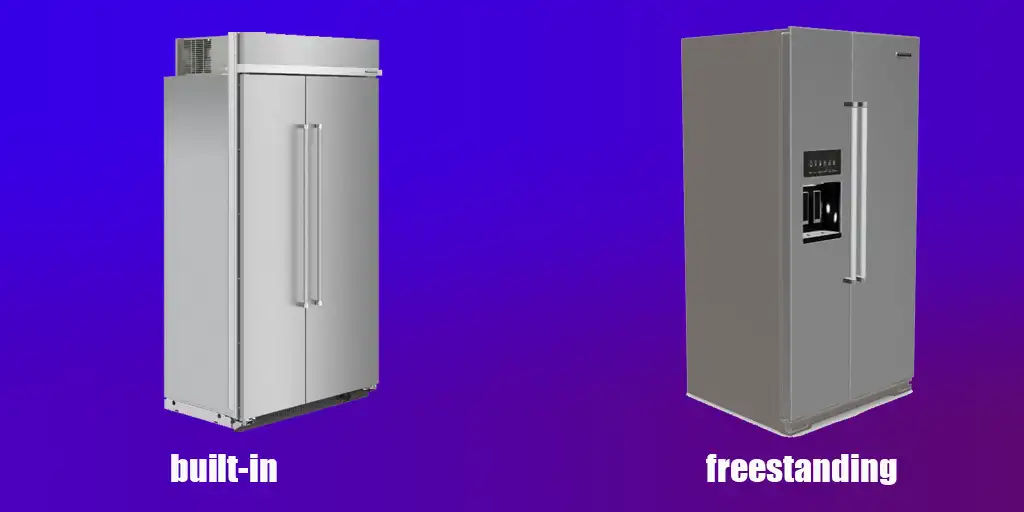
If you are renovating your kitchen or planning a new one, a built-in refrigerator can create an elegant, high-end look that blends seamlessly with your kitchen cabinets. To decide if this is the right choice, it helps to understand how built-in refrigerators differ from traditional freestanding models.
What is a built-in refrigerator?
A built-in refrigerator is designed to be installed directly into kitchen cabinetry, allowing it to blend seamlessly with the overall design of the space. In addition to refrigerators, many household appliances—such as dishwashers and washing machines—can also be built in for a cohesive, streamlined look.
When it comes to refrigerators, there are two main built-in options. The first features a reduced depth, allowing the appliance to sit flush with standard kitchen cabinets. The second type is fully integrated and accepts a custom cabinet panel on the front, making the refrigerator nearly invisible within the kitchen design. This fully integrated style is less common than the shallow-depth model.
Key differences
Freestanding refrigerators offer flexibility. They can be placed almost anywhere in the kitchen where there is access to electricity and, if necessary, water supply. Installation is simple and usually does not require any changes to the kitchen layout, except for choosing a suitable location.
Built-in refrigerators, on the other hand, must be planned as part of the kitchen design from the outset. Since refrigerators emit heat to the outside when cooling the interior, built-in models require proper ventilation. This usually means leaving space behind or above the appliance so that hot air can escape naturally.
To compensate for the reduced size, manufacturers often rework the internal layout. In some built-in models, the compressor and condenser are moved to the top of the refrigerator to maximize usable storage space.
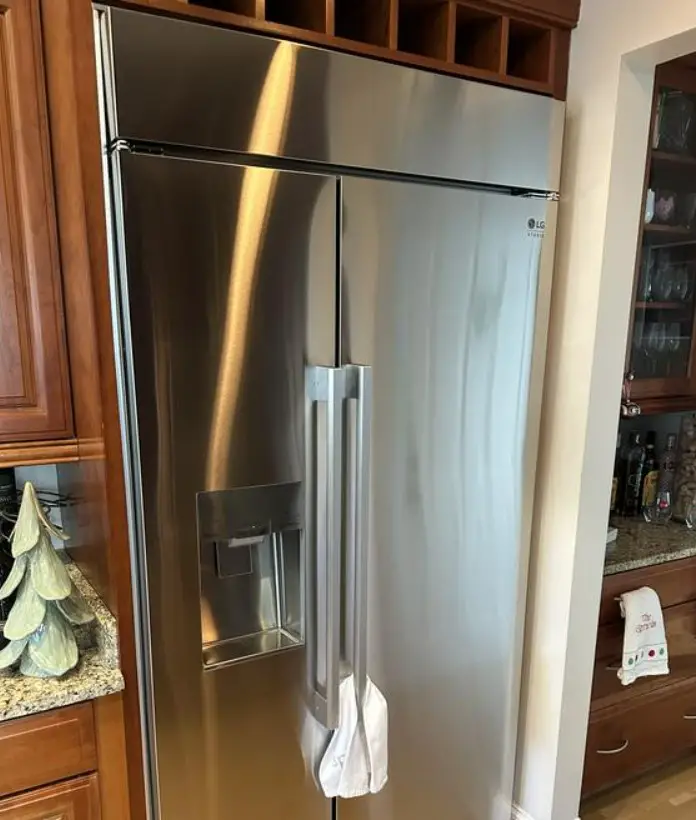
Features of built-in refrigerators
There is a common misconception that built-in refrigerators are quieter or consume more energy than freestanding models. In reality, there is no noticeable difference—both types are comparable in terms of noise levels and energy efficiency.
It is also important to note that large built-in refrigerators have become much less common in recent years. Major brands such as Samsung, LG, and GE have largely stopped producing full-size built-in models. Today, most built-in refrigerators available on the market are compact units, typically used in offices, hotels, or as secondary refrigerators.
This trend is partly due to the increasing use of features such as displays and water dispensers, which are difficult to integrate into built-in designs. As a result, the number of built-in refrigerator models is quite limited. For example, in 2025, LG offers only a small selection of built-in refrigerators, while Samsung has completely moved away from classic built-in models. The Bespoke line initially allowed for interchangeable front panels, but it later evolved into a premium series without the option to replace the panels.




[…] Samsung’s built-in refrigerator vs conventional refrigerator […]