

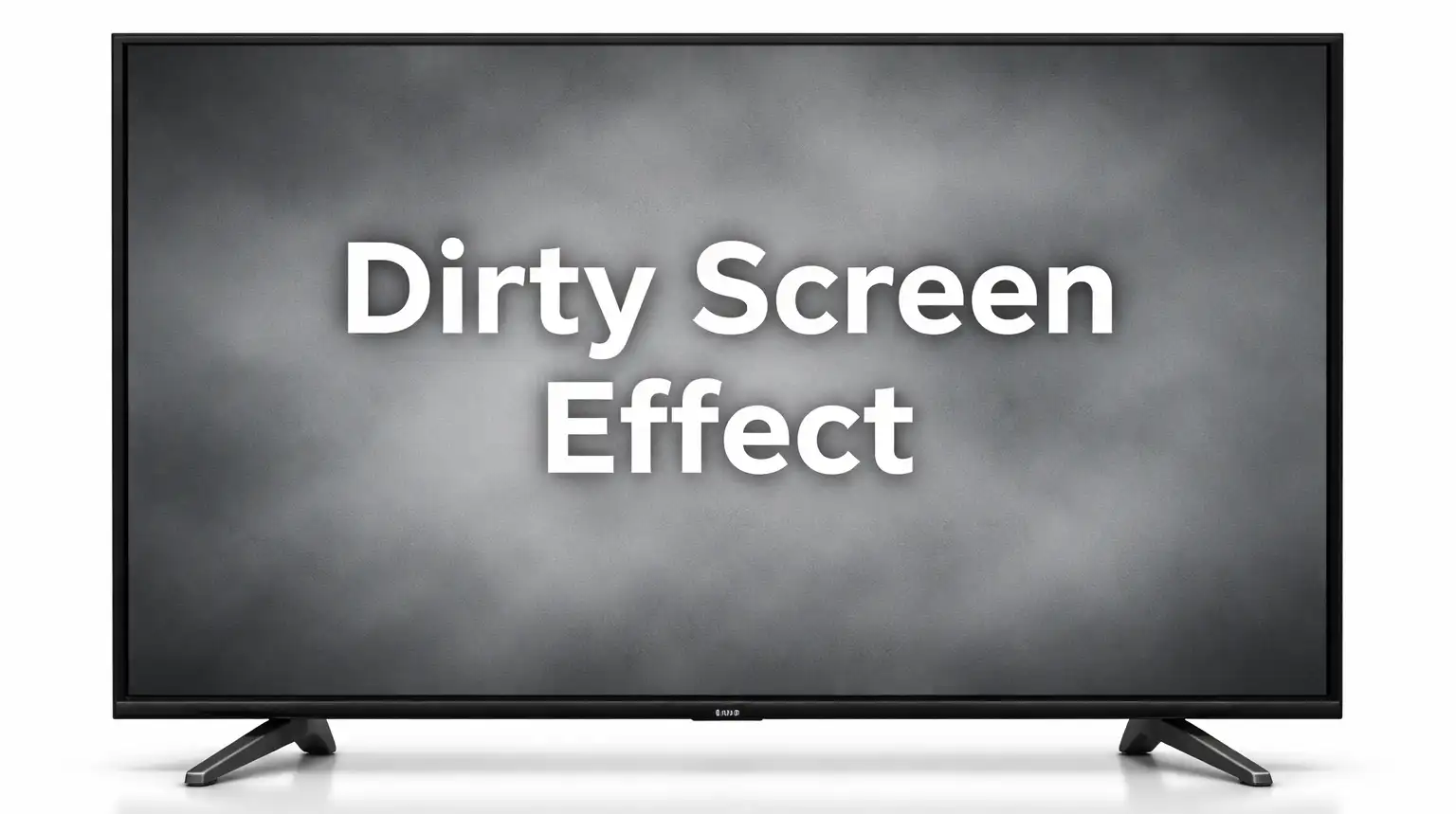
The “dirty screen” effect is a visual phenomenon that can appear on LED and LCD televisions. It presents itself as uneven brightness or faint, blurry patches on the screen, most noticeable against uniform backgrounds such as gray, white, or other light scenes. Many viewers describe it as if the display has smudges or uneven “stains,” even though the surface is actually clean. This effect became widely discussed in the mid-2010s, when LED TVs dominated the market.
Why the “Dirty Screen” effect occurs
LED/LCD TVs use a backlighting system in which light is distributed through a special reflective substrate and diffusion layers. The light reflects, passes through the LCD matrix, and forms the visible image. In theory, this illumination should be perfectly uniform, but in real manufacturing conditions, slight deviations are unavoidable.
The main causes include uneven backlight distribution, where certain areas of the panel receive slightly more or less light than others. Small variations in the LCD matrix and diffusion layers also play a role. In addition, mechanical tolerances during assembly can affect how tightly the panel layers are pressed together, influencing light uniformity.
Even minimal inconsistencies in these elements can lead to visible unevenness on the screen.
When the effect is most noticeable
The “dirty screen” effect does not appear equally across all types of content. It becomes noticeable mainly in specific situations.
It is often seen during sports broadcasts with large uniform backgrounds, such as football fields or ice arenas. It can also appear when the camera pans across smooth surfaces like the sky, walls, or grass. Gray test screens designed to check panel uniformity make the effect especially visible. In addition, it may be noticeable in low-brightness scenes or in dark content with subtle transitions.
In typical movies, TV shows, or colorful scenes, the effect is usually much less noticeable or not visible at all.
Manufacturing variations
This phenomenon is not tied to any specific brand or model. It depends primarily on the quality of the display panel itself. Higher-end TVs generally undergo stricter quality control, which reduces the likelihood or severity of the effect. More affordable models often use panels with wider tolerances, where such unevenness can be more apparent.
Although the effect exists, it is rarely emphasized, as it is considered a characteristic of the technology and usually does not significantly impact the overall viewing experience. At the same time, newer display approaches, including advanced backlighting systems such as Micro RGB, aim to minimize this issue, while OLED TVs do not exhibit the dirty screen effect due to the absence of a traditional backlight.
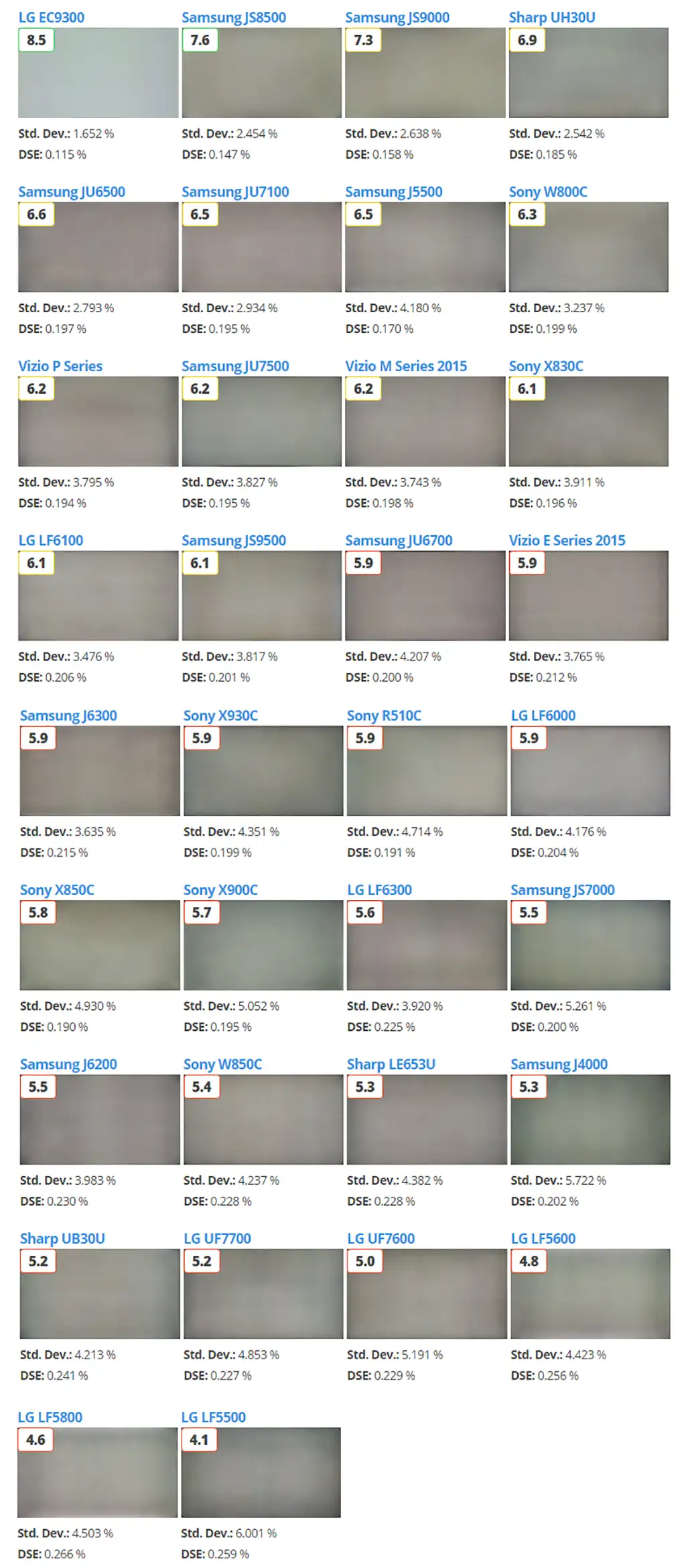
Below is a comparison of various 2015 TV models in terms of the presence and severity of the dirty screen effect.

[…] de DSE que você vê depende parcialmente do modelo que você adquiriu. Modelos mais caros geralmente apresentam melhor uniformidade melhorada, principalmente porque os fabricantes usam padrões de qualidade mais rigorosos para seus produtos […]