

The Hisense model number reliably indicates the screen size and the model’s release year, but not its year of manufacture. In the U.S. and some other markets, it also includes a code indicating the operating system. However, the model number does not reveal the panel type or processor.
Some confusion surrounding Hisense model numbers stems from the company’s history. Hisense manufactures TVs both under its own brand and for other companies (OEM production), including Toshiba TVs. As a result, until 2021, the same TV models had different model numbers in North America, Europe, and Australia. Hisense began gradually introducing a unified numbering system in 2018. Since 2021, all new models have followed this system, making it easier to identify each TV.
How to Read Hisense TV Model Numbers (2021–Present)
Since 2021, Hisense TV model numbers have used a naming system that identifies the screen size, product line, series, release year and operating system. Take 65U7SR as an example.
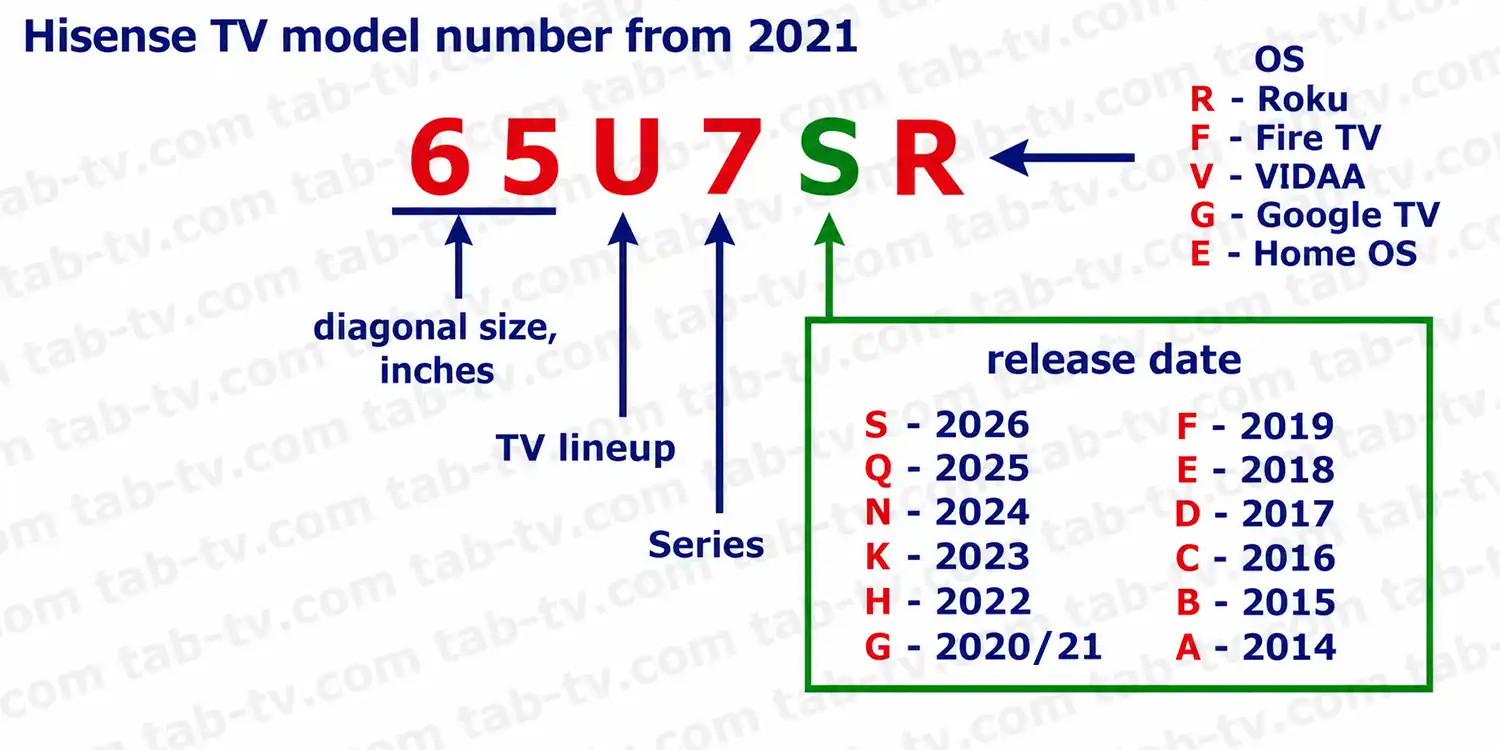
| Part | Meaning | Possible values |
|---|---|---|
| 65 | Screen size in inches | 32, 43, 50, 55, 65, 75, 85, etc. |
| U | Product line | U, E, A, QD, S and others |
| 7 | Series | 4, 5, 6, 7, 8, 9 |
| S | Year of release | G – 2021; H – 2022; K – 2023; N – 2024; Q – 2025; S – 2026 |
| R | Operating system (OS) | R – Roku TV; F – Fire TV; V – VIDAA; G – Google TV; E – Home OS |
Generally, the last letter indicates the TV’s operating system; however, Hisense sometimes releases TVs with a “G” but featuring the ViDAA TV OS instead of Google TV. Therefore, this letter should be considered a general guideline rather than a guarantee. Always check the technical specifications of the specific TV model before purchasing.
Hisense TV Model Numbers and Their Meaning
The letter after the screen size identifies the TV line, indicating its general class and display technology. The digit following the letter indicates the series within that line: generally, a higher number means a higher-tier model (for example, U8 sits above U7). However, numbers from different lines cannot be compared directly because each line has its own positioning. For example, A7 and U7 belong to different product categories.
| Line | Class | Technology |
|---|---|---|
| UX | Flagship | RGB MiniLED |
| MX | Ultra-premium | MicroLED |
| UR | Premium (since 2026) | RGB MiniLED |
| U | Main ULED line | MiniLED and QLED, depending on the series and model |
| E | Mainly European midrange and gaming models | QLED; MiniLED on selected models, such as E8 |
| QD | More affordable QLED line (since 2025) | QLED; MiniLED on selected models, such as QD7 |
| A | Affordable mainstream line | LED and QLED; OLED on selected models, such as A85 |
| S | Lifestyle TVs | QLED with a matte screen on CanvasTV models |
| R | Roku TV line, mainly in the US | LED and QLED; specifications vary by series |
| H | Older and budget-oriented model families | LED and QLED, depending on the model |
| L, PX | Laser TVs and projectors | Laser projection technology |
The product lines serve as a general guide for Hisense TVs, rather than a strict technical classification. Display technology, features, and positioning may vary depending on the year of manufacture, screen size, and regional version. For example, not all U-series TVs are equipped with MiniLED technology, and not all A-series TVs are LED models.
Year of Release Based on the Letter in the Model Number
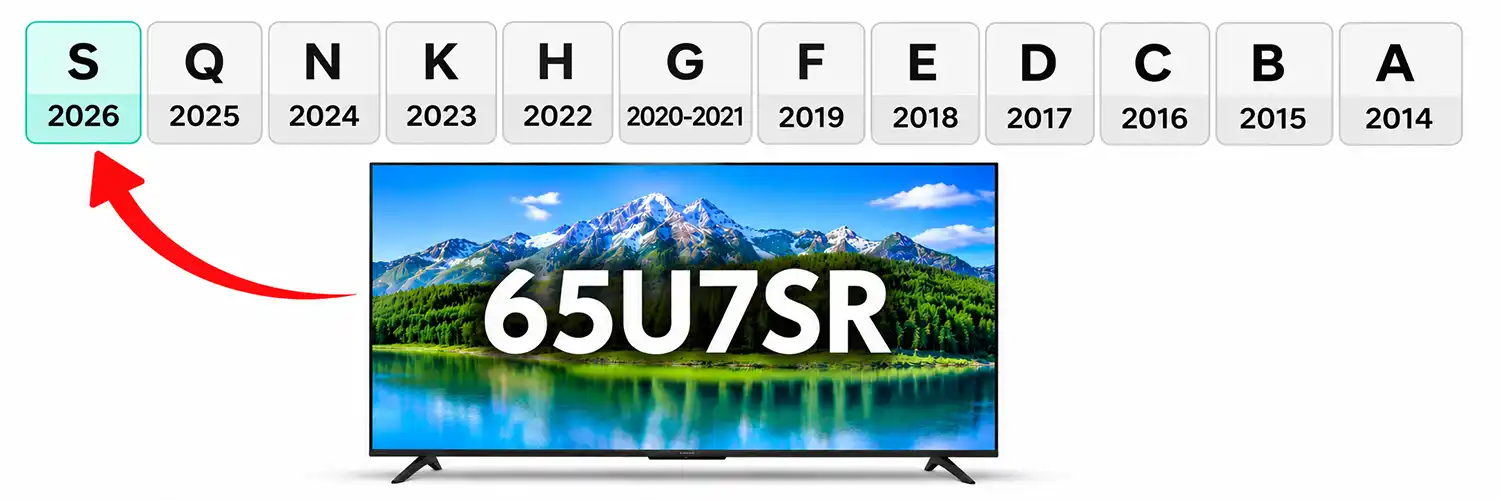
The letter in the model number indicates the year of release. It appears after the digits that identify the TV model.
Previously, Hisense sometimes released TVs designated for the following year before that year actually began. This practice is no longer relevant to current models, whose year codes correspond to their release year.
| Letter | Year of Release |
|---|---|
| S | 2026 |
| Q | 2025 |
| N | 2024 |
| K | 2023 |
| H | 2022 |
| G | 2020-2021 |
| F | 2019 |
| E | 2018 |
| D | 2017 |
| C | 2016 |
| B | 2015 |
| A | 2014 |
Old Hisense TV Model Numbers Until 2021
As mentioned earlier, Hisense did not have a unified system for assigning model numbers to its TVs until 2021. This was largely due to the company’s focus on TV manufacturing through outsourcing, with model numbering varying across markets and product lines. Although this situation has gradually changed, Hisense still adapts its TV lineup to the requirements of individual markets as it expands its global presence.
For example, in the US, Hisense sells TVs with several operating systems, including its own VIDAA OS, Fire TV, Roku TV, and Google TV. In its home market of China, the company also uses the VIDAA brand for its TVs.
Because of these differences, Hisense TV model numbers used before 2021 followed various formats and were difficult to classify under a single system. Below are examples of the model number formats used for older Hisense TVs.

Decoding the Old Hisense TV Model Number 55H9050E
When Hisense expanded into international markets, it used different model number formats for its TVs. The example below shows how to decode one of the older Hisense TV model numbers.
- 55 – TV screen size in inches.
- H – TV version or target market:
- H – Hisense Smart TV (US).
- R – Roku TV.
- P – TVs for Australia.
- O – TVs for Japan.
- E – TVs for China.
- 9 – TV series.
- 050 – Design identifier. This part may be absent in some TV models.

What year is 50M7000UW?
HM65K560X3D
What is the code for a 50A7300FTUK, can I use it on my Sky remote?
2018/2019
What model is 55k305pw
2015
What year model is 50k321uw
An ordinary TV is inferior in quality to a Samsung or LG
Is HISENSE H55U8B good to buy
2020 model, budget model, produced for Asia and Australia.
Comments are closed.