
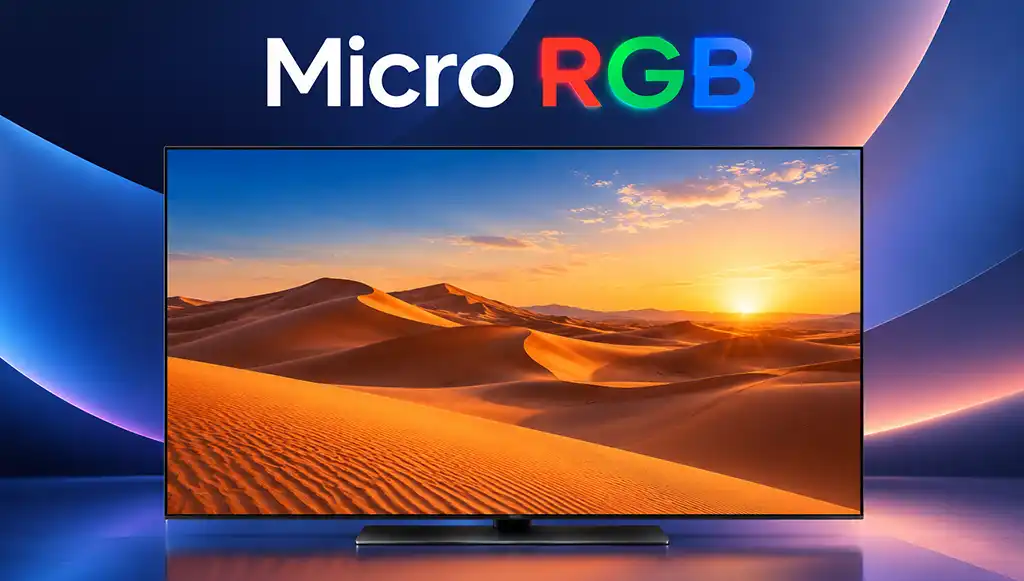
In 2026, several major TV manufacturers began producing models with Micro RGB backlighting. This is not the first attempt to improve TV backlighting. Previously, there were technologies such as Dual LED, which uses two types of LEDs with different color characteristics—blue and white LEDs—and Mini LED, which uses a large number of small LEDs. Micro RGB takes a different approach: instead of traditional white or blue backlighting, it uses three types of LEDs—red, green, and blue—which combine to produce white light. Each color can be adjusted separately.
The RGB LEDs are grouped to illuminate specific areas of the screen. Each group illuminates a cluster of pixels and functions as a local dimming zone. Thanks to the separate control of the three colors, the TV can adjust the backlight in each zone and reduce unwanted light bleed.
There is a common misconception that each LED illuminates a single pixel. This is not the case. Modern displays with Micro RGB technology use groups of LEDs to illuminate areas containing multiple pixels. Although manufacturers are working on implementing pixel-level backlighting, such displays have not yet entered mass production.
Manufacturers use different names for their TVs, even when they use panels from the same suppliers. This is particularly noticeable when it comes to screen sizes. CSOT, a subsidiary of TCL, and BOE are the two largest manufacturers of panels for large TVs. That’s why TCL and Sony TVs have similar screen sizes. Sony and TCL have also signed strategic partnership agreements covering their home entertainment businesses. Under the agreement, TCL will hold a 51% stake, and Sony will hold a 49% stake in the new company.
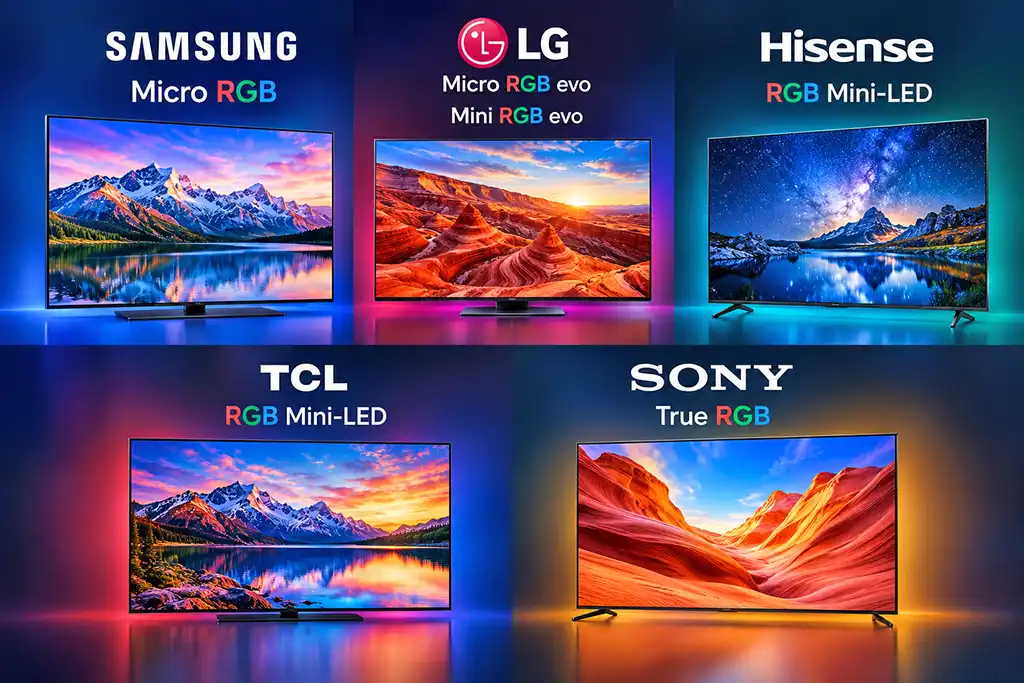
Manufacturers have given their RGB-backlit TV lines their own names. Samsung calls its technology Micro RGB, LG uses Micro RGB evo and Mini RGB evo, Hisense and TCL use RGB Mini-LED, and Sony calls its system True RGB. Essentially, these are displays with three-color backlighting and controllers capable of managing each color independently.
RGB TVs by Manufacturer and Region in 2026
| Manufacturer | USA | Europe | Australia | Middle East | South America |
|---|---|---|---|---|---|
| Samsung | R85H 55″, 65″, 75″, 85″, 100″ R95H 65″, 75″, 85″ MR95F (previous generation) 115″ | R85H 55″, 65″, 75″, 85″, 100″ R95H 65″, 75″, 85″, 115″ | R85H 55″, 65″, 75″, 85″ R95H 65″, 75″, 85″, 115″ | R85H 55″, 65″, 75″, 85″, 100″ R95H 65″, 75″, 85″ R95F (previous generation) 115″ | R85H 55″, 65″, 75″ R95H 85″ |
| LG | MRGB95 (Micro RGB evo) 75″, 86″, 100″ | MRGB96B (Micro RGB evo) 75″, 86″, 100″ MRGB86B / MRGB87B / MRGB88B (Mini RGB evo) 50″, 55″, 65″, 75″, 86″ | MRGB96 (Micro RGB evo) 75″, 86″, 100″ | MRGB95 (Micro RGB evo) 100″ | MRGB85 (Mini RGB evo) 55″, 65″, 75″, 86″ |
| Hisense | UR9S 65″, 75″, 85″ UR8S 55″, 65″, 75″, 85″, 100″ 116UXS (shown at CES 2026) 116″ | UXQ (previous generation) 100″, 116″ UR9S 65″, 75″, 85″ UR8S / UR8DS 55″, 65″, 75″, 85″, 100″ | UX (previous generation) 100″, 116″ UR9S 65″, 75″, 85″ UR8S 55″, 65″, 75″, 85″, 100″ | UR9S 65″, 75″, 85″ UR8S 65″, 75″, 85″ 116UXS (shown at CES 2026) 116″ | 116UX (previous generation) 116″ |
| TCL | RM9L 85″, 98″, 115″ | RM9L 85″, 98″, 115″ RM7L 65″, 75″, 85″, 98″ | — | RM9L 85″, 98″, 115″ RM7L / Q7D 65″, 75″, 85″, 98″ | — |
| Sony | BRAVIA 9 II 65″, 75″, 85″, 115″ BRAVIA 7 II 50″, 55″, 65″, 75″, 85″, 98″ | BRAVIA 9 II 65″, 75″, 85″, 115″ BRAVIA 7 II 50″, 55″, 65″, 75″, 85″, 98″ | BRAVIA 9 II 65″, 75″, 85″, 115″ BRAVIA 7 II 50″, 55″, 65″, 75″, 85″, 98″ | BRAVIA 9 II 65″, 75″, 85″, 115″ BRAVIA 7 II 50″, 55″, 65″, 75″, 85″, 98″ | — |
Pay attention to LG’s technology names
LG uses the names Micro RGB evo and Mini RGB evo to refer to different technologies. The Micro RGB evo (MRGB95) technology uses separate, independently controllable RGB light sources. Mini RGB evo technology (MRGB86, MRGB87, MRGB88), on the other hand, is based on Tandem LED technology. According to LG, it uses a multi-layer RGB architecture without individually controllable red, green, and blue LEDs.
A teardown of the TV conducted by the French publication AVCesar revealed the presence of only a single LED strip along the bottom of the screen, without a controller for individual colored LEDs. This means that the light produced by the backlight is white and then passes through filters, as in conventional LCD TVs. LG responded that this type of backlighting produces a purer white light with clearly separated red, green, and blue components, but it lacks local dimming.
What are the benefits?
RGB LED backlighting allows TVs to reproduce a wider range of colors. For example, TCL claims that its RM9L model covers 100% of the BT.2020 color space and achieves a peak brightness of up to 9,000 nits. LG specifies 100% coverage of both DCI-P3 and Adobe RGB for its Mini RGB evo series models.
Another advantage is brightness: TVs with RGB LED backlighting can deliver higher brightness because they have more LEDs than traditional displays. Additionally, they use light more efficiently, as there is less light loss through the color filters.
How the Models Differ in Terms of Specifications
Refresh rate. Hisense claims the highest refresh rate at 180 Hz, while the Samsung R95H and LG MRGB95 reach a maximum of 165 Hz. TCL supports 144 Hz, and Sony supports 120 Hz. These refresh rates are available only through HDMI connections from game consoles and depend on the type of processor installed in the TV.
Brightness. The highest advertised brightness figures belong to the TCL RM9L (9,000 nits) and Hisense UR9S (5,000 nits). However, tests show that the Sony BRAVIA 9 II is brighter, offers higher contrast, and provides more precise dimming control than the Samsung R95H. This means that advertised brightness figures alone do not determine picture quality.
HDMI and Gaming. The Samsung R95H offers full HDMI 2.1 support on all four inputs, while the Sony BRAVIA 9 II provides it on only two. On the BRAVIA 7 II, VRR and 4K/120 Hz are also supported on only two of the four ports. If you connect multiple consoles and PCs, the number of fully supported HDMI ports is more important than the difference between 165 Hz and 180 Hz.