

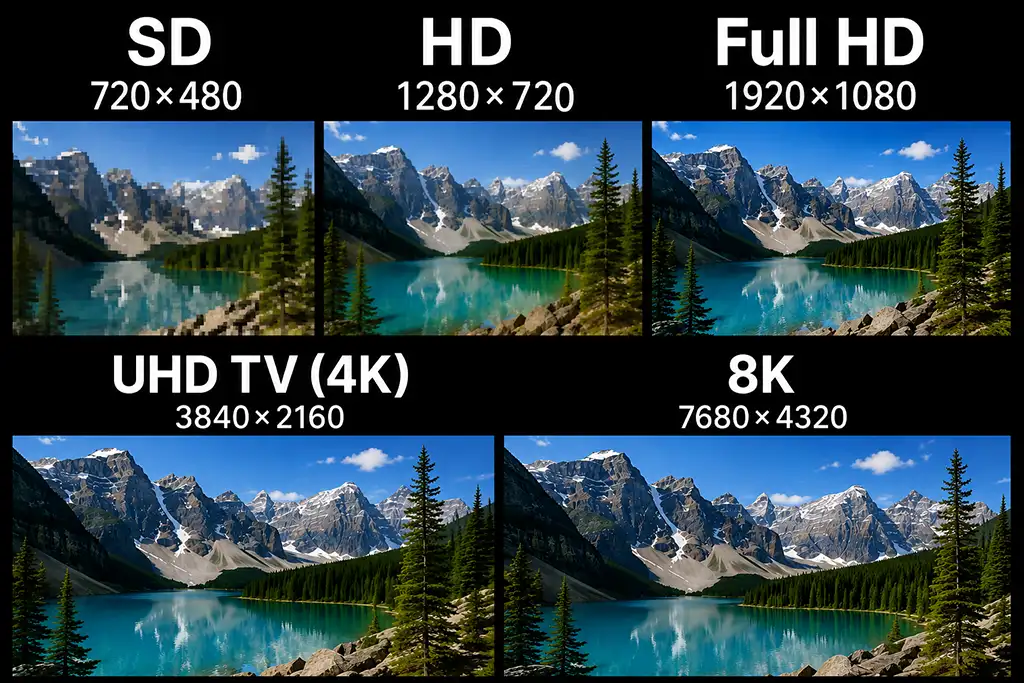
A TV’s resolution is the number of pixels that make up the image displayed on the screen. As TV screen sizes have become larger, higher resolutions have been required to maintain image quality, allowing viewers to sit closer to the screen without noticing individual pixels. The more pixels a display has, the sharper and more detailed the image appears.
A pixel is the smallest element of an image that contains color information. Each pixel consists of three or four subpixels that represent the primary colors—red, green, and blue. Some manufacturers also produce panels with an additional subpixel. For example, LG’s OLED panels include a white subpixel to increase brightness, while Sharp’s Aquos LED panels featured an additional yellow subpixel. These additional subpixels do not receive separate image data; instead, their values are calculated from the information contained in the three primary color channels.
SD resolution, SD TV

SD (Standard Definition) is the oldest television resolution format, typically with a resolution of 720 × 480 pixels (NTSC) or 720 × 576 pixels (PAL and SECAM). It was the standard for analog television broadcasting and was also used for DVDs. There are both analog and digital SD standards, although the term SDTV is generally used to refer to the digital version.
On modern TVs, SD content appears noticeably blurry because it contains relatively little image detail. When displayed on high-resolution screens, the image must be enlarged, but the limited number of original pixels cannot provide enough detail for a sharp picture.
Today, the SD format is considered obsolete and is rarely used for broadcasting or creating new content. However, it can still often be found on older media, such as videotapes and DVDs.
In the photo, you can see a screenshot from the TV broadcast; the video is being streamed in 576i mode (576 lines, interlaced scan, 16×9 aspect ratio, SD quality).
HD TV resolution

HD (High Definition) has a resolution of 1280 × 720 pixels and is commonly referred to as 720p. You may also come across the designation 1080i, although it is rarely used. Compared to SD, HD provides a much sharper image with better definition and more visible detail.
The HD format emerged with the introduction of digital television and the start of digital broadcasting. As SD resolution became insufficient for the growing demands of digital content, HD began to be adopted. However, its time as the primary standard was relatively short, as it was eventually replaced by higher-resolution formats. Even so, HD is still used in some television broadcasts and online videos.
Full HD TV
Full HD (FHD) has a resolution of 1920 × 1080 pixels and is also known as 1080p. It provides more than twice as many pixels as HD, resulting in a significantly sharper and more detailed image. For many years, Full HD was the standard resolution for TVs, Blu-ray discs, game consoles, and other video equipment. Video recorded in this resolution offers a high level of detail and is well suited for viewing on virtually any display.
This TV screen resolution format remained the standard until the mid-2010s. With the introduction of UHD displays, however, Full HD has become much less common in televisions. Despite this, it has not lost its relevance, as most video is still produced in Full HD because it provides an optimal balance between image quality and the amount of data that needs to be transmitted.
UHD TV resolution
UHD (4K) TVs have a resolution of 3840 × 2160 pixels, providing four times as many pixels as Full HD. These TVs began appearing between 2015 and 2016, following the widespread transition of panel manufacturers to 4K display production. Today, UHD (4K) is the dominant TV resolution and is widely supported by streaming services, game consoles, and Ultra HD Blu-ray discs. The latest ATSC 3.0 (Advanced Television Systems Committee) broadcasting standard, adopted in the United States and several other countries, also supports 4K resolution.
Much of today’s video content is produced in 4K. Nature documentaries are often recorded and presented in native 4K to preserve maximum detail. Feature films are also commonly shot at this resolution, but the image is typically processed during post-production to soften excessive detail. This is done because native 4K capture can reveal skin imperfections on actors’ faces that viewers may find distracting. Overall, UHD (4K) has become the most widely used resolution for both video production and playback.
8K TV resolution
8K has a resolution of 7680 × 4320 pixels, which is four times the number of pixels in UHD (4K) and sixteen times that of Full HD. This extremely high resolution delivers exceptional image detail on very large screens, although the amount of 8K content remains limited. While there are cameras capable of shooting in 8K, there is virtually no content available in this resolution.
When 8K TVs first appeared in 2018, many people noted that there was no noticeable difference in picture quality between 4K and 8K TVs when watching television. Despite the relatively high cost of manufacturing 8K panels, they were sold at cost, and the TVs themselves were positioned as premium models. However, in 2025, panel manufacturers shut down their production lines for these panels due to low profitability, and the production of 8K TVs was discontinued. The 8K format still exists, but it is rarely used because it is considered excessive.




Thanks
You have a spelling error on your web page. You have “HDTV (High Definition TeleVision) — Image resolution: 108х720. It is customary to call an image or an HD screen if the resolution is 1080 × 720.” and the 108×720 should actually be 1080×720.