
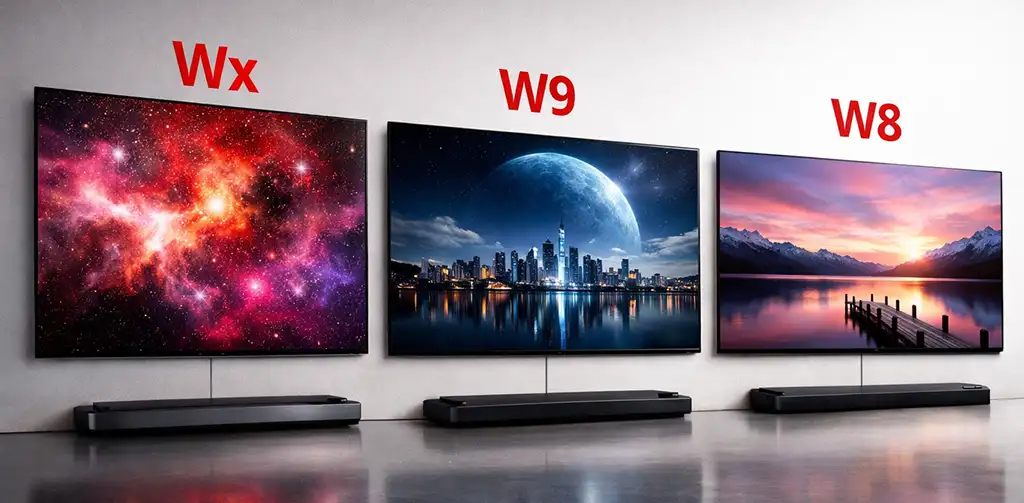
The LG OLED W Series is a line of premium TVs featuring a design in which the display and the control unit are separate, with the display connecting to the control unit via a special cable. Across all model generations from 2018 to 2020—the W8, W9, and WX—the overall concept and design have remained virtually unchanged.
The OLED65WXPUA, OLED65W9PUA, OLED65W8PUA, OLED77WXPUA, OLED77W9PUA, and OLED77W8PUA models are intended for the North American market, including the United States, Canada, and Mexico. The OLED65WXPLA, OLED65W9PLA, OLED65W8PLA, OLED77WXPLA, OLED77W9PLA, and OLED77W8PLA are intended for the European market. These versions are virtually identical in terms of hardware and features, with the main difference being the supported broadcast standards—that is, the digital tuners—depending on regional requirements.
LG OLED series сomparison (W8 vs W9 vs WX)
| Feature | LG OLED WX (2020) | LG OLED W9 (2019) | LG OLED W8 (2018) |
|---|---|---|---|
| Screen | |||
| Screen Size | 65″, 77″ | 65″, 77″ | 65″, 77″ |
| Design | Flat Panel | Flat Panel | Flat Panel |
| Resolution | 4K Ultra HD (3840×2160) | 4K Ultra HD (3840×2160) | 4K Ultra HD (3840×2160) |
| Panel Bit Depth | 10-bit | 10-bit | 10-bit |
| Panel Type | WRGB OLED | WRGB OLED | WRGB OLED |
| Backlight | No (self-emissive) | No | No |
| Dimming | Pixel-Level Dimming | Pixel-Level Dimming | Pixel-Level Dimming |
| Video | |||
| Refresh Rate | 120 Hz | 120 Hz | 120 Hz |
| Color Technologies | Advanced Color Enhancer, True Color Accuracy Pro | Same | Same |
| Contrast | Ultra Luminance Pro, Object Depth Enhancer | Same | Same |
| Clarity | Quad Step Noise Reduction | Same | Same |
| Upscaling | AI 4K Upscaling | 4K Upscaling | 4K Upscaling |
| HDR | Dolby Vision, HDR10, HLG, Dolby Vision IQ, Dynamic Tone Mapping Pro | Dolby Vision, HDR10, HLG, Technicolor HDR | Dolby Vision, HDR10, HLG, Technicolor HDR |
| Processor | α9 Gen 3 | α9 Gen 2 | α9 Gen 1 |
| AI / Smart Features | |||
| LG ThinQ AI | Yes | Yes | Yes |
| Alexa | Built-in | Supported (update required) | Supported (external device) |
| Google Assistant | Built-in | Supported (update required) | Supported (external device) |
| Apple AirPlay 2 / HomeKit | Yes | No | No |
| AI Picture Pro | Yes | No | No |
| Gallery Mode | Yes | No | No |
| Home Dashboard | Yes | No | No |
| Voice Control (Hands-Free) | Yes | No | No |
| Smart TV Platform | |||
| OS | webOS 5.0 | webOS 4.5 | webOS 4.0 |
| Remote | Magic Remote | Magic Remote | Magic Remote |
| App Store | LG Content Store | LG Content Store | LG Content Store |
| Web Browser | Yes | Yes | Yes |
| Audio | |||
| Audio Format | Dolby Atmos | Dolby Atmos | Dolby Atmos |
| DTS Support | No / Limited | Yes | Yes |
| Output Power | 60W (4.2ch, 20W woofer) | Same | Same |
| Bluetooth Audio | Yes | Yes | Yes |
| WiSA Ready | Yes (requires dongle) | Yes (requires transmitter) | No |
| Gaming Features | |||
| G-SYNC | No | No | No |
| VRR | No | No | No |
| Response Time | ~1 ms | ~1 ms | ~1 ms |
| FreeSync | No | No | No |
| ALLM | Yes | No | No |
| HGiG | Yes | No | No |
| Connectivity | |||
| ATSC 3.0 (NextGen TV) | Yes | No | No |
| Wi-Fi | Yes | Yes | Yes |
| Bluetooth | 5.0 | 5.0 | 4.2 |
| HDMI | 4 × HDMI 2.1 | 4 × HDMI 2.1 | 4 × HDMI 2.0 |
| ARC | eARC | ARC | ARC |
| USB | 3 | 3 | 3 |
| Ethernet | Yes | Yes | Yes |
| Optical Audio Out | Yes | Yes | Yes |
| Satellite Input | EU only | EU only | EU only |
Image quality and hardware
All three generations use the same WRGB-structured OLED panels, meaning each pixel consists of 4 subpixels, with 10-bit color depth, 4K resolution, and a 120 Hz refresh rate. OLED panels are manufactured using the same technology but may have some differences as LG continuously improves them; however, all OLED panels released between 2017 and 2020 belong to the third generation of OLED panels.
The differences are mainly related to software improvements. Although LG has stated that the W8 model is equipped with an α9 Gen 1 processor, the W9 model with an improved α9 Gen 2 processor, and the WX model with an α9 Gen 3 processor, these are actually physically identical processors manufactured by MediaTek, and the “generations” are merely a marketing strategy.
Streaming Features and AI Capabilities
The most notable differences between the models lie in their smart features. The WX series represents a significant upgrade: it runs on webOS 5.0 and offers full integration with modern smart home systems. It features built-in voice assistants—Alexa and Google Assistant—with remote-free voice control, as well as support for Apple AirPlay 2 and HomeKit. Additional features, such as AI Picture Pro, Gallery mode, and Home Control Panel, transform the TV into a smart home hub. The built-in microphone allows you to control the device using your voice without a remote.
The W9 model, running on webOS 4.5, offers partial support for voice assistants; you need to configure specific settings via the LG ThinQ app, and voice control is available only via the remote. In future OS updates, LG promises to implement direct integration with Alexa and Google.
The W8 model, running on webOS 4.0, requires special settings for voice assistants; compared to newer models, this one feels somewhat outdated.
Differences in connectivity, gaming features, and audio
Connectivity and gaming features show clear progress from generation to generation. The WX is the most advanced model, offering full HDMI 2.1 support with features such as eARC for improved audio transmission and ALLM for automatic low-latency mode in games. It also supports ATSC 3.0, the new broadcasting standard.
The W9 is equipped with HDMI 2.1 ports but lacks full feature support, making it less future-proof. It also lacks eARC and modern gaming enhancements. The W8 model is equipped with HDMI 2.0 ports, which are considered outdated primarily due to support for older versions of HDCP.
As for audio, all three models are equipped with identical 60-watt sound systems with Dolby Atmos support. However, DTS support is present in the W9 and W8 models, while the WX lacks it. The WX also expands wireless audio capabilities with WiSA support, though this requires additional equipment.