
Over the past decade, Samsung has used a variety of names for its premium TVs: SUHD, QLED, Neo QLED, QD-OLED, and now Micro RGB. Some of these terms reflect actual technological changes, while others are primarily marketing names. This guide explains what each term means, how they differ from one another, and which ones still matter when buying a TV today.
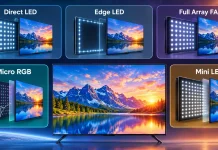
SUHD and QLED are LCD TVs with a layer of quantum dots. Neo QLED uses the same basic concept but with significantly improved Mini LED backlighting. QD-OLED is a different technology in which each pixel generates light independently. In 2026, Samsung positioned its Micro RGB lineup above Neo QLED, making it the flagship line of its backlit LCD TVs.
What Are Quantum Dots?
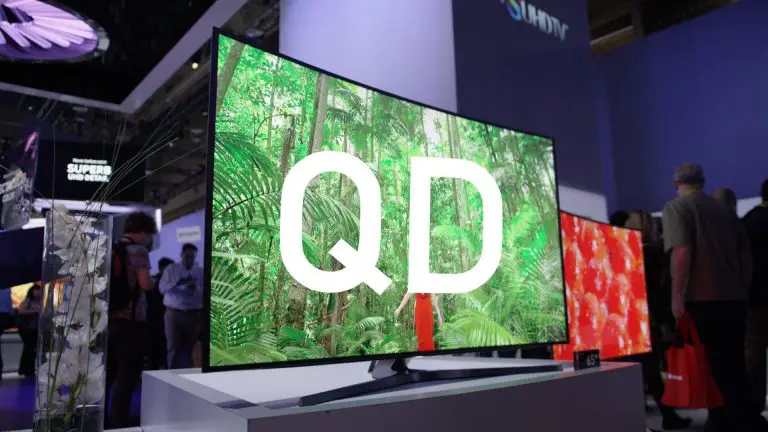
Quantum dots are tiny semiconductor crystals just a few nanometers in diameter. When light passes through them, they emit light in a very precise color, depending on their intended function. In a TV, a layer of quantum dots converts the blue backlight into pure red, blue, and green colors. The result is purer colors, a wider color gamut, and better brightness compared with a standard LED-backlit LCD TV.
That said, quantum dot technology can vary significantly. The generally accepted standard involves installing a separate film, as specified by the IEC standard, but many manufacturers interpret the concept of quantum dots in their own way.
An important detail is that in SUHD, QLED, and Neo QLED TVs, quantum dots only improve color reproduction, while the image itself is still formed by a conventional liquid crystal layer. The pixels do not consist of quantum dots.
Generations of Samsung TVs with quantum dots
The generations of Samsung’s quantum dot TVs are divided as follows:
- SUHD TVs (2015-2016): The first generation of quantum dot TVs, positioned to provide higher picture quality than traditional LED displays.
- QLED TVs (2017 onwards): The second generation of quantum dot TVs, initially positioned as the next evolution with super screens. Despite the evolution, by 2020, QLED TVs have moved from the high-end category to the budget and mid-range TV category.
- Neo QLED TVs (from 2019): The third generation of quantum dot TVs. In 2019, a significant advancement was the introduction of Neo QLED TVs with 8K resolution. The subsequent 2020 release included the Neo QLED series with 4K resolution, positioning these TVs as mid to high-end TVs, and with the release of Samsung’s OLED TVs, QLEDs took the second tier in the TV hierarchy.
The future of Samsung’s QLED TVs
The trajectory of Samsung’s QLED TV technology appears uncertain despite the advertised support for a 10-bit color depth, promising 1 billion colors in their premium displays. In 2021, Samsung’s decision to divest its LED and QLED screen factory to China’s TCL raises questions about the future of this technology.
Historically, significant divestments of extensive production facilities often occur either at the peak of their value or when the future is deemed particularly risky. Analogous situations, such as Toshiba’s exit from the TV business and the subsequent sale of its division to China’s Hisense, lend context to Samsung’s strategic move.
The rationale behind Samsung’s sale of its extensive LED panel factory becomes evident when considering that LED (QLED) technology has likely reached its zenith. Following the introduction of new materials based on quantum dots, substantial advancements in this technology have been elusive. While QLED displays will continue to enjoy demand for their durability and cost-effectiveness, the future appears to favor OLED screens. The only impediment to OLED’s global competitiveness against QLED displays remains the pricing of the panels. If manufacturers successfully reduce the cost of OLED technology, a widespread transition to such panels may be on the horizon.