
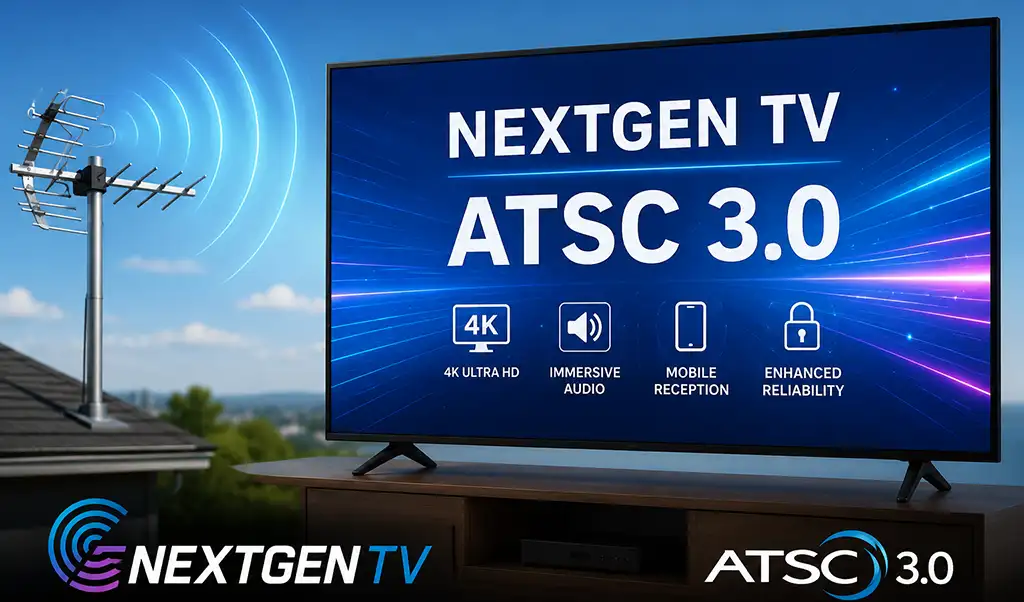
In the U.S., you’ll often encounter two terms: NEXTGEN TV and ATSC 3.0. A lot has been written about them, but it’s not always clear whether they are actually different. Here’s what you need to know.
ATSC 3.0 is the next, third-generation standard for terrestrial (over-the-air) broadcasting, designed to replace the first-generation ATSC 1.0. The ATSC 2.0 standard was in development but became obsolete before it was ever implemented, and its advancements were incorporated into ATSC 3.0.
NEXTGEN TV (Next Generation TV) is a brand name used by the Consumer Technology Association in the U.S. to refer to TVs that can receive ATSC 3.0 broadcasts. There is no separate technology or broadcast standard behind the name. Even the official NEXTGEN TV website notes that the available features depend on the device and the broadcaster, as commercial services roll out in local markets.
In other words, all the actual TV features come from the ATSC 3.0 standard, not from the NEXTGEN TV name. Still, it’s a catchy and marketable name that TV manufacturers happily use.
- Site NextGen: https://www.watchnextgentv.com/
- Site ATSC: https://www.atsc.org/
TSC 3.0 (NEXTGEN TV), features, adoption, and antenna requirements
ATSC 3.0, marketed as NEXTGEN TV, is the latest digital television broadcasting standard developed to replace ATSC 1.0. Its development began in response to the rapid adoption of 4K televisions and the introduction of High Dynamic Range (HDR) technology in 2015–2016. The previous ATSC 1.0 standard was designed for Full HD broadcasting and could not support UHD resolution, HDR, advanced audio formats, or many modern broadcast features. ATSC 3.0 was created to meet these new technical requirements and provide a platform for future television broadcasting.
The standard supports broadcasts in resolutions from SD and HD up to 4K Ultra HD, with frame rates of up to 120 frames per second. It is also compatible with HDR technologies, including Hybrid Log-Gamma (HLG) and Perceptual Quantizer (PQ), allowing for higher contrast, improved brightness, and a wider color range.
Audio capabilities have also been significantly upgraded. ATSC 3.0 supports Dolby AC-4 and MPEG-H 3D Audio, enabling immersive surround sound, object-based audio, and improved speech clarity.
Another important feature is an enhanced emergency alert system. Compatible televisions can receive emergency notifications even while in standby mode, provided they remain connected to power and the broadcast signal. When an alert is received, the TV can automatically display the emergency message.
ATSC 3.0 is designed to coexist with existing broadcast formats, allowing stations to continue transmitting SD and HD content while gradually introducing new services. This makes the transition to the new standard more flexible for both broadcasters and viewers.
South Korea became the first country to launch commercial ATSC 3.0 broadcasts in 2017. The United States began deployment in 2020, where adoption remains voluntary and broadcasters can transition according to their own schedules.
To receive ATSC 3.0 (NEXTGEN TV) broadcasts, a compatible television or external ATSC 3.0 tuner and an over-the-air (OTA) antenna are required. Since the standard uses terrestrial television broadcasts, reception depends on the strength of the local broadcast signal and the type of antenna used. Indoor antennas may be sufficient in areas with strong coverage, while outdoor antennas generally provide better reception in locations farther from broadcast transmitters.