

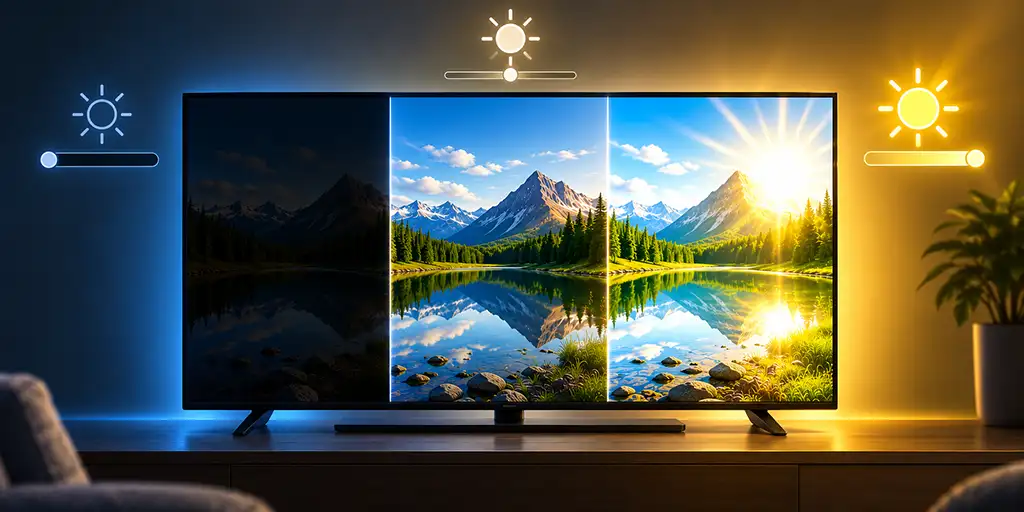
The technical specifications for televisions and monitors often include several brightness-related values. Manufacturers typically highlight peak brightness and typical brightness, but these figures can be confusing without understanding how they are measured and what they represent in real-world use.
So, what do these brightness ratings actually mean for the viewer, and how should they be interpreted? This article explains the differences between the three main brightness measurements used for modern displays: peak brightness, typical brightness (often referred to simply as brightness), and minimum brightness. Although these are presented as separate specifications, they all describe the same characteristic—screen brightness—measured under different test conditions.
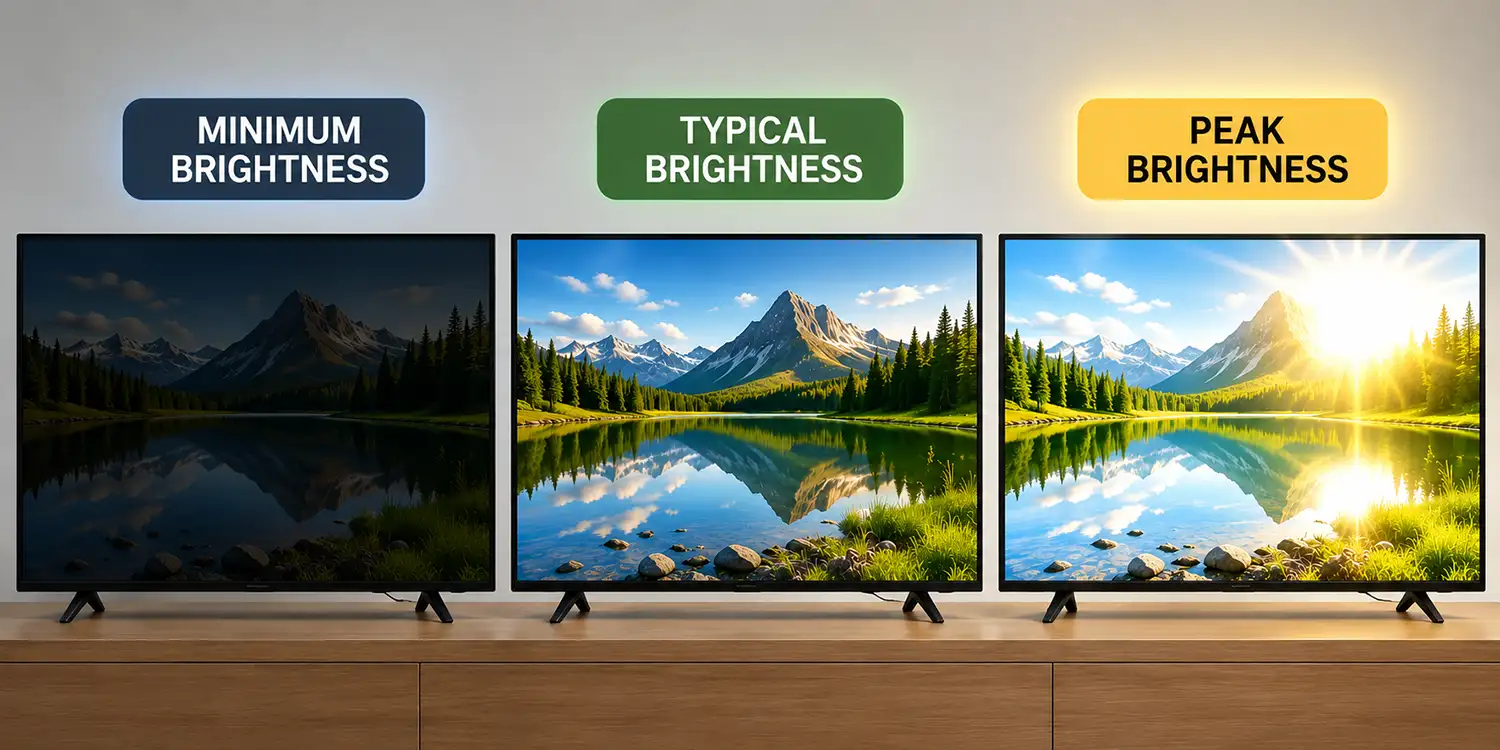
Typical (Standard) Screen Brightness
Typical brightness is the standard level of brightness that a television or monitor delivers during everyday use. It reflects the screen’s performance with normal picture settings—the settings most people use when watching television, movies, or other content.
On most TVs, these settings correspond to a brightness level of around 50 and a contrast level between 80 and 100, although the exact values vary by manufacturer and picture mode.
For modern televisions and monitors, typical brightness usually falls within the range of 300 to 400 cd/m² (candelas per square meter). Some manufacturers still express brightness in nits, an older term that is technically equivalent to cd/m². In this article, we use cd/m², the official SI unit for luminance.
Typical brightness is the most useful specification for everyday viewing because it represents the brightness level you will experience under normal operating conditions. Unlike peak brightness, which is achieved only in specific situations, typical brightness provides a much more realistic indication of how bright a TV or monitor will appear during regular use.
Peak Screen Brightness
Peak brightness is the highest level of brightness a TV or monitor can produce under test conditions. It is typically measured with both brightness and contrast set to their maximum values while displaying a full white test image or, more commonly, a small white test window.
In everyday use, the screen almost never displays content under these conditions, so the advertised peak brightness is rarely achieved during normal viewing. Manufacturers often emphasize this specification in marketing materials—for example, promoting a TV with a peak brightness of 2,000 cd/m²—without explaining the exact testing methodology used to obtain that figure.
Although peak brightness can give a general indication of the display’s maximum light output, it is not the best measure of real-world performance. A higher peak brightness generally means the display has a more powerful backlight or, in the case of self-emissive displays, can produce brighter highlights. However, it does not indicate how bright the screen will appear during everyday viewing.
For OLED displays, manufacturers are often more cautious about advertising peak brightness. While OLED panels can produce very bright highlights for short periods, maintaining extremely high brightness for long durations increases heat generation, accelerates panel aging, and raises the risk of permanent image retention (burn-in). As a result, OLED TVs automatically limit brightness to protect the panel.
Minimum Screen Brightness
Minimum brightness is the lowest brightness level a TV or monitor can produce. It is measured with both brightness and contrast set to their minimum values while displaying a white image. For most displays, this level is approximately 100 cd/m², although the exact value depends on the model.
From a practical standpoint, minimum brightness is of little importance. It is rarely used outside of laboratory testing and has virtually no effect on normal viewing. For this reason, it should be regarded as a reference specification rather than a meaningful factor when comparing TVs or monitors.