

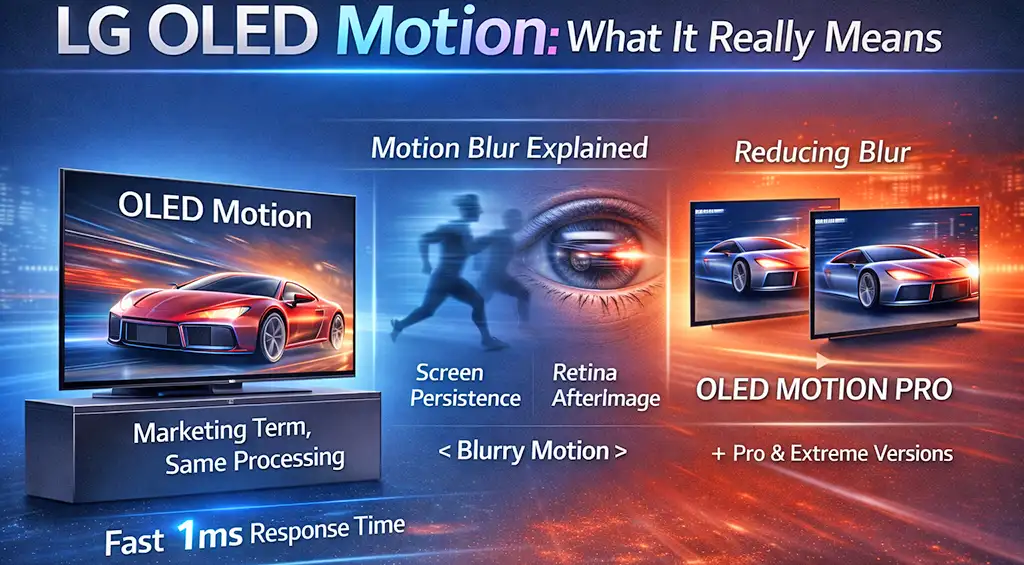
OLED Motion means that the TV’s software processes dynamic video very well. You may ask, what is the difference between motion processing on OLED and other TVs, such as LED? There is no difference—the same processors and software are used. This term exists solely for marketing purposes, and OLED Motion is essentially a marketing label.
How motion blur occurs
When a TV displays moving objects, some blurring occurs. You may even notice this while reading this article: if you move your mouse quickly across the screen, you will see several faint images of the cursor. These afterimages make the picture blurry. Blur is caused both by screen technology, which cannot change images instantly, and by human vision, as the image lingers on the retina for a short time and remains in the brain even after the object has moved.
TV manufacturers are trying to reduce motion blur with image processing software. For example, a black frame is inserted between frames for a short time, which changes the human brain’s perception of the image, making the motion smoother and less blurry. If you think that a real frame is being added, that’s not the case. The screen simply turns off the backlight for a few milliseconds, creating the effect of a black frame.
OLED Motion in LG TVs
OLED panels have an extremely fast response time. As soon as a pixel is turned off, the organic light-emitting diode stops emitting light. OLED panels have a response time of about 1 ms, so in practice, no additional processing is required — the response is so fast that it can be ignored. A black frame can still be added, or several identical frames can be displayed if the video has a low frame rate. In essence, OLED Motion is mainly a marketing ploy.
According to marketing research, something new must be presented every year, so OLED Motion becomes OLED Motion Pro.

Informative.Thankyou.