
Hisense TVs are manufactured by the Hisense Group, a Chinese corporation headquartered in Qingdao. The company produces not only TVs but also home appliances, air conditioners, and electronics. The group has been in existence since 1969, when it began as a radio manufacturer, and its current structure took shape in the 1990s.
The television business is managed by Hisense Visual Technology, while the production of home appliances is handled by Hisense Home Appliances Group (Hong Kong and Shenzhen). Historically, Hisense was a state-owned enterprise owned by the Qingdao municipal government. In late 2020, the company underwent a mixed-ownership reform, brought in a private investor, and reduced the state’s stake in the holding company.
Brands Used by Hisense
It is important to distinguish between brands Hisense owns and brands it licenses.
- Hisense — the group’s main brand.
- Toshiba (TVs) — in 2017, Hisense Electric agreed to buy 95% of Toshiba Visual Solutions for 12.9 billion yen (about 113 million dollars), with Toshiba keeping the remaining 5%. The deal closed in 2018. Hisense received a 40-year license to use the Toshiba brand on televisions. This was not a purchase of the whole Toshiba corporation, only of its TV division.
- Sharp (TVs in the Americas) — in 2015, Hisense bought Sharp’s Mexican factory for 23.7 million dollars and received a five-year license for the brand in the Americas, excluding Brazil. After Sharp came under the control of Foxconn, a conflict began. In 2017, Sharp filed lawsuits accusing Hisense of poor quality in TVs sold under its brand (in particular, violations of FCC rules and misleading advertising). In February 2018, Sharp withdrew the lawsuits, and in May 2019 it agreed to take the license back on undisclosed terms. Hisense made Sharp-branded TVs for the US from 2016 until May 2019. Since late 2019, Sharp has been selling TVs in the US on its own again, though its presence on the market remains modest. The Mexican factory stayed with Hisense.
- Gorenje and ASKO — Hisense acquired the Slovenian company Gorenje for 339 million dollars, and the deal was completed in August 2018. ASKO is part of Gorenje.
- Sanden — in March 2021, Hisense Home Appliances announced the purchase of about 75% of the voting rights in Sanden, a Japanese maker of automotive air conditioning systems.
- Hisense-Hitachi — a joint venture for commercial air conditioners, created in 2003.
- Kelon, Ronshen, Vidda — appliance and electronics brands aimed mainly at the Chinese market.
How Hisense Became a Global Name
Hisense started out as an OEM manufacturer for other companies’ brands. In the 2000s it launched its own brand and then began buying assets abroad, including Sharp in the Americas, Toshiba’s TV business in Japan and other markets, and Gorenje in Europe. These deals gave the company factories, technology and recognizable brands.
Today Hisense is among the largest TV brands in the world. According to Omdia data for 2025, Hisense ranks first globally in the segment of TVs 100 inches and larger (57.1% of shipments) and in the laser TV category (70.3%). These figures come from the company’s own press release.
Where Hisense TVs Are Assembled
The company places assembly close to its sales markets. This reduces logistics costs and helps avoid some import duties on finished TVs.
- China — the main production center, where the group’s principal factories are located.
- Mexico — the plant bought from Sharp in 2015 serves the North American market. According to Hisense, its size and capacity have tripled since the purchase.
- South Africa — Hisense opened its Atlantis manufacturing plant near Cape Town in 2013. The facility assembles televisions using imported display panels and mainboards and also manufactures refrigerators. It supplies the South African market and exports products to other African countries. The plant has an annual production capacity of up to one million TVs and 500,000 refrigerators.
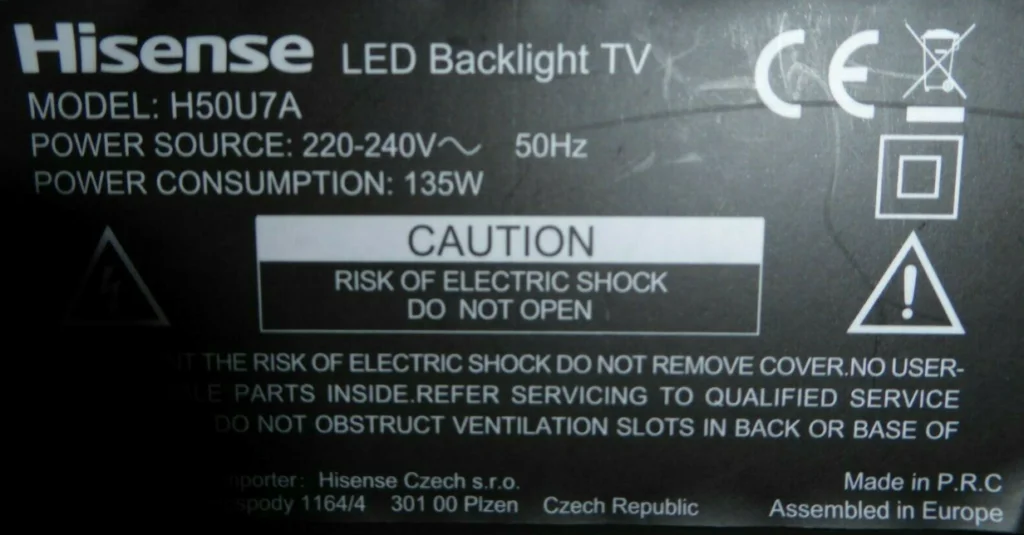
- Europe — Czech Republic, Hisense opened a TV factory in Plzeň in 2015, with an initial capacity of about 600,000 TVs per year. The plant later ceased TV production, and manufacturing was transferred to other facilities. The Czech company Hisense Czech was subsequently liquidated. Since 2021, Hisense has also produced TVs in Velenje, Slovenia, at the Gorenje site, with about 2.5 million TVs per year planned for the European market. The TV factory in Hungary was closed back in 2009 due to falling orders.
Which plant a particular TV comes from depends on the model, the sales market and the production date, so the country of assembly is best checked on the label.
According to Hisense itself, the group has 36–37 industrial parks and production bases (across all business lines, not just TVs), 30 research and development centers and 64 overseas offices.
Who Makes the Components and Panels
Hisense makes some components itself, but not the LCD panels. The company assembles LCD modules (the first line was launched in 2007), develops its own chip business and, in the Mini/Micro LED field, controls the LED chip maker Xiamen Changelight. The panels themselves are purchased. The company does not officially disclose its suppliers, but according to Omdia the main ones are BOE, AUO and HKC.
Production of large LCD panels is now concentrated in China. LG Display sold its last plant in Guangzhou to TCL CSOT (the deal closed on April 1, 2025), and Samsung Display sold CSOT its Suzhou plant back in 2021. According to TrendForce, BOE, CSOT and HKC now account for about two thirds of global large-format LCD panel production. CSOT belongs to TCL, Hisense’s main competitor, which is why independence from this supplier matters to Hisense.
The same model may be fitted with panels from different manufacturers in different countries or different batches, which is common practice in the industry. For this reason, reviews of a specific model should be matched to your region and hardware revision.
Hisense TV Brands and Technologies
Model lineups and numbers. Hisense sells different lineups in different regions, and model names and indexes in the US, Europe, Australia and Asia do not match. This makes comparison inconvenient, but it is typical of large manufacturers, which adapt to local broadcast standards, prices and certification.
ULED. This is Hisense’s marketing name for LCD TVs with local dimming, not a separate panel technology like OLED. Advertising sometimes presents ULED as superior to OLED, and this should be treated with caution. Modern Mini-LED (and RGB Mini-LED) TVs are usually brighter than OLED but fall behind it in black depth and viewing angles. Hisense also sells its own OLED models.
The Toshiba brand. The Toshiba TVs you see in stores are now tied to Hisense, which owns the business and the license. In some regions, agreements with Vestel and other partners existed separately, so the specific manufacturer should be checked in the model’s documentation.