
Until 2020, Samsung clearly specified the color depth of its TV panels, making it easy to determine whether a model featured a true 10-bit display. Since then, however, the company has shifted its marketing strategy. Instead of highlighting color depth, Samsung now promotes its QLED TVs with the simplified claim of “100% Color Volume.” But what does this actually mean, and how important is it when choosing a TV?
100% Color Volume with Quantum Dots, what does It mean?
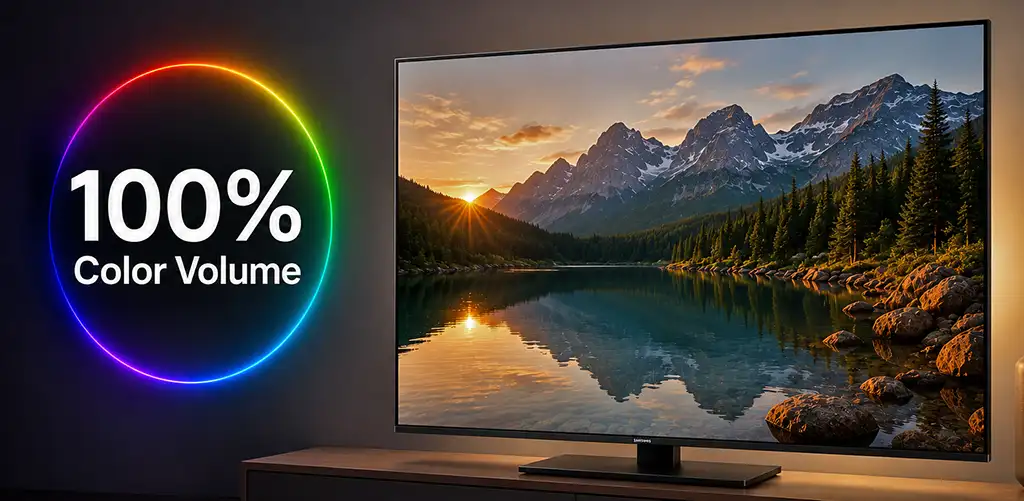
Samsung uses the “100% Color Volume with Quantum Dots” label to describe one of the characteristics of its QLED TVs. It refers to the display’s ability to maintain a wide range of colors at different brightness levels. Quantum dots improve color reproduction, allowing QLED TVs to display more saturated and consistent colors than conventional LED TVs, particularly in bright scenes.
Samsung states that some QLED TVs achieve 100% color volume in the DCI-P3 color space, as verified by VDE (Verband Deutscher Elektrotechniker). The certification measures color volume, which combines color gamut and brightness. It does not measure the panel’s color depth or indicate how accurately the TV reproduces every color. It is also important to note that this certification applies only to certain QLED models.
Because of this, 100% Color Volume does not mean that a TV has a native 10-bit panel. It also does not indicate the overall image quality or place one model above another.
How the term appeared
Until around 2020, Samsung’s specifications often included information about panel bit depth. Many TVs were described as displaying 1 billion colors, with a note explaining that this was achieved using Frame Rate Control (FRC).
FRC allows an 8-bit panel to simulate additional shades by rapidly alternating between neighboring colors. This technique produces smoother color transitions and has been widely used in the TV industry for many years. However, an 8-bit panel with FRC is not the same as a native 10-bit panel. Differences may become visible in HDR content, smooth gradients, and scenes with subtle transitions between dark shades.
Over time, Samsung gradually stopped publishing panel bit depth in its product specifications and shifted its marketing toward the 100% Color Volume label. As a result, TVs from different product lines and with different panel characteristics may all carry the same claim.
Each TV still has its own limitations in brightness, contrast, local dimming, HDR performance, and image processing. For example, a standard Q-Series QLED TV and a QN-Series Neo QLED TV can both be advertised as having 100% Color Volume, while producing noticeably different picture quality.
What It means for buyers
The 100% Color Volume label does not provide information about the display hardware. It does not indicate whether the TV uses a native 10-bit panel, an 8-bit + FRC panel, or another panel type. It also does not allow direct comparison between different Samsung TV models.
Since Samsung no longer publishes detailed panel specifications for most TVs, information about panel type usually comes from independent reviews, laboratory measurements, or panel databases.
The 100% Color Volume label describes only one display characteristic. It should not be interpreted as a measure of overall picture quality or as evidence that different QLED TVs deliver the same viewing experience.
Samsung uses a similar approach for its Micro RGB TVs, which are promoted with the “Micro RGB Precision Color 100” label. Like 100% Color Volume, it is a proprietary specification and should not be considered an industry-standard measurement for comparing TVs.