
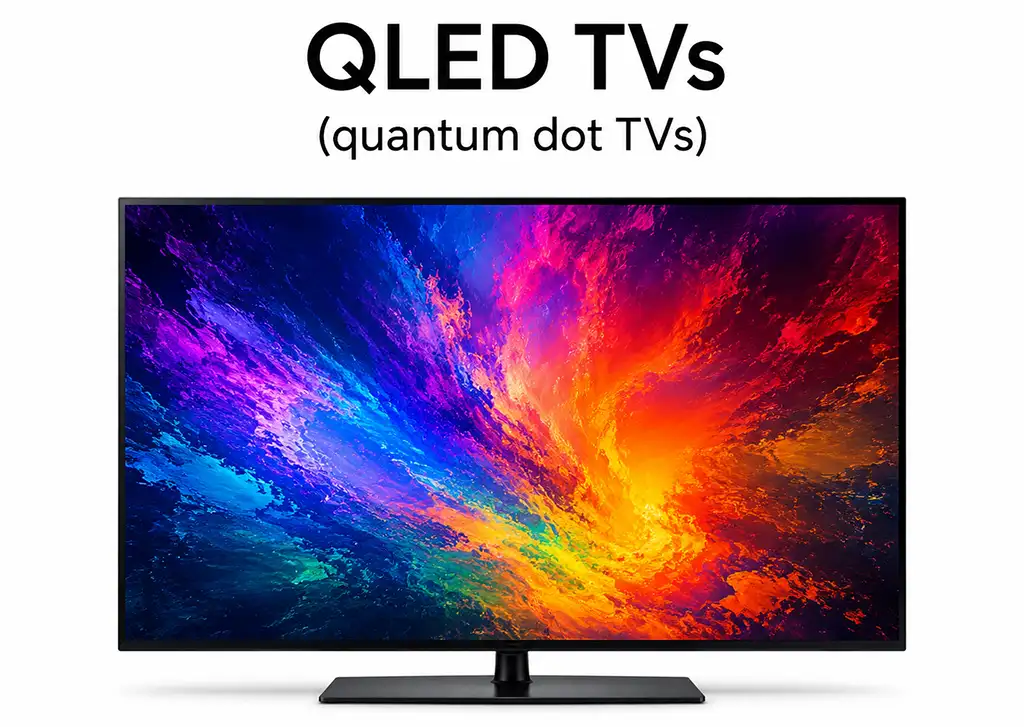
Quantum Dot technology was first introduced at CES 2015. According to Samsung, it was developed to enhance picture quality on TV screens, and in practice, it does exactly that. Quantum Dot technology improves image quality by using advanced materials with high selective bandwidth and low light attenuation, resulting in more accurate colors and higher brightness. Initially available only in premium TV models, Quantum Dot technology has since expanded into the mid-range segment, while OLED TVs have taken over the high-end market.
What is QLED/Quantum Dot
First and foremost, it’s important to understand that QLED and quantum dot technology are essentially the same. The image is produced in exactly the same way as on traditional LCD/LED displays—QLED TVs are simply an enhanced version of LED TVs.
We are all familiar with the RGB color model, which consists of red, green, and blue. By combining these three primary colors in different proportions, virtually any color can be reproduced.
There are several types of QLED displays, depending on the technology used by the manufacturer. In higher-end displays, the pixels themselves incorporate quantum dot materials, while more affordable models use an additional quantum dot enhancement layer placed within the display. This is why QLED TVs are available across a wide range of price points, from budget-friendly models to premium flagship TVs.
The image itself is still created using standard LCD technology. When a specific voltage is applied, the pixels adjust to allow a controlled amount of light to pass through. Thanks to the high color selectivity and minimal light attenuation provided by quantum dot materials, the resulting image is brighter, more vibrant, and offers improved contrast compared to conventional LED displays.
Should I worry about QLED burn-in?
In reality, LED TVs, including QLED models, are not susceptible to burn-in. Unlike OLED displays, their pixels do not emit light—they simply regulate the amount of light passing through the LCD panel. As a result, there is nothing in the display itself that can permanently burn in.
When QLED TVs were first introduced, however, manufacturers used this fact as a marketing advantage. For example, Samsung promoted its QLED TVs with a 10-year warranty against screen burn-in. In practice, such failures have never been a real concern because LCD-based displays are inherently resistant to burn-in. A far more likely issue over time is the failure of the LED backlight, which is a completely different type of hardware problem and has nothing to do with burn-in.
As consumers became more familiar with how QLED technology actually works and QLED TVs became a mainstream product, these marketing campaigns gradually disappeared. The change happened quietly and went largely unnoticed by most buyers.
What is the life expectancy of a QLED TV?
The typical lifespan of a Samsung QLED TV is around 7–10 years. In most cases, TVs fail due to a variety of hardware issues that are not directly related to the display panel itself. One of the more common problems is LED backlight failure, although its likelihood depends largely on the overall build quality of the panel. Pixel defects can also occur over time, resulting in so-called “dead pixels” that either stop functioning completely or become stuck in a fixed state and no longer respond to electrical signals.
However, display-related failures are rarely the main reason people replace their TVs. More often, older models become obsolete because they no longer receive operating system updates. As software support ends, certain streaming services and applications may stop working or lose compatibility, prompting users to upgrade to a newer TV even if the display itself is still functioning properly.