

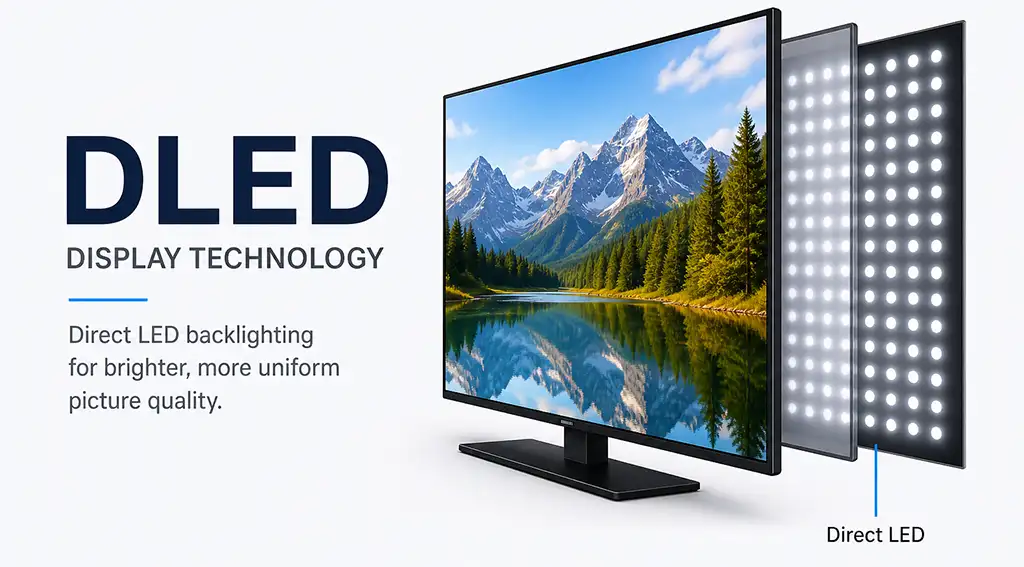
Technology is something only some potential buyers understand. And that’s okay, but if you decide to buy a new TV, you need to know what a DLED display is. After all, you’ve seen DLED display in the description of some TV. Now I’m going to tell you what these displays are.
DLED stands for Direct Light Emitting Diode. It means that the screen’s backlighting is located at the back across the entire screen area in a TV. It is only used in LED TVs and their variants.
The term “DLED” is most often used as a marketing label by certain manufacturers. Saying a TV has a Direct LED backlight is clear and descriptive, whereas the phrase “a TV with a DLED display” can sound less transparent and somewhat ambiguous to the average reader.
Varieties of DLED display
DLED (Direct LED) technology includes several configurations, each offering a different balance of performance, complexity, and cost.
Full-Array LED
In this design, LEDs are distributed evenly across the entire back of the screen. It often supports local dimming, allowing specific zones of the backlight to be adjusted independently. This results in improved contrast, deeper blacks, and a more refined image overall.
DLED with Local Dimming
A variation of full-array backlighting that incorporates local dimming for more precise control over brightness and contrast. The number of dimming zones can vary, directly influencing picture quality—the more zones, the finer the control.
DLED without Local Dimming
A simpler and more cost-effective solution that does not include advanced backlight control. While it still provides more uniform illumination than Edge LED, it lacks the contrast and depth improvements offered by local dimming.
Enhanced DLED
This category includes models with additional refinements, such as improved backlight management or enhanced color filtering technologies, aimed at delivering better overall picture quality.
Mini LED
An advanced evolution of DLED technology. By using significantly smaller LEDs, Mini LED TVs enable a much higher number of dimming zones and more precise light control. This leads to superior contrast, brightness, and overall image performance, placing them among the most advanced LCD TV options available.
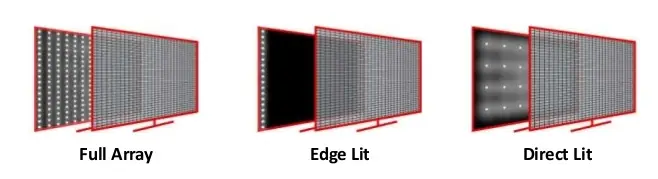
Difference between DLED, LED and mini LED display
When comparing DLED, LED, and Mini LED displays, it is essential to realize that they are all variations of LED (Light Emitting Diode) technology used differently in TV screens, resulting in unique backlighting characteristics”.
- LED TVs: “LED TV” typically refers to LCD screens using LED backlighting. The traditional form is Edge LED backlighting, in which the LEDs are placed at the bottom or side of the screen. This design aims for edge-to-edge distribution, using a particular material with non-uniform reflectivity as a reflector.
- DLED TVs: This type of LED TV, standing for Direct LED, distributes LEDs across the entire back of the screen, unlike traditional LED TVs, which are located at the edges. This arrangement provides more even illumination across the entire screen. In addition, DLED TVs are often equipped with a local dimming function, which increases contrast and improves black levels in some regions of the screen, providing a more dynamic viewing experience.
- Mini LED TVs: Mini LED TVs, a more advanced iteration of LED technology, utilize many small LEDs behind the screen, much larger than conventional displays. This increased number of LEDs greatly expands the local dimming zones, providing careful control over the screen’s brightness and contrast. As a result, Mini LED TVs exhibit superior picture quality with higher contrast ratios and deeper blacks than standard LED or DLED TVs.
DLED is better than LED
In conclusion, DLED (Direct LED) TVs are generally preferable to TVs with simple LED (Edge LED) backlighting. DLED provides more uniform screen illumination and better contrast due to its local dimming capability, improving picture quality, especially in black depth. Meanwhile, Edge LED backlit TVs can suffer from less lighting and poor contrast.
When comparing DLED and LED displays, it’s also essential to consider the type of matrix used in TVs, such as VA (Vertical Alignment) or IPS (In-Plane Switching). These types of matrices affect the picture quality and the type of backlight.
- VA Matrices: Typically offer better contrast and black depth, making them ideal for use with DLED backlighting. This reinforces the contrast and black color advantages of DLED.
- IPS Matrices: They offer wider viewing angles and better color reproduction but often contrast poorly compared to VA. When using IPS matrices with DLED backlighting, more even lighting and improved color display can be achieved.
Thus, the choice between DLED and simple LED backlighting should also consider the type of matrix used in the TV. VA matrices combined with DLED backlighting will provide better contrast, while IPS matrices with DLED will improve viewing angles and color reproduction.

Hi, now the leaders in TV production, Samsung, LG, Sony. Of the Chinese manufacturers, Hisense
Overview of TV manufacturers
TV brands, history, who owns TV brands
Hi my name is Thomas Ormshaw I am involved for the past 7years in producing coffee tables with the tv inside that rises and goes down with one button press.but now find difficulty in finding a manufacture who would supply me a tv to my specific specifications.is it possible that you could put me in the direction where I could find a good company.I thought Panasonic may be a start seeing that are ceasing marketing tv,s here in Australia but I don’t know?.Thanking you in anticipation .Tom