
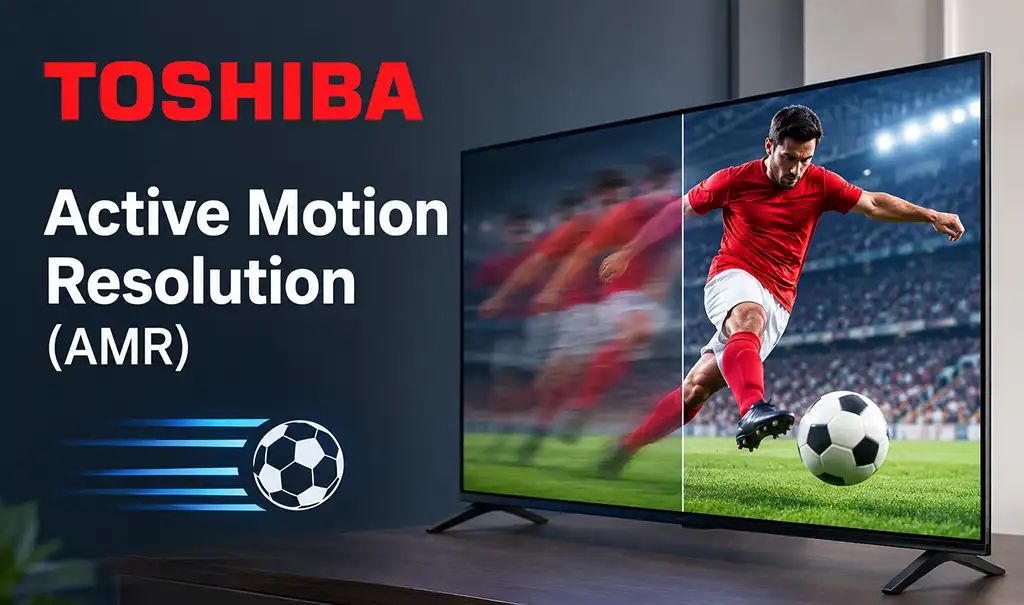
Active Motion Resolution (AMR) is a picture-processing technology and marketing specification that Toshiba used in its televisions to describe motion clarity. The term appeared in Toshiba TV specifications mainly during the 2010s and was later used in the form AMR+ on some models and in some regional markets.
AMR was created to give consumers an idea of how well a television could handle fast-moving images. However, the AMR number does not represent the actual refresh rate of the TV panel.
This distinction is important because specifications such as AMR 100, AMR 200, AMR 400 or AMR 800 can easily be mistaken for 100 Hz, 200 Hz, 400 Hz or 800 Hz panels. They are not.
What the AMR number means
Toshiba used different AMR values depending on the TV series and market. Common designations included AMR 100, AMR 200, AMR 400 and AMR 800.
The number was intended to indicate the relative level of motion-processing capability within Toshiba’s product range. A higher AMR figure generally indicated a television positioned as having more advanced motion handling.
However, the number should not be interpreted as a precise physical measurement.
For example, AMR 800 does not mean eight times the panel refresh rate of a 100 Hz television. It is a Toshiba product specification used to communicate the TV’s overall motion performance.
The exact technologies behind an AMR rating could also vary between TV generations. Therefore, the number alone does not provide enough information to determine the actual behavior of a particular model.
How Toshiba improved motion clarity
A television displaying fast-moving content can suffer from motion blur or a loss of detail. This can be particularly noticeable during sports broadcasts, action movies, racing games and scenes with rapid camera movement.
Toshiba used several image-processing techniques to improve the appearance of motion. Depending on the model and generation, these could include motion interpolation and backlight-related technologies.
Motion interpolation works by generating additional frames between existing frames. This can make movement appear smoother than it would when displaying the original source frames directly.
Backlight control can also affect perceived motion clarity. By controlling when the backlight is illuminated, the TV can reduce the amount of time each image remains visible to the viewer.
These technologies contribute to the overall motion performance that Toshiba represented with the AMR specification.
AMR and AMR+
Toshiba later began using the designation AMR+ (Active Motion Resolution Plus) on some televisions.
AMR+ followed the same general concept: it was intended to describe the TV’s ability to maintain clarity during moving scenes rather than specify the physical refresh rate of the panel.
The use of the AMR+ name became particularly noticeable on some Toshiba televisions sold in different regional markets. Consequently, there is no single worldwide date on which Toshiba completely stopped using the original AMR designation.
The transition also varied according to the market and the company responsible for Toshiba-branded televisions in that region.