

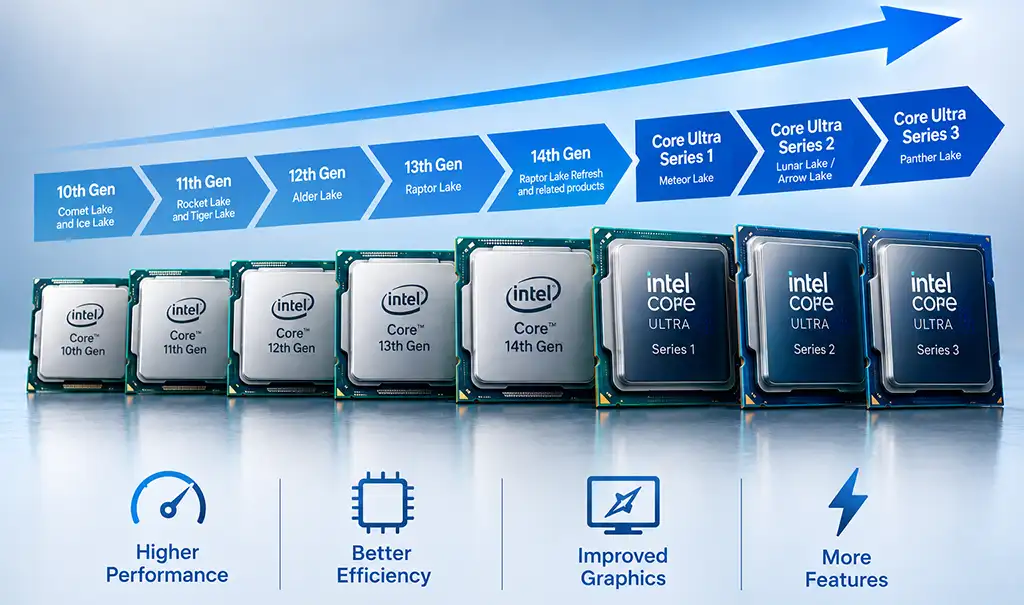
Intel processor naming has changed significantly over the years. Older Intel Core processors use the familiar Core i3, i5, i7, and i9 designations, while newer processors use the Intel Core Ultra and Intel Core naming systems.
This Intel processor comparison chart brings together Intel Core processors from different generations and allows you to compare their main specifications, including the processor number, launch date, socket, clock speed, Turbo frequency, cache, cores and threads, TDP, integrated graphics, manufacturing process, and memory support.
The original part of the table covers older Intel processors released from the 4th generation onward. Newer generations and the current Intel Core and Core Ultra naming systems are explained below.
Intel Processor Generations
Intel’s traditional Core processor generations started with the first-generation Core processors and continued through the 14th generation. The first three generations were based on Nehalem/Westmere, Sandy Bridge, and Ivy Bridge architectures. From the 4th generation onward, Intel used architectures such as Haswell, Broadwell, Skylake, and later generations.
| Generation | Intel architecture | Main launch period |
|---|---|---|
| 1st Gen | Nehalem / Westmere | 2008–2010 |
| 2nd Gen | Sandy Bridge | 2011 |
| 3rd Gen | Ivy Bridge | 2012 |
| 4th Gen | Haswell | 2013 |
| 5th Gen | Broadwell | 2014 |
| 6th Gen | Skylake | 2015 |
| 7th Gen | Kaby Lake | 2016–2017 |
| 8th Gen | Coffee Lake and related products | 2017–2018 |
| 9th Gen | Coffee Lake Refresh | 2018–2019 |
| 10th Gen | Comet Lake and Ice Lake | 2020 |
| 11th Gen | Rocket Lake and Tiger Lake | 2021 |
| 12th Gen | Alder Lake | 2021 |
| 13th Gen | Raptor Lake | 2022 |
| 14th Gen | Raptor Lake Refresh and related products | 2023 |
| Core Ultra Series 1 | Meteor Lake | 2023–2024 |
| Core Ultra Series 2 | Lunar Lake / Arrow Lake | 2024–2026 |
| Core Ultra Series 3 | Panther Lake | 2026 |
Intel’s traditional Core processor generation numbering runs from the 1st generation through the 14th generation. Starting with Core Ultra, Intel changed its naming system. Newer Core Ultra processors are identified as Series 1, Series 2, and Series 3 rather than as 15th, 16th, or 17th-generation Core processors.
Intel Core Laptop Processor Generations
Intel Core processors for laptops have gone through several generations since the first Core i-series processors appeared. The early generations are now obsolete and are mainly relevant when identifying older laptops. Newer generations introduced major changes in CPU architecture, core count, manufacturing process, and power efficiency.
1st–4th Generation — Obsolete Laptop Processors
| Generation | Architecture | Example laptop processors | Cores / Threads | Process | Typical TDP | Launch period |
|---|---|---|---|---|---|---|
| 1st Gen | Nehalem / Westmere | Core i3-330M, i5-520M, i7-720QM | 2–4 / 4–8 | 32 nm | 25–45 W | 2010 |
| 2nd Gen | Sandy Bridge | Core i3-2310M, i5-2520M, i7-2630QM | 2–4 / 4–8 | 32 nm | 35–45 W | 2011 |
| 3rd Gen | Ivy Bridge | Core i3-3110M, i5-3230M, i7-3630QM | 2–4 / 4–8 | 22 nm | 35–45 W | 2012 |
| 4th Gen | Haswell | Core i3-4000M, i5-4200U, i7-4700HQ | 2–4 / 4–8 | 22 nm | 15–47 W | 2013 |
5th–11th Generation Intel Core Laptop Processors
| Generation | Processor | Cores / Threads | Base Clock | Max Turbo | Cache | TDP | Process | Graphics | Launch period |
|---|---|---|---|---|---|---|---|---|---|
| 5th Gen | Core i3-5010U | 2 / 4 | 2.1 GHz | 2.1 GHz | 3 MB | 15 W | 14 nm | HD 5500 | 2014 |
| 5th Gen | Core i5-5200U | 2 / 4 | 2.2 GHz | 2.7 GHz | 3 MB | 15 W | 14 nm | HD 5500 | 2015 |
| 5th Gen | Core i7-5500U | 2 / 4 | 2.4 GHz | 3.0 GHz | 4 MB | 15 W | 14 nm | HD 5500 | 2015 |
| 6th Gen | Core i3-6100U | 2 / 4 | 2.3 GHz | 2.3 GHz | 3 MB | 15 W | 14 nm | HD 520 | 2015 |
| 6th Gen | Core i5-6200U | 2 / 4 | 2.3 GHz | 2.8 GHz | 3 MB | 15 W | 14 nm | HD 520 | 2015 |
| 6th Gen | Core i7-6700HQ | 4 / 8 | 2.6 GHz | 3.5 GHz | 6 MB | 45 W | 14 nm | HD 530 | 2015 |
| 7th Gen | Core i3-7100U | 2 / 4 | 2.4 GHz | 2.4 GHz | 3 MB | 15 W | 14 nm | HD 620 | 2016 |
| 7th Gen | Core i5-7200U | 2 / 4 | 2.5 GHz | 3.1 GHz | 3 MB | 15 W | 14 nm | HD 620 | 2016 |
| 7th Gen | Core i7-7700HQ | 4 / 8 | 2.8 GHz | 3.8 GHz | 6 MB | 45 W | 14 nm | HD 630 | 2017 |
| 8th Gen | Core i3-8130U | 2 / 4 | 2.2 GHz | 3.4 GHz | 4 MB | 15 W | 14 nm | UHD 620 | 2018 |
| 8th Gen | Core i5-8250U | 4 / 8 | 1.6 GHz | 3.4 GHz | 6 MB | 15 W | 14 nm | UHD 620 | 2017 |
| 8th Gen | Core i7-8550U | 4 / 8 | 1.8 GHz | 4.0 GHz | 8 MB | 15 W | 14 nm | UHD 620 | 2017 |
| 9th Gen | Core i5-9300H | 4 / 8 | 2.4 GHz | 4.1 GHz | 8 MB | 45 W | 14 nm | UHD 630 | 2019 |
| 9th Gen | Core i7-9750H | 6 / 12 | 2.6 GHz | 4.5 GHz | 12 MB | 45 W | 14 nm | UHD 630 | 2019 |
| 10th Gen | Core i3-1005G1 | 2 / 4 | 1.2 GHz | 3.4 GHz | 4 MB | 15 W | 10 nm | UHD Graphics | 2019 |
| 10th Gen | Core i5-10210U | 4 / 8 | 1.6 GHz | 4.2 GHz | 6 MB | 15 W | 14 nm | UHD Graphics | 2019 |
| 10th Gen | Core i7-10750H | 6 / 12 | 2.6 GHz | 5.0 GHz | 12 MB | 45 W | 14 nm | UHD 630 | 2020 |
| 11th Gen | Core i3-1115G4 | 2 / 4 | 3.0 GHz | 4.1 GHz | 6 MB | 28 W | 10 nm SuperFin | UHD Graphics | 2020 |
| 11th Gen | Core i5-1135G7 | 4 / 8 | 2.4 GHz | 4.2 GHz | 8 MB | 28 W | 10 nm SuperFin | Iris Xe | 2020 |
| 11th Gen | Core i7-11800H | 8 / 16 | 2.3 GHz | 4.6 GHz | 24 MB | 45 W | 10 nm SuperFin | UHD Graphics | 2021 |
12th–14th Generation Intel Core Laptop Processors
| Generation | Processor | Cores / Threads | Clock Speed | Cache | Base Power | Graphics | Launch period |
|---|---|---|---|---|---|---|---|
| 12th Gen | Core i5-1240P | 12 / 16 | 1.7 / 4.4 GHz | 12 MB | 28 W | Iris Xe | 2022 |
| 12th Gen | Core i7-1270P | 12 / 16 | 2.2 / 4.8 GHz | 18 MB | 28 W | Iris Xe | 2022 |
| 12th Gen | Core i7-1280P | 14 / 20 | 1.8 / 4.8 GHz | 24 MB | 28 W | Iris Xe | 2022 |
| 12th Gen | Core i5-12500H | 12 / 16 | 2.5 / 4.5 GHz | 18 MB | 45 W | Iris Xe | 2022 |
| 12th Gen | Core i7-12700H | 14 / 20 | 2.3 / 4.7 GHz | 24 MB | 45 W | Iris Xe | 2022 |
| 12th Gen | Core i9-12900H | 14 / 20 | 2.5 / 5.0 GHz | 24 MB | 45 W | Iris Xe | 2022 |
| 13th Gen | Core i5-1340P | 12 / 16 | 1.9 / 4.6 GHz | 12 MB | 28 W | Iris Xe | 2023 |
| 13th Gen | Core i7-1360P | 12 / 16 | 2.2 / 5.0 GHz | 18 MB | 28 W | Iris Xe | 2023 |
| 13th Gen | Core i7-1370P | 14 / 20 | 1.9 / 5.2 GHz | 24 MB | 28 W | Iris Xe | 2023 |
| 13th Gen | Core i5-13500H | 12 / 16 | 2.6 / 4.7 GHz | 18 MB | 45 W | Iris Xe | 2023 |
| 13th Gen | Core i7-13700H | 14 / 20 | 2.4 / 5.0 GHz | 24 MB | 45 W | Iris Xe | 2023 |
| 13th Gen | Core i9-13900H | 14 / 20 | 2.6 / 5.4 GHz | 24 MB | 45 W | Iris Xe | 2023 |
| 14th Gen | Core i5-14500HX | 14 / 20 | 2.5 / 4.9 GHz | 24 MB | 55 W | UHD | 2024 |
| 14th Gen | Core i7-14650HX | 16 / 24 | 2.2 / 5.2 GHz | 30 MB | 55 W | UHD | 2024 |
| 14th Gen | Core i7-14700HX | 20 / 28 | 2.1 / 5.5 GHz | 33 MB | 55 W | UHD | 2024 |
| 14th Gen | Core i9-14900HX | 24 / 32 | 2.2 / 5.8 GHz | 36 MB | 55 W | UHD | 2024 |
2023–2026 Intel Core Ultra Laptop Processors
| Series | Processor | Core Configuration | Threads | Max Turbo | Cache | Power | Process | Graphics | Launch period |
|---|---|---|---|---|---|---|---|---|---|
| Series 1 | Core Ultra 5 125H | 4P + 8E + 2 LP E | 18 | 4.5 GHz | 18 MB | 28 / 115 W | Intel 4 | Arc | 2023 |
| Series 1 | Core Ultra 7 155H | 6P + 8E + 2 LP E | 22 | 4.8 GHz | 24 MB | 28 / 115 W | Intel 4 | Arc | 2023 |
| Series 1 | Core Ultra 9 185H | 6P + 8E + 2 LP E | 22 | 5.1 GHz | 24 MB | 45 / 115 W | Intel 4 | Arc | 2023 |
| Series 2 | Core Ultra 5 226V | 4P + 4 LP E | 8 | 4.5 GHz | 8 MB | 17 / 37 W | TSMC N3B | Arc 130V | 2024–2025 |
| Series 2 | Core Ultra 7 258V | 4P + 4 LP E | 8 | 4.8 GHz | 12 MB | 17 / 37 W | TSMC N3B | Arc 140V | 2024–2025 |
| Series 2 | Core Ultra 9 288V | 4P + 4 LP E | 8 | 5.1 GHz | 12 MB | 30 / 37 W | TSMC N3B | Arc 140V | 2024–2025 |
| Series 2 | Core Ultra 5 225H | 4P + 8E + 2 LP E | 14 | 4.9 GHz | 18 MB | 28 / 115 W | Intel 3 | Arc | 2025 |
| Series 2 | Core Ultra 7 255H | 6P + 8E + 2 LP E | 16 | 5.1 GHz | 24 MB | 28 / 115 W | Intel 3 | Arc | 2025 |
| Series 2 | Core Ultra 9 285H | 6P + 8E + 2 LP E | 16 | 5.4 GHz | 24 MB | 45 / 115 W | Intel 3 | Arc | 2025 |
| Series 2 | Core Ultra 5 255HX | 6P + 8E | 14 | 4.9 GHz | 30 MB | 55 / 160 W | Intel 3 | Arc | 2025 |
| Series 2 | Core Ultra 7 275HX | 8P + 12E | 20 | 5.4 GHz | 36 MB | 55 / 160 W | Intel 3 | Arc | 2025 |
| Series 2 | Core Ultra 9 285HX | 8P + 16E | 24 | 5.5 GHz | 36 MB | 55 / 160 W | Intel 3 | Arc | 2025 |
| Series 3 | Core Ultra 5 336H | 4P + 8E + 4 LP E | 16 | 4.6 GHz | 18 MB | 25 / 80 W | Intel 18A | Intel Xe3 | 2026 |
| Series 3 | Core Ultra 7 366H | 4P + 8E + 4 LP E | 16 | 4.8 GHz | 18 MB | 25 / 80 W | Intel 18A | Intel Xe3 | 2026 |
| Series 3 | Core Ultra 9 386H | 4P + 8E + 4 LP E | 16 | 4.9 GHz | 18 MB | 25 / 80 W | Intel 18A | Intel Xe3 | 2026 |
| Series 3 | Core Ultra X7 368H | 4P + 8E + 4 LP E | 16 | 5.0 GHz | 18 MB | 25 / 80 W | Intel 18A | Arc B390 | 2026 |
| Series 3 | Core Ultra X9 388H | 4P + 8E + 4 LP E | 16 | 5.1 GHz | 18 MB | 25 / 80 W | Intel 18A | Arc B390 | 2026 |
Why the Processor Tables Are Divided
The tables are divided because Intel changed both its processor architecture and naming system over time.
- 1st–11th Generation — these processors use the traditional Intel Core naming system, such as Core i3, i5, and i7. They are grouped together because they belong to the same general naming era.
- 12th–14th Generation — starting with the 12th generation, Intel introduced a hybrid architecture with Performance-cores (P-cores) and Efficient-cores (E-cores). This makes the core configuration an important specification to include in the table.
- Core Ultra Series 1–3 — Intel introduced a new Core Ultra brand and stopped using the traditional generation numbers for these processors. Therefore, Core Ultra Series 1, Series 2, and Series 3 should not be called the 15th, 16th, or 17th generations.
This structure makes it easier to compare processors within the same naming and architectural era while keeping the tables compact and readable.