

Intel has used many different integrated graphics solutions in its processors over the years. The names of these graphics solutions have gradually evolved from Intel GMA and Intel HD Graphics to Intel Iris, UHD Graphics, Iris Xe, and the newer Intel Arc graphics. Some graphics families were also released in several versions and used across different generations of processors.
Integrated graphics are found in virtually all laptop processors and in some desktop processors, eliminating the need for a separate graphics card. However, Intel also manufactures processors without integrated graphics, specifically models designed to be used in conjunction with a discrete graphics card.
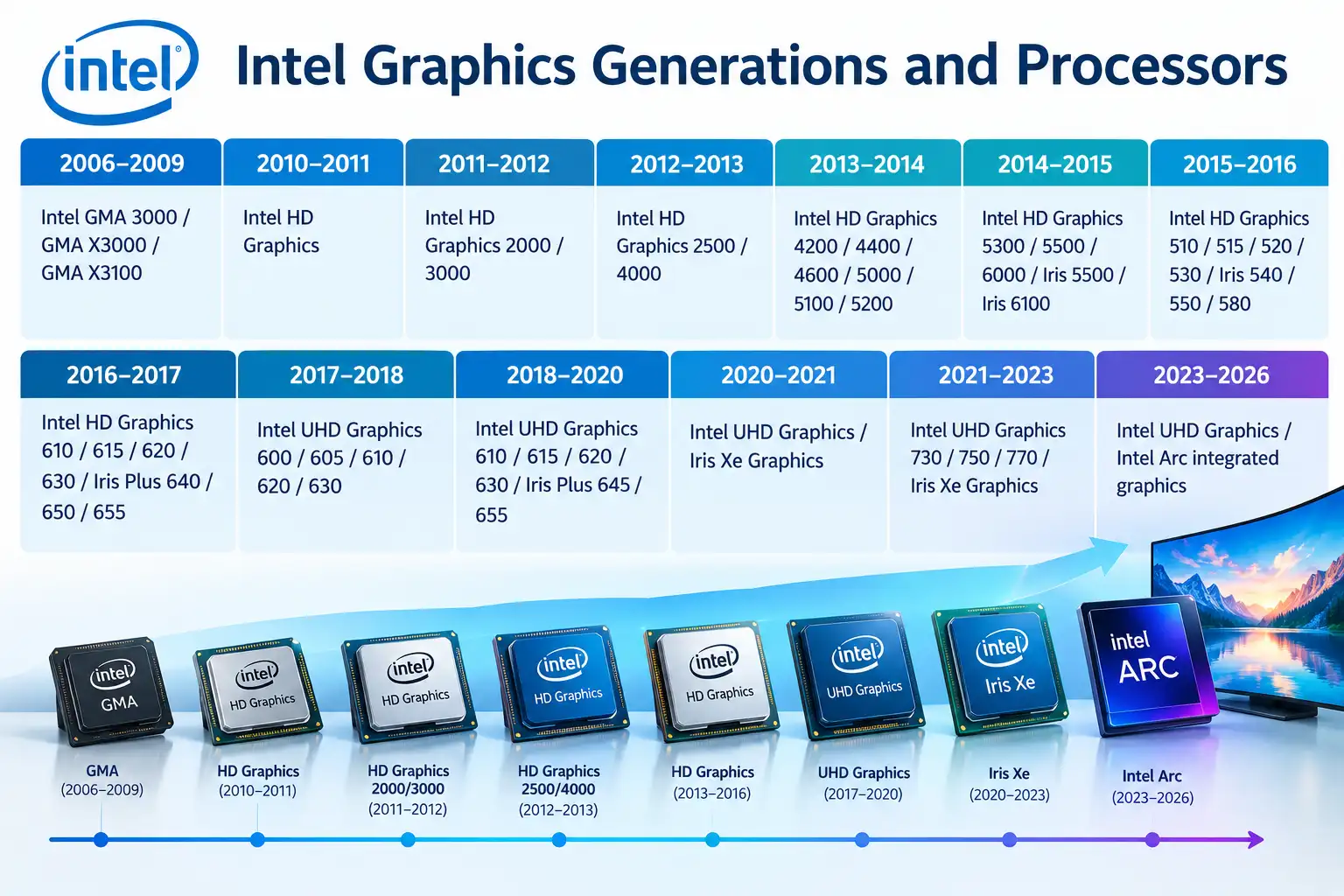
The table below provides a chronological overview of the major integrated graphics solutions used in Intel processors, along with their approximate release dates. This makes it easy to trace the evolution of Intel’s integrated graphics from the early GMA solutions to modern graphics architectures.
| Period | Intel Graphics |
|---|---|
| 2006–2009 | Intel GMA 3000 / GMA X3000 / GMA X3100 |
| 2010–2011 | Intel HD Graphics |
| 2011–2012 | Intel HD Graphics 2000 / 3000 |
| 2012–2013 | Intel HD Graphics 2500 / 4000 |
| 2013–2014 | Intel HD Graphics 4200 / 4400 / 4600 / 5000 / 5100 / 5200 |
| 2014–2015 | Intel HD Graphics 5300 / 5500 / 6000 / Iris 5500 / Iris 6100 |
| 2015–2016 | Intel HD Graphics 510 / 515 / 520 / 530 / Iris 540 / 550 / 580 |
| 2016–2017 | Intel HD Graphics 610 / 615 / 620 / 630 / Iris Plus 640 / 650 / 655 |
| 2017–2018 | Intel UHD Graphics 600 / 605 / 610 / 620 / 630 |
| 2018–2020 | Intel UHD Graphics 610 / 615 / 620 / 630 / Iris Plus 645 / 655 |
| 2020–2021 | Intel UHD Graphics / Iris Xe Graphics |
| 2021–2023 | Intel UHD Graphics 730 / 750 / 770 / Iris Xe Graphics |
| 2023–2026 | Intel UHD Graphics / Intel Arc integrated graphics |
Intel GMA
Intel GMA (Graphics Media Accelerator) is an early family of integrated graphics solutions from Intel that was used before the introduction of Intel HD Graphics. In early generations, the graphics processing unit (GPU) was part of the chipset rather than the processor. In other words, a single processor package contained two separate processors: the CPU and the GPU. Well-known models include the GMA 950, GMA 3000, GMA X3000, and GMA X3100.
Early GMA solutions were designed primarily for display output, desktop graphics, video playback, and basic 3D acceleration. The GMA X3000 introduced a more programmable architecture with unified execution resources.
Integrated graphics were significantly inferior to discrete graphics cards and served as a low-cost alternative for basic display capabilities.
Intel HD Graphics
The Intel HD Graphics system debuted alongside the first-generation Intel Core processors. In the first Westmere-series processors, the CPU and GPU were separate chips housed within a single package. In the Sandy Bridge architecture, Intel integrated the CPU and GPU onto a single die. The Sandy Bridge architecture also introduced Intel Quick Sync Video technology, which provides dedicated hardware acceleration for video encoding and transcoding.
Intel HD Graphics 2000 and 3000
The HD Graphics 2000 and HD Graphics 3000 graphics cores were introduced in 2011 alongside the second-generation Intel Core processors, based on the Sandy Bridge architecture.
HD Graphics 2000 contained 6 execution units (EUs), while HD Graphics 3000 had 12 EUs, making HD Graphics 3000 the more powerful version. Both graphics processors utilized shared DDR3 system memory instead of dedicated graphics memory.
Sandy Bridge was also the generation in which Intel integrated the CPU and GPU onto a single physical die. Another important innovation was Quick Sync Video technology, which provided dedicated hardware for video encoding and transcoding—a feature that later became standard.
Intel HD Graphics 2500 and 4000
The HD Graphics 2500 and HD Graphics 4000 graphics cores were introduced in 2012 alongside the third-generation Intel Core processors based on the Ivy Bridge architecture.
The Ivy Bridge architecture also introduced Intel’s 22-nm manufacturing process for these processors. The integrated graphics gained support for DirectX 11, as well as improvements in hardware video decoding, video processing, and support for multiple displays.
Intel HD Graphics 4200, 4400, 4600, 5000, 5100 and 5200
These graphics processors were introduced in 2013 alongside the fourth-generation Intel Core processors, based on the Haswell architecture.
Intel significantly increased the number of execution units. The HD Graphics 4200, 4400, and 4600 models had 20 EUs, while the higher-performance HD Graphics 5000, 5100, and 5200 models reached 40 EUs.
The HD Graphics 5000 series was primarily used in mobile processors. The higher-performance Iris Pro Graphics 5200 model went even further by adding 128 MB of eDRAM, which acted as a high-speed cache and reduced performance bottlenecks caused by system memory bandwidth.
The Haswell architecture also added support for DirectX 11.1 and improved hardware for multimedia processing.
Intel HD Graphics 5300, 5500 and 6000
The HD Graphics 5300, 5500, and 6000 graphics processors belonged to the Broadwell generation, introduced in 2014–2015. Broadwell was the first generation of Intel Core processors for the mass market manufactured using a 14-nm process.
HD Graphics 5500 had 24 execution units (EUs), while HD Graphics 6000 had 48. Thus, the 6000 model had twice as many execution units as the 5500 model.
Intel also improved energy efficiency and multimedia processing capabilities. These changes were particularly important for laptops, where integrated graphics needed to deliver higher performance without a significant increase in power consumption. Intel continued to use eDRAM in some higher-performance mobile graphics configurations.
Intel Iris and Iris Pro
Iris was a line of Intel integrated graphics solutions offering higher performance. It was used in select mobile processors from the Broadwell and Skylake generations.
The Skylake architecture featured graphics solutions such as Iris 540, Iris 550, and Iris Pro 580. Iris Pro 580 had 72 execution units (EUs) and 128 MB of eDRAM, which provided it with significantly more resources for performing operations than standard HD Graphics solutions of the same period. It can be said that these graphics processors began to match the performance of mid-range discrete graphics cards.
Intel HD Graphics 510, 515, 520 and 530
The HD Graphics 510, 515, 520, and 530 graphics processors were introduced alongside the Skylake processors in 2015. Intel changed its naming convention, replacing the previous 4000 and 5000 series model numbers with the 500 series designations.
HD Graphics 510 had 12 EUs, while HD Graphics 515, 520, and 530 each had 24 EUs. HD Graphics 520 was widely used in mobile processors, and HD Graphics 530 was used in higher-performance Core desktop processors.
The Skylake architecture introduced support for DirectX 12 and OpenCL 2.0, as well as improvements to multimedia processing and support for high-resolution displays.
Intel HD Graphics 610, 615, 620 and 630
The HD Graphics 610, 615, 620, and 630 graphics processors were introduced alongside the Kaby Lake processors in 2016–2017. The HD Graphics 610 had 12 EUs, while the HD Graphics 615, 620, and 630 each had 24 EUs. Thus, in terms of the number of execution units, most models remained similar to their Skylake-based counterparts.
More significant changes were made to the media engine. Kaby Lake featured significantly improved hardware acceleration for HEVC/H.265 and VP9 formats, including 10-bit video. As a result, the platform became much better suited for hardware-accelerated 4K video playback, while simultaneously reducing the load on the CPU.
Intel UHD Graphics
Intel began using the name “UHD Graphics” for several generations and product segments. Among the models were the UHD Graphics 600, 605, 610, 620, and 630.
For example, the UHD Graphics 630 was used in Coffee Lake processors and had 24 EUs. Thus, the name “UHD” alone did not define a specific performance level. UHD Graphics 630 and the later UHD Graphics 770 belong to different generations and have different architectures and capabilities.
Later desktop processors featured UHD Graphics 730 and UHD Graphics 770. UHD Graphics 770, used in Alder Lake, increased the number of execution units to 32 EUs, compared to 24 EUs in UHD Graphics 630. Intel also continued to improve the media engine, 4K video support, and HEVC and VP9 decoding, and added hardware support for AV1 in later generations.
Intel Iris Xe Graphics
Iris Xe Graphics appeared with mobile Tiger Lake processors in 2020. It represented a major architectural change because it was based on Intel’s new Xe-LP graphics architecture rather than the older HD/UHD Graphics architecture.
Mobile Iris Xe configurations reached 96 Execution Units, a substantial increase over the 24 EU found in many previous UHD Graphics implementations. Xe-LP also introduced a more advanced media engine with hardware AV1 decoding, along with DirectX 12 support and improved multi-display capabilities.
Actual Iris Xe performance depends heavily on memory configuration. Since the GPU uses system memory rather than dedicated VRAM, faster memory such as LPDDR4x or LPDDR5 can have a significant effect on graphics performance.
Intel Arc Graphics
Intel Arc represents the next generation. The Xe HPG architecture was initially used in Intel Arc discrete graphics cards and later influenced the development of integrated Arc graphics in select Core Ultra processors.
Compared to Iris Xe, Arc-class graphics solutions incorporate specialized XMX processors for artificial intelligence tasks and ray tracing units for hardware-accelerated ray tracing.
In Core Ultra processors, Arc integrated graphics is not simply a version of UHD Graphics or Iris Xe with a higher clock speed. It uses the new Xe architecture with more advanced graphics, media, and AI capabilities.