

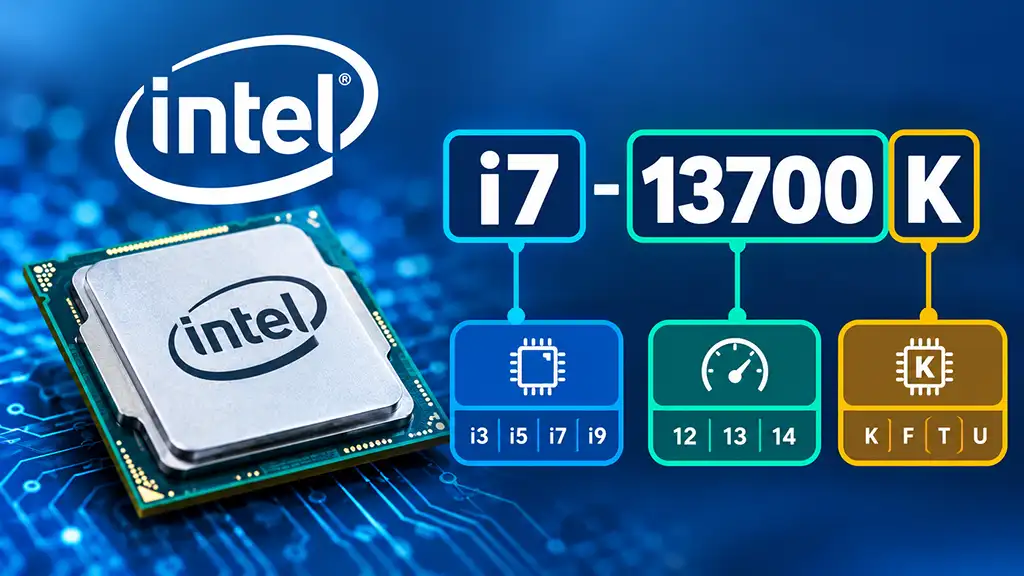
Intel processor model numbers identify the processor family, series, generation, and the specific model. Depending on the processor generation and series, the structure of the model number has changed over the years. It can contain both digits and letters, and individual characters may have a specific meaning. Modern Intel processors may also use names that include entire words.
Every Intel processor has a model number. In Intel product listings, the model number may be followed by additional information, such as cache size, maximum turbo frequency, package code, and distribution type. For example, Intel may list a processor as “Intel® Core™ 7 processor 150HL” or use a more detailed designation such as “Intel® Core™ 7 processor 150HL (24M Cache, up to 5.00 GHz) FC-LGA16C, Tray.”
The second designation contains the model number plus additional product information. FC-LGA16C is the package code, while Tray indicates the distribution format, meaning the processor is supplied as a component for OEM system manufacturers rather than as a boxed retail product.
Core series processor model numbers explained
Intel has used different model-numbering conventions for its Core processors over the years. The traditional naming scheme was used through 2023, while Intel introduced a new naming structure starting in 2024.
For example, the older naming convention is represented by the Intel® Core™ i5-1334U Processor.
Starting in 2024, Intel introduced new naming formats, such as Intel® Core™ 5 Processor 330 and Intel® Core™ Ultra 7 Processor 266V.
The main difference is that Intel moved away from the traditional Core i3/i5/i7/i9 format and introduced Core 3/5/7 and Core Ultra 5/7/9 processor names.
Core processor model numbers, starting in 2024
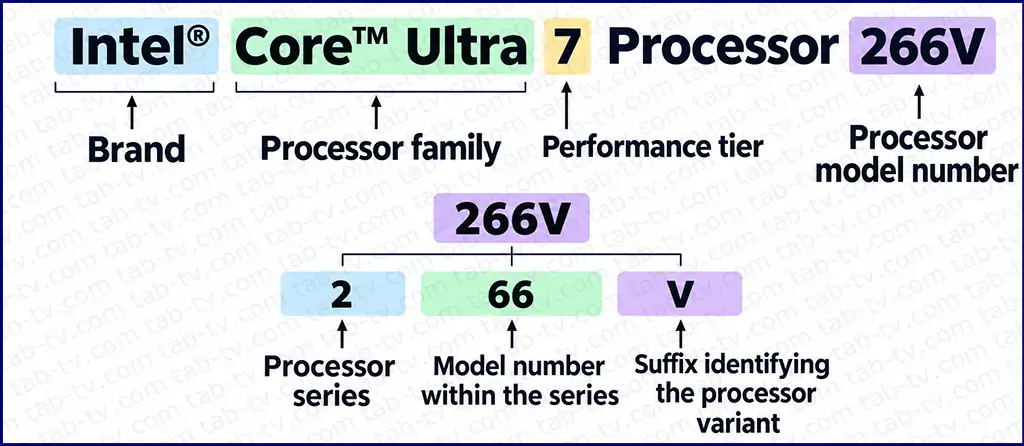
Intel® Core™ Ultra 7 Processor 266V
The processor designation can be broken down into several parts:
- Intel — the brand name.
- Core™ Ultra — the processor family.
- 7 — the performance tier within the Core Ultra family.
- 266V — the specific processor model number.
The 266V designation is sometimes referred to as an SKU, but this is not technically correct. SKU (Stock Keeping Unit) is a general term for an internal identifier assigned to a specific product item by a seller, manufacturer, or inventory management system. It is not the standard name for Intel’s processor model number.
The 266V model number can be further divided into:
- 2 — processor series.
- 66 — model number within the series.
- V — suffix identifying the processor variant.
Core™ Processor model numbers through 2024
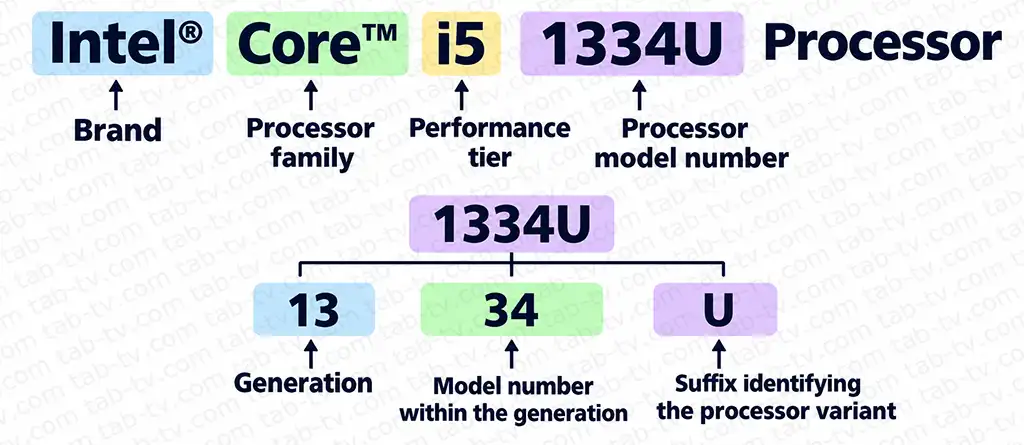
Intel® Core™ i5-1334U Processor
- Intel — the brand name.
- Core™ — the processor family.
- i5 — the performance series.
- 1334U — the processor model number, where:
- 13 — the 13th generation.
- 34 — the processor model within the generation.
- U — the suffix indicating the processor’s characteristics and intended use.
What do the last letters in the Intel processor model number mean?
The letters at the end of an Intel processor model number are called suffixes. They identify the processor’s form factor, performance level, power characteristics, or intended use. For example, the K suffix indicates an unlocked desktop processor, while F means that the processor does not have integrated graphics. Mobile processors use suffixes such as HX, H, P, U, and Y to distinguish different performance and power levels.
Intel has changed its suffix system over time, so the meaning of a particular letter can vary between processor generations. The table below shows the main suffixes used in recent Intel processor families and what each designation indicates.
| Form/Function Type/Segment | Suffix | Optimized/Designed for |
|---|---|---|
| Desktop | K | High performance, unlocked |
| F | Requires discrete graphics | |
| S | Special edition | |
| T | Power-optimized lifestyle | |
| Mobile (Laptop and 2 in 1) | HX | Highest performance, all SKUs unlocked |
| HK | Highest performance, all SKUs unlocked | |
| H | Highest performance | |
| P | Performance optimized for thin and light laptops | |
| U | Power efficient | |
| Y | Extremely low-power efficient | |
| G1-G7 | Graphics level (processors with newer integrated graphics technology) | |
| Embedded | E | Embedded |
| UE | Power efficient | |
| HE | High performance | |
| UL | Power efficient, in LGA package | |
| HL | Highest performance, in LGA package |
Historical Intel Core Processor Suffixes
Over the years, Intel has used a number of processor suffixes that have since been discontinued or replaced. These designations were especially common in Intel Core processors from the mid-2000s through the late 2010s. Some suffixes were used for only a few generations, while others changed meaning as Intel introduced new processor families. The table below lists the main historical suffixes and their approximate periods of use.
| Suffix | Approximate period of use | Meaning / Description |
|---|---|---|
| X | 2008–2017 | High-performance processor |
| XE | 2008–2019 | Extreme Edition processor |
| M | 2006–2015 | Mobile processor |
| MX | 2006–2011 | Extreme mobile processor |
| QM | 2008–2012 | Quad-core mobile processor |
| MQ | 2012–2015 | Quad-core mobile processor |
| HQ | 2015–2019 | High-performance quad-core mobile processor |
| P | 2006–2010s | Processor suffix used for specific mobile and desktop generations; meaning varied by generation |
| S | 2010–2019 | Special Edition / special desktop variant |
| L | 2006–2011 | Low-power processor |
| E | 2006–2010s | Embedded processor |
| QE | 2008–2012 | Quad-core embedded processor |
| ME | 2008–2012 | Mobile embedded processor |
| LE | 2008–2012 | Low-power embedded processor |
| UE | 2011–2015 | Ultra-low-power embedded processor |
| R | 2013–2018 | BGA processor with higher-performance integrated graphics |
| C | 2015–2016 | Desktop processor with integrated graphics based on Broadwell |
| H | 2015–2020s | High-performance mobile processor; later superseded/redefined across newer generations |
How to decode an Intel Xeon processor model number
Intel Xeon processor model numbers follow a structured naming system. The different parts of the model number identify the processor family, generation, performance level, model, and suffix. However, the exact structure has changed between Xeon generations, so the meaning of each digit depends on the specific Xeon family.
For example, consider Intel® Xeon® 6780E:
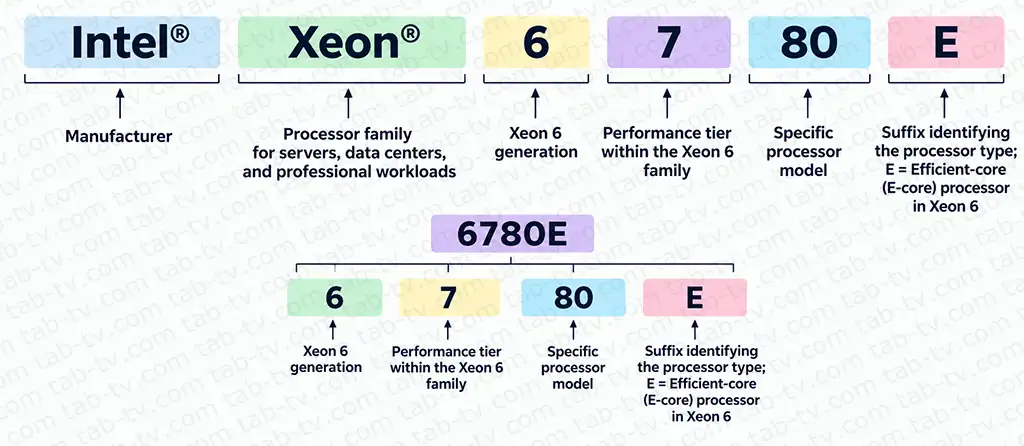
- Intel — manufacturer.
- Xeon — processor family for servers, data centers, and professional workloads.
- 6 — Xeon 6 generation.
- 7 — performance tier within the Xeon 6 family.
- 80 — specific processor model.
- E — suffix identifying the processor type; in Xeon 6, E identifies an Efficient-core (E-core) processor.
Another example is Intel® Xeon® 6980P:
- 6 — Xeon 6 generation.
- 9 — higher performance tier.
- 80 — specific model.
- P — Performance-core (P-core) processor.
For example, a model such as Intel Xeon Gold 6430 can be read as follows:
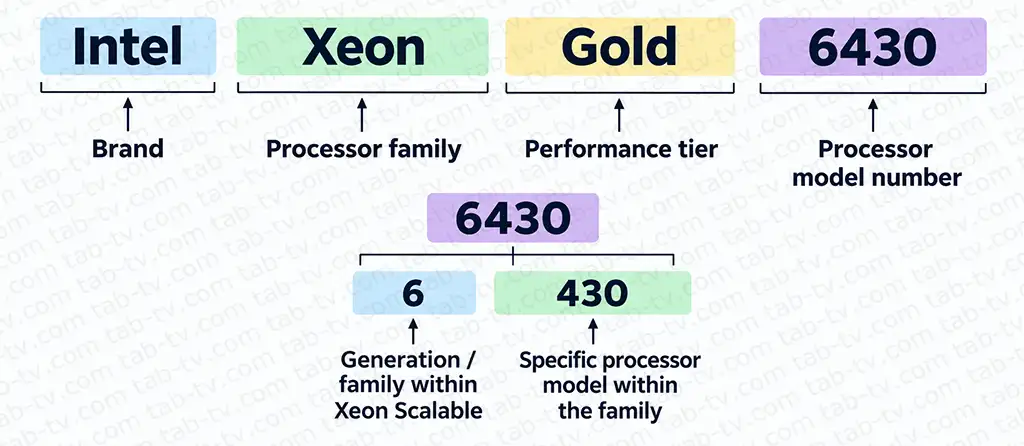
- Intel — processor manufacturer.
- Xeon — processor family designed primarily for servers, workstations, and professional systems.
- Gold — processor performance tier within the Xeon Scalable family.
- 6 — identifies the processor generation/family within the Xeon Scalable naming system.
- 430 — identifies the specific processor model within that family.
For newer Xeon processors, Intel uses different naming conventions. Therefore, the model number should not be interpreted using one universal digit-by-digit formula for all Xeon processors. The generation and Xeon family should first be identified, and then the individual digits and suffixes can be decoded according to that naming scheme.
Intel Arc G3 Processor Series Model Number Explained
The Intel Arc G3 processor is designed primarily for portable gaming PCs and handheld gaming consoles. The model name consists of several parts that identify the processor brand, product family, and series.
- Intel — the processor manufacturer.
- Arc — Intel’s processor platform name, used for products that combine CPU computing with powerful integrated Arc graphics.
- G — identifies the G-Series, a family of processors designed specifically for compact gaming devices such as handheld gaming PCs and portable gaming consoles.
- 3 — identifies the processor level within the G-Series. It does not mean that the processor is the third generation of Arc processors.
Intel Atom processor model number explained
Intel Atom processor model numbers use letters and numbers to identify the processor family, generation, and individual model. The exact numbering system varies between Atom families.
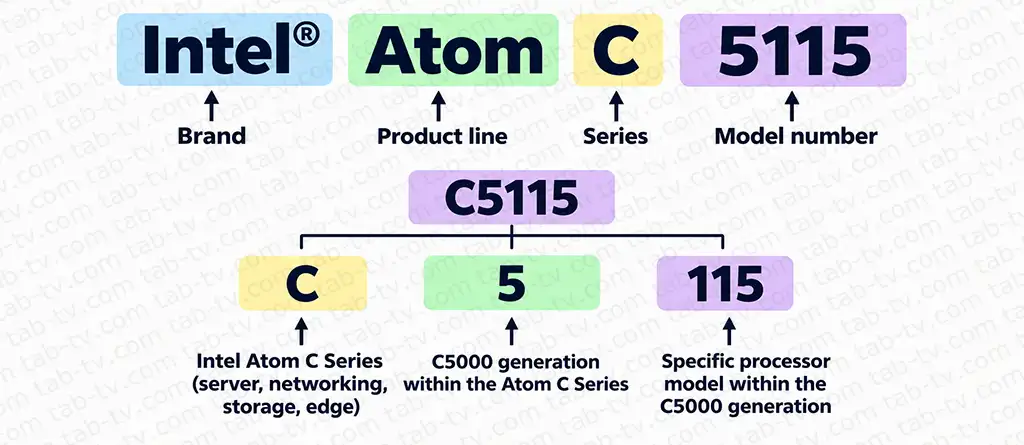
For example, Intel Atom C5115 can be decoded as follows:
C — identifies the Intel Atom C Series, designed for server, networking, storage, and edge applications.
5 — identifies the C5000 generation within the Atom C Series.
115 — identifies the specific processor model within the C5000 generation. The three digits work together as the model identifier; they do not each have a separate technical meaning.
Therefore:
C → Atom C Series
5 → C5000 generation
115 → specific processor model
This type of numbering should not be used to infer specifications such as the number of cores, clock speed, or power consumption. Those specifications must be checked separately in Intel’s processor documentation.
Intel Atom Processor Series by Letter
| Series | Release years |
|---|---|
| Z | 2008–2016 |
| N | 2008–2011 |
| D | 2010–2012 |
| C | 2012–2022 |
| E | 2013–2016 |
| S | 2013–2014 |
| X | 2015–2025 |
| P | 2020–2026 |
How to decode Intel Pentium, Celeron, and Intel Processor model numbers
Intel Pentium
The brand name may be followed by a product line designation, such as Silver or Gold.
For example, in the name “Pentium Silver N6000,” the letter N denotes the series, and 6000 is the model identifier. Depending on the generation, Pentium processors have used designations such as N, J, G, U, and Y.
Intel Celeron
Celeron processors use a similar system. Common formats include models starting with the letter N or J, as well as models in which the numerical designation is followed by a suffix.
For example, in the Celeron N6210 model, the letter N denotes the series, and 6210 is the model identifier.
This means that the numerical part should be considered primarily as the identifier for a specific processor. Its digits should not be automatically interpreted as the generation, number of cores, or clock speed.
Intel Processor
Under the newer Intel Processor brand, a simpler model designation format was introduced, with examples including the Intel Processor N100, N200, U300, and U300L.
In these names, the letters N or U denote the series, and the following digits indicate the processor model. If additional letters are present, they are part of the full model designation. For example, U300L consists of the U series, model 300, and the suffix L.