

Samsung’s 2020 QLED 8 Series included several models for the European market, including the Q87T, Q85T, Q84T and Q80T. At first glance, these TVs appear very similar because they use the same basic QLED platform, 4K resolution, Quantum Processor 4K and Direct Full Array backlighting.
The main differences are found between the Q80T and the other three models. The Q87T, Q85T and Q84T are almost identical in their core specifications, while the Q80T has a different screen surface and speaker configuration.
Q87T vs Q85T vs Q84T vs Q80T — Main Differences
| Feature | Q87T | Q85T | Q84T | Q80T |
|---|---|---|---|---|
| Year | 2020 | 2020 | 2020 | 2020 |
| Display technology | QLED | QLED | QLED | QLED |
| Resolution | 3,840 × 2,160 | 3,840 × 2,160 | 3,840 × 2,160 | 3,840 × 2,160 |
| Panel | VA | VA | VA | VA |
| Color depth | 8-bit + FRC | 8-bit + FRC | 8-bit + FRC | 8-bit + FRC |
| Anti-reflective coating | Yes | Yes | Yes | No |
| Backlight | Direct Full Array 16X | Direct Full Array 16X | Direct Full Array 16X | Direct Full Array 16X |
| Refresh rate | 100/120 Hz | 100/120 Hz | 100/120 Hz | 100/120 Hz |
| PQI | 3900 | 3900 | 3900 | 3800 |
| Picture processor | Quantum Processor 4K | Quantum Processor 4K | Quantum Processor 4K | Quantum Processor 4K |
| Sound output | 60 W | 60 W | 60 W | 60 W |
| Speaker configuration | 4.2.2 CH | 4.2.2 CH | 4.2.2 CH | 2.2.2 CH |
| HDMI | 4 | 4 | 4 | 4 |
| HDMI 2.1 | Yes | Yes | Yes | Yes |
| eARC | Yes | Yes | Yes | Yes |
| VRR | Yes | Yes | Yes | Yes |
| FreeSync | Yes | Yes | Yes | Yes |
As the table shows, most of the important specifications are the same. The clearest differences are the anti-reflective coating, PQI rating and speaker configuration.
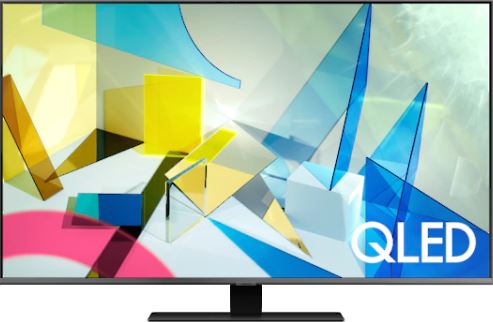
Q87T, Q85T, and Q84T
The Q87T, Q85T, and Q84T are essentially regional versions of the same 8th-Series QLED platform. Samsung used different model numbers for different European markets, so availability varied by country. There could also be minor cosmetic differences between versions, such as the stand design or color.
The Q80T belongs to the same QLED 8 Series but differs from the Q87T, Q85T, and Q84T in several hardware details.
The most noticeable difference is the screen surface. Unlike the Q87T, Q85T, and Q84T, the Q80T does not have an anti-glare coating. As a result, reflections from windows, lamps, and other light sources can be more visible.
The audio configuration is also different. The Q80T has a 2.2.2-channel speaker system, while the Q87T, Q85T, and Q84T use a 4.2.2-channel configuration. Despite this difference, Samsung rates the total audio output of all four models at 60 watts.
All four TVs use VA panels with Quantum Dot technology and a 3840 × 2160 4K resolution. The panels use 8-bit color processing with FRC, which increases the number of visible color gradations by alternating between adjacent color levels.
The advertised refresh rate is 100/120 Hz, allowing the TVs to handle fast-moving content smoothly and supporting the refresh rates required by many gaming applications.
Samsung also specifies 100% color volume coverage with Quantum Dot technology. However, this specification alone does not determine the overall picture quality, which also depends on factors such as contrast, backlighting, image processing, and viewing conditions.
Image processing is handled by the Quantum Processor 4K, which also performs upscaling of lower-resolution content. The TVs additionally feature AI Upscale technology to improve the appearance of content that is not available in native 4K resolution.
Gaming capabilities are largely identical across the four models. They include HDMI 2.1, variable refresh rate (VRR), FreeSync, eARC, and Game Mode. Each TV has four HDMI inputs, with one supporting HDMI 2.1.
Samsung also included a range of audio technologies, including Object Tracking Sound, Q-Symphony, Adaptive Voice Amplifier, Dolby Audio, and Multiroom Link. Q-Symphony allows a compatible Samsung soundbar to operate together with the TV’s built-in speakers, creating a more integrated sound system.
All four models run on the Samsung Tizen 5.5 platform. Smart TV features include Smart Hub, Bixby, Samsung TV Plus, Ambient Mode, a web browser, DLNA, screen mirroring, Wi-Fi, and Bluetooth 4.2.
Depending on the market and the services available in that region, the TVs also support Google Assistant and Amazon Alexa.