

LG advertises some of its TVs as featuring “Quad Step Noise Reduction”—a four-stage image processing system. At first glance, this sounds like a significant advantage. Most people believe that noise reduction improves image quality, and if the processing consists of four stages instead of one, the result should be even better.
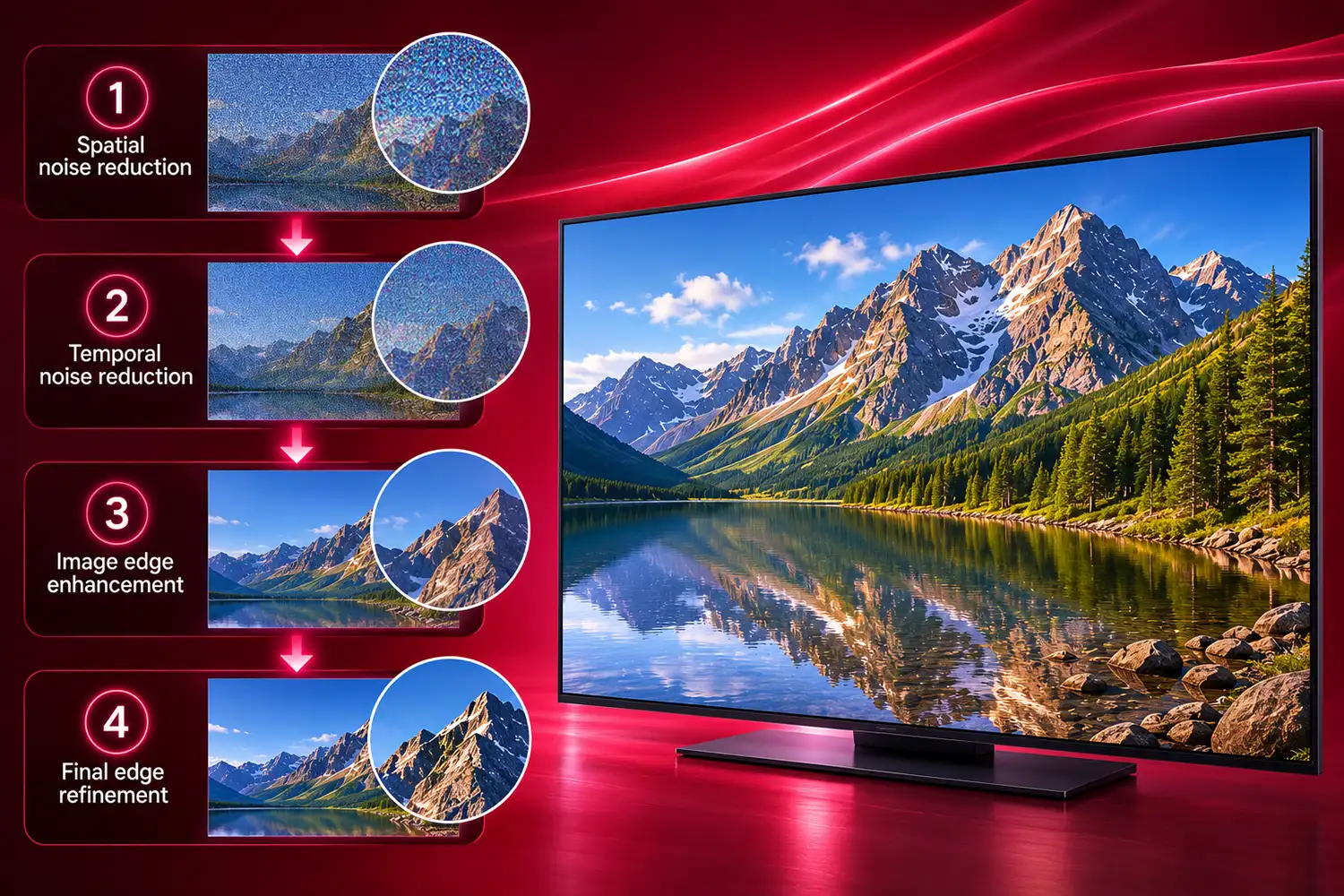
LG describes these four stages as follows:
Stage 1 — Spatial noise reduction.
Stage 2 — Temporal noise reduction.
Stage 3 — Image edge enhancement.
Stage 4 — Final edge refinement.
What does the term “noise” mean in the context of digital video?
To understand the essence of this feature, it’s important to know what the term “noise” actually means.
The concept of video noise originated back in the era of analog television. Analog television signals were vulnerable to electrical interference, poor reception, and other external factors that caused random dots, graininess, and flickering to appear on the screen. These unwanted disturbances became known as video noise.
Digital video is fundamentally different. Modern TVs receive video as digital data, so the analog signal noise that existed in broadcast television is no longer present. If the digital stream is received correctly, the image is reproduced exactly as it was encoded.
So why does LG still talk about noise reduction?
The answer is simple. Consumers are familiar with this term, and it has long been associated with improved picture quality. In reality, modern TVs do not eliminate analog signal noise—they reduce the visible artifacts that arise in compressed digital video.
How Quad Step Noise Reduction works

Digital video is compressed before it is stored or transmitted. Higher compression reduces file size and bandwidth requirements, making streaming more efficient. However, strong compression can also introduce visible image defects known as compression artifacts.
The most common artifacts include blocky areas in the image, uneven color gradients, halos around object edges, random grain created during encoding, and motion artifacts that may appear as faint trails or “ghosting” behind moving objects. These imperfections are not caused by the TV itself—they are introduced during the video compression process.
Quad Step Noise Reduction is designed to minimize these defects. Before each frame is displayed, the TV’s image processor analyzes the video for common compression artifacts and applies correction algorithms to reduce their visibility. The “Quad Step” designation simply means that the image passes through four consecutive stages of processing, with each stage performing a different type of analysis and refinement. This is entirely a software-based image enhancement process carried out by the TV’s video processor rather than a feature of the display panel itself.
Which TVs use Quad Step Noise Reduction and Is It worth using?
Quad Step Noise Reduction is available mainly on LG TVs equipped with more advanced image processors, including the α7 and α9 processors used in many OLED and NanoCell models. These processors provide enough computing power to analyze each frame in real time and apply more sophisticated image correction algorithms. The feature can be turned on or off in the TV’s picture settings.
Its usefulness depends largely on the quality of the source video. When watching older TV broadcasts, DVDs, low-bitrate streaming services, or other heavily compressed content, Quad Step Noise Reduction can noticeably reduce compression artifacts and make the picture appear cleaner.
With modern high-quality video, however, the benefit is usually minimal. Content encoded using current codecs at high bitrates, such as 4K Blu-ray discs or premium streaming services, contains very few visible compression artifacts. In these cases, additional image processing often provides little improvement and may even reduce fine image detail, which is why many users prefer to leave the feature disabled when watching high-quality content.