

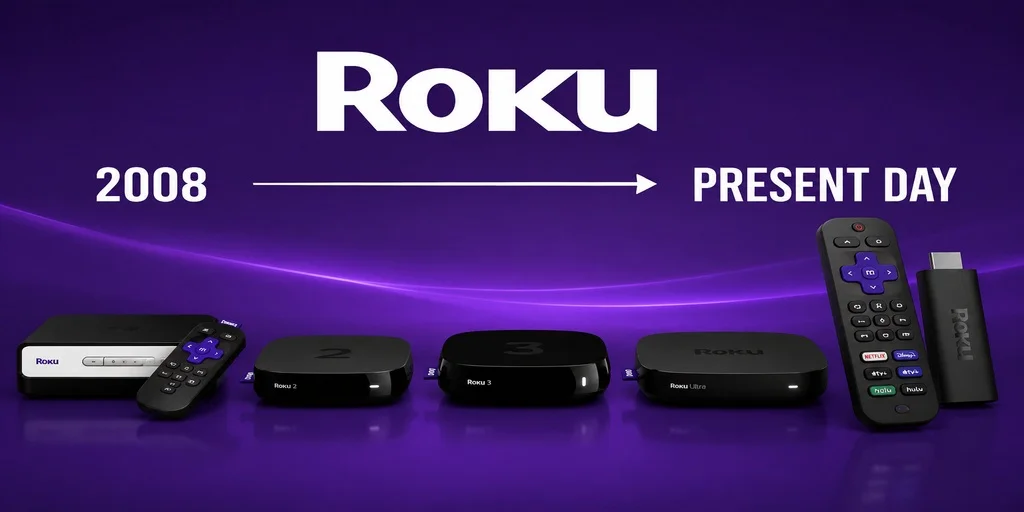
Roku is a very popular video streaming service that was first launched in the United States and Canada. Today, it operates not only in the North American market but also in Latin America, Australia, and some European Union countries, including the United Kingdom, Austria, Germany, and France. As one of the first video streaming platforms, Roku gained popularity by becoming a pioneer in the industry. Roku devices allow users to turn an older TV into a modern smart TV for as little as $30.
Users appreciate this concept: they purchase a small external device and gain access to thousands of TV channels, shows, and movies. With Roku TV, you can cut the cord and, most importantly, access channels that may not be available through your cable provider. If you own an older TV, Roku also allows you to use streaming services that the television itself does not support.
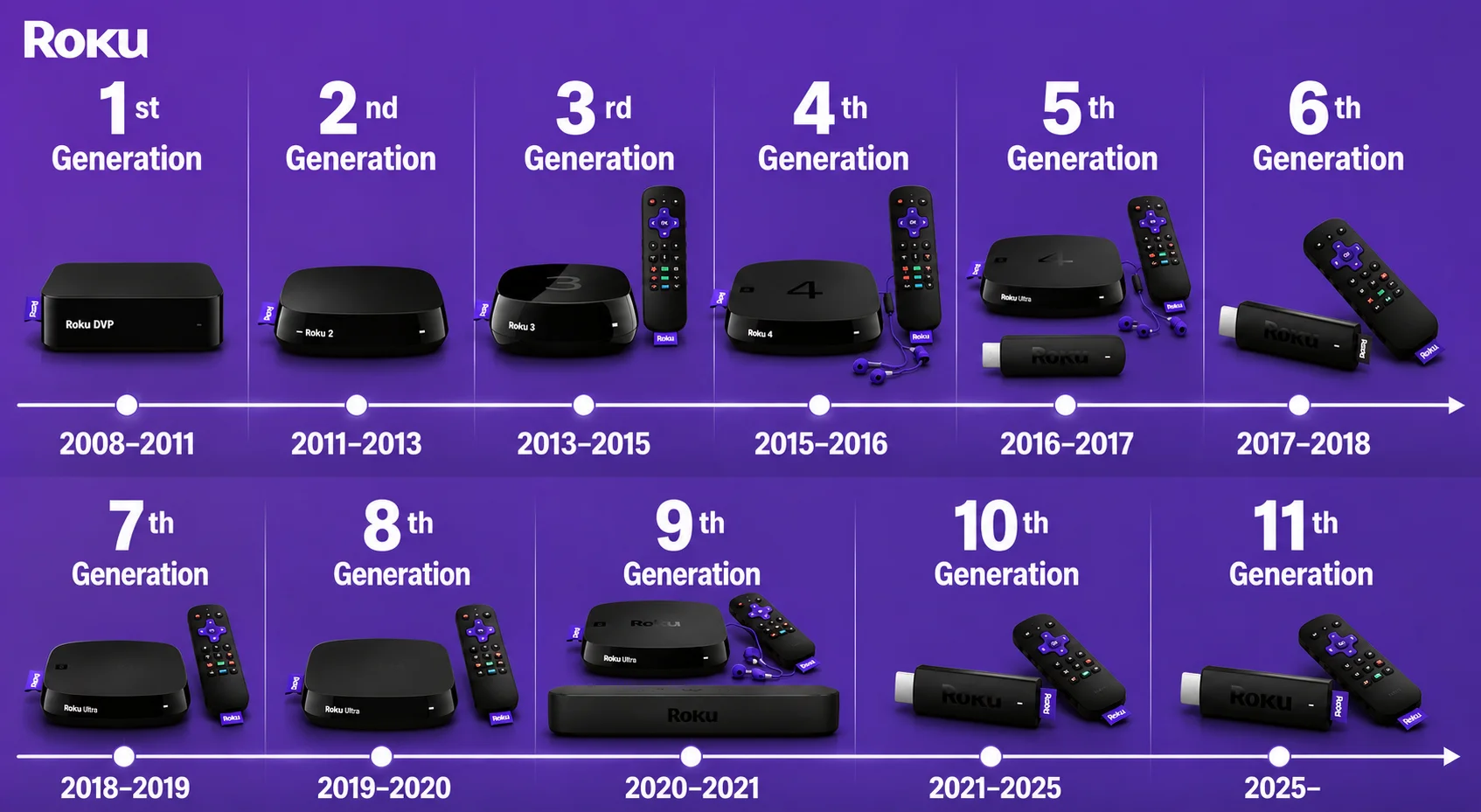
First Generation of Roku (2008–2011)
The first generation of Roku devices began with the release of the Roku DVP N1000 on May 20, 2008. The device was developed in partnership with Netflix as a compact streaming player for the newly launched Watch Instantly service. The main goal was to create an affordable and simple media player that could give traditional televisions access to online video content.
The Roku DVP introduced automatic software updates, allowing Roku to add new channels, improve performance, and expand functionality even after the device had been purchased.
In 2009, Roku expanded its product range with the release of the Roku SD and Roku HD-XR models. The Roku SD was a simplified version designed for basic use and included only analog video outputs, while the Roku HD-XR offered improved connectivity with Wi-Fi support and a USB port.
During this period, Roku also introduced the Channel Store, which allowed users to install applications from third-party streaming services. This change transformed Roku from a device focused mainly on Netflix into a platform supporting a wider range of online content.
Later, Roku released the Roku XD and Roku XDS models, which added support for 1080p video, improved wireless connectivity, USB functionality, and optical audio output on the XDS model.
Support for first-generation Roku devices was discontinued in 2015, ending the first stage of Roku’s development and leading to newer generations with improved hardware and expanded features.
Second Generation of Roku (2011–2013)
The second generation of Roku devices was introduced in 2011 with the release of the Roku 2 HD, Roku 2 XD, and Roku 2 XS models. These devices featured upgraded hardware with faster processors, improved performance, and built-in support for Wi-Fi and Bluetooth connectivity.
The Roku 2 XS was the most advanced model in the lineup, offering additional features such as an Ethernet port, USB support, and compatibility with the Roku Game Remote for motion-controlled games.
In 2012, Roku introduced the Streaming Stick, a compact streaming device designed in the form of an HDMI adapter. It allowed users to add Roku functionality to compatible televisions without using a traditional set-top box.
During the same period, Roku added a universal search feature that allowed users to find movies, TV shows, and other content across multiple streaming services directly from their Roku device. This made searching for content faster and more convenient.
Third Generation of Roku (2013–2015)
The third generation of Roku devices was introduced in 2013 with the release of the Roku 3 and an updated version of the Roku 2.
The Roku 3 featured a much more powerful processor compared with the previous Roku 2 XS, providing faster operation and improved performance. It also introduced a new remote control that connected to the player through Wi-Fi Direct instead of traditional infrared signals. The remote included a built-in headphone jack, allowing users to listen to TV audio privately through headphones. At the time, this was a unique and convenient feature among streaming devices.
In 2014, Roku added Miracast support, allowing users to wirelessly mirror content from compatible mobile devices to their television.
Fourth Generation of Roku (2015–2016)
The fourth generation began with the release of the Roku 4 in October 2015. The main improvement was support for 4K Ultra HD video streaming, making Roku compatible with the new generation of UHD televisions that were becoming increasingly popular.
The device was designed to handle higher-resolution video and provide better performance for modern streaming services as 4K TVs started to become more widely available.
Fifth Generation of Roku (2016–2017)
In 2016, Roku introduced a completely updated lineup of streaming devices, including the Roku Express, Roku Express+, Roku Premiere, Roku Premiere+, and Roku Ultra.
This generation appeared during a period when streaming technology was rapidly changing. New video compression formats and the introduction of HDR video required more powerful hardware and updated software support. Premium Roku models gained HDR10 support, while all new devices received improved performance and better compatibility with modern televisions.
At the same time, many manufacturers were updating their operating systems and hardware platforms, which gradually limited support for older devices. Roku’s new generation focused on providing better performance and support for the latest video standards.
Sixth Generation of Roku (2017–2018)
In 2017, Roku introduced its sixth generation of streaming devices. The company discontinued the Roku Premiere and Premiere+ models and introduced the Streaming Stick+, which featured an improved Wi-Fi antenna system for better wireless performance.
The Roku Streaming Stick, Roku Express, and Roku Express+ also received updated processors, improving speed and overall responsiveness. The main focus of this generation was enhancing performance, improving wireless connectivity, and providing a smoother streaming experience.
Seventh Generation of Roku (2018–2019)
In 2018, Roku updated its product lineup with minor improvements rather than a complete redesign.
The existing Express, Express+, Streaming Stick, and Streaming Stick+ models continued with small hardware changes. The Roku Ultra received a new model number and was offered with premium JBL headphones included in the package.
Roku also brought back the Premiere and Premiere+ names, but these models were completely new devices and were not direct successors to the earlier versions. They were based on newer hardware and focused on providing affordable 4K streaming.
Eighth Generation of Roku (2019–2020)
The eighth generation of Roku devices was introduced in 2019. During this period, Roku focused mainly on improving existing models and expanding the capabilities of Roku OS through software updates.
At the same time, support for older first-generation Roku devices, including the Roku HD, HD-XR, SD, XD, and XDS models, was discontinued. These devices had received support for many years, which was a long lifespan compared with many modern consumer electronics products.
Ninth Generation of Roku (2020–2021)
In 2020, Roku introduced an updated generation of streaming devices with improved hardware and new product categories.
The main new model was the Roku Ultra 4800, which featured updated components, faster performance, and support for Dolby Vision. It became one of the most advanced Roku players available at the time.
Roku also introduced the Streambar, a device that combined a Roku streaming player with a compact soundbar, providing both streaming capabilities and improved TV audio in a single product.
The new Roku Ultra 4800 also removed the microSD card slot, which had previously been used for expanding storage on some models.
In 2021, Roku expanded the lineup with the Roku Express 4K+ and introduced the Roku Voice Remote Pro with additional voice control features.
Tenth Generation of Roku (2021–2025)
In 2021, Roku introduced its tenth generation of streaming devices, with the main additions being the Roku Streaming Stick 4K and Roku Streaming Stick 4K+.
These models added support for Dolby Vision, improved performance, faster wireless connectivity, and compatibility with the new Roku Voice Remote Pro.
The Roku Ultra LT was also updated with a faster processor, improved Wi-Fi performance, Ethernet connectivity, and Dolby Vision support. This generation focused on improving picture quality, wireless performance, and compatibility with modern 4K televisions.
Eleventh Generation of Roku (2025)
In 2025, Roku introduced its eleventh generation of streaming devices.
The new lineup included the Roku Streaming Stick and Roku Streaming Stick Plus. These models focused on improved energy efficiency and greater convenience, including the ability to receive power directly from a television’s USB port.
Another important change was the transition from Micro USB to USB-C connectors in the new devices, bringing Roku hardware in line with newer connection standards.
Roku TVs
Building on the success of its streaming devices, Roku introduced Roku TV, a television operating system, in 2014. Chinese manufacturers TCL and Hisense were among the first to launch televisions with Roku OS for the North American market.
Rather than manufacturing televisions itself, Roku licenses its operating system to TV manufacturers. As a result, Roku TV is available from brands including TCL, Hisense, Sharp, Philips, JVC, RCA, Element, Westinghouse, Onn, and Sanyo.
In 2023, Roku expanded into the television market by introducing TVs under its own brand. Although these models carry the Roku name, they are manufactured by TCL and Hisense.

[…] fact, the only difference between Roku TV and Roku Devices is that Roku TV is the operating system that is installed on the Roku Devices themselves and on some […]