

For decades, Dolby has been a leader in the field of audio, developing audio codecs and sound technologies. Its innovations have become indispensable in many sectors—from the film industry to home entertainment. One of the company’s areas of focus is the development of sound processing technologies, one of which is Dolby Atmos.
What is Dolby Atmos?
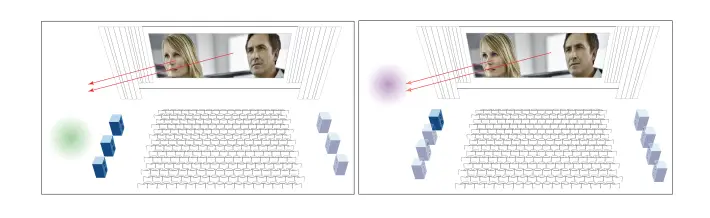
Dolby Atmos is a sound processing technology designed to create the most realistic sound environment possible. This technology is based on the concept of “sound objects”—individual sounds that can be precisely placed anywhere in three-dimensional space, including above the listener.
This creates a fully immersive experience, as if sounds are coming from all around and above your head, turning your home into a real movie theater.
First introduced in movie theaters in 2012, Dolby Atmos technology has since become available for home use. Today, it is supported by a wide range of devices, including soundbars, AV receivers, and TVs, making it accessible to many users.
Advantages of Dolby Atmos over traditional systems
Traditional sound systems, such as 5.1 and 7.1 configurations, use fixed channels that distribute sound in specific directions. For example, front, side, and rear speakers work together to create a surround sound effect, but they are limited by the channels.
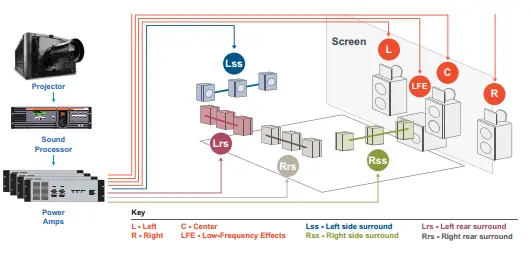
In contrast, Dolby Atmos delivers dynamic surround sound by supporting up to 128 sound objects, each of which can be independently positioned and moved within the space.
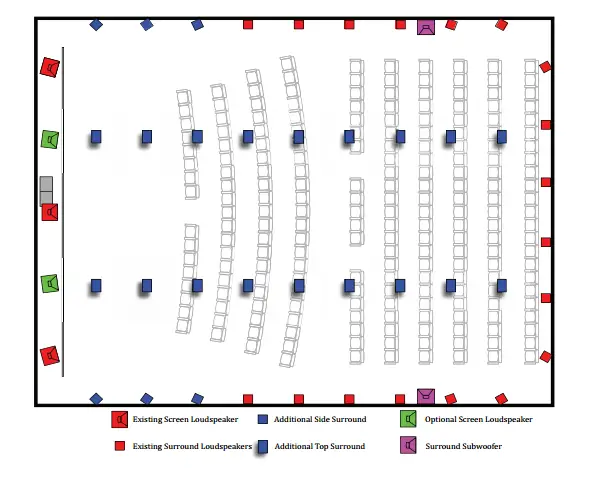
The use of ceiling speakers or special reflectors helps create a vertical surround sound effect. This effect is particularly noticeable in scenes with flying helicopters or falling rain, where sounds seem to surround the listener.
Applications of the technology in various fields
Dolby Atmos isn’t limited to movie theaters; it’s also widely used in the music industry, video games, and streaming platforms. Services such as Netflix, Disney+, and Amazon Prime Video offer many movies and TV shows that support this format, enhancing the viewing experience.
Music albums recorded in Dolby Atmos allow listeners to hear every detail, as if they were in the studio alongside the artists. Game developers use this technology to make gameplay more immersive, allowing players to pinpoint the direction of sounds—such as footsteps or approaching danger.
Using Dolby Atmos at home
Despite marketing efforts and the availability of movies with Dolby Atmos codecs, achieving this level of sound quality at home can be challenging. To fully enjoy Dolby Atmos, you’ll need a compatible speaker system. Just because an audio system claims to support Dolby Atmos doesn’t guarantee exceptional sound quality. TV manufacturers are trying to make the most of Atmos’ capabilities by creating systems where the TV’s speakers and the audio system’s speakers work together—Samsung calls it Q-Symphony, LG calls it WOW Orchestra, Sony calls it Acoustic Center Sync, and Philips calls it Play-Fi.
The main problem is that achieving such sound reproduction accuracy often requires a specially designed room, essentially creating a mini-movie theater in your home. You’ll also need a sound system that includes omnidirectional speakers.
Even with all the necessary equipment, the sound quality at home won’t match that of a commercial movie theater; while it will improve significantly, it may still fall short of a true cinematic experience.