
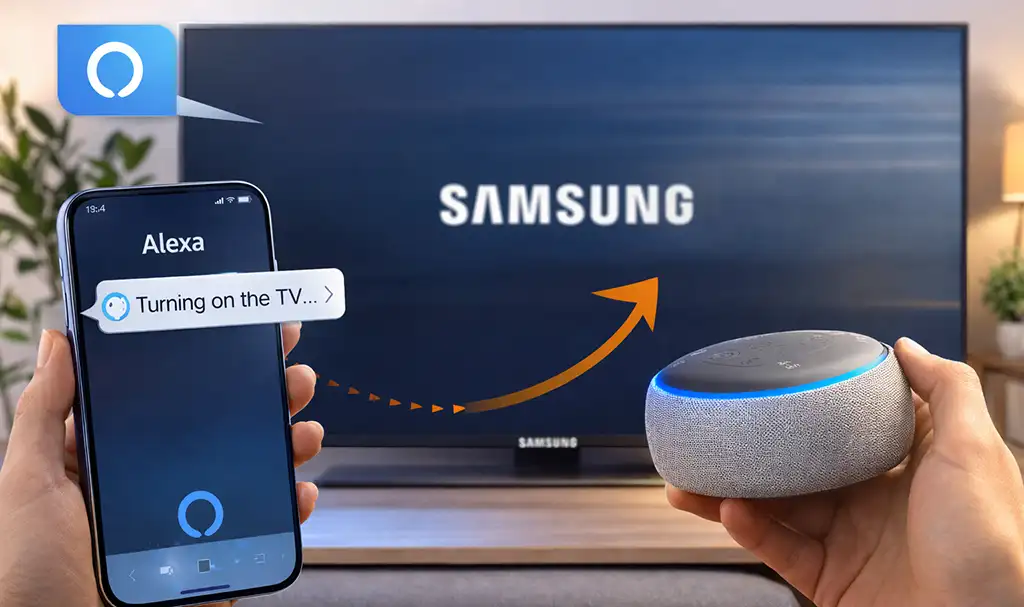
If your Samsung TV turns off through Alexa, Google Assistant, or SmartThings but does not turn on again, the problem is usually related to how the TV handles network communication in standby mode.
Remote power-on requires the TV to remain available to the network after it has been switched off. Whether this works depends on the TV model, its year of release, the type of network connection, and the available settings.
How remote power On works on Samsung TVs
When the TV is on, SmartThings can communicate with it through the home network. Alexa and Google Home can use the SmartThings connection to send commands to the TV.
Turning the TV off is straightforward because the TV is already active and connected to the network. Turning it on remotely requires a supported wake-up function that allows the TV to respond while it is in standby.
Samsung has used technologies such as Wake on LAN (WOL) and Wake on Wireless LAN (WOW) for this purpose. On some models, these functions are not shown under these names and are instead included in settings such as Wake via Mobile Device, Wireless TV On, or Wired TV On.
Setting up voice control for a Samsung TV
Samsung TVs released before 2018 supported standby mode only for Wi-Fi and HDMI. If your TV is connected via a wired connection, you can only control it when it is turned on. Although you can send a command to turn it off, you won’t be able to turn it back on.
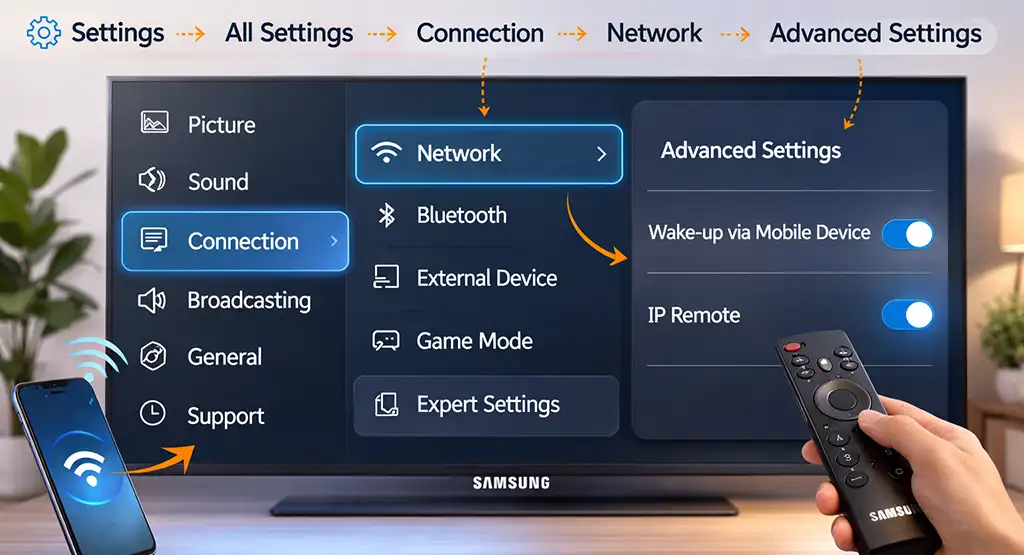
Modern Samsung TVs do not have separate WOL or WOW settings. Instead, they use the “Wake via Mobile Device” feature, which allows third-party mobile devices to turn on the TV, and “IP Remote,” which enables control over the Internet. Both of these settings must be enabled.
To enable the “Wake-up via Mobile Device” feature, go to “Settings,” then “All Settings,” select “Connection,” then “Network,” open “Advanced Settings,” and enable this option. The “IP Remote” feature is enabled through the same menu.
After enabling these features, try turning off the TV via Alexa and turning it back on after five minutes. The TV should now support waking up from standby via Wi-Fi. If it still doesn’t turn on, check to see if the Wi-Fi module is disabled in standby mode.
Checking Wi-Fi Standby Mode
You can check whether the Wi-Fi connection remains active when your TV is in standby mode. The easiest way to do this is to use your smartphone as a mobile hotspot.
Turn on the hotspot on your smartphone and connect the TV to it. Then turn off the TV and wait about five minutes. Check your smartphone to see whether the TV is still listed as a connected device. If the TV remains connected to the hotspot, its Wi-Fi module continues to operate while the TV is in standby mode. This means that the TV can maintain a network connection after being turned off.
Experienced users can also check the TV’s connection status through the router. The router’s device list can show whether the TV remains connected after it enters standby mode. If the TV disconnects from Wi-Fi shortly after being turned off, it will not be able to receive commands over the network until it is turned on again.
Turning On Older Samsung TV Models via Alexa or Google
Some older Samsung TV models do not support network wake-up, so they cannot be turned on directly through SmartThings, Alexa, or Google while in standby mode. In this case, you can use an external streaming device connected to the TV via HDMI.
You can control devices such as the Fire TV Stick, Roku, or Chromecast via Alexa or Google. To get started, enable Anynet+ (HDMI-CEC) on your Samsung TV and make sure your streaming device supports HDMI-CEC; this feature must be enabled on the streaming device. When you use Alexa or Google to turn on a streaming device, it starts up via its own network connection. If HDMI-CEC is enabled, the TV can detect that the HDMI device has become active and will automatically turn on or switch to the corresponding HDMI input.
This method allows you to control older Samsung TVs via Alexa or Google, even if the TV itself does not support network wake-up.