

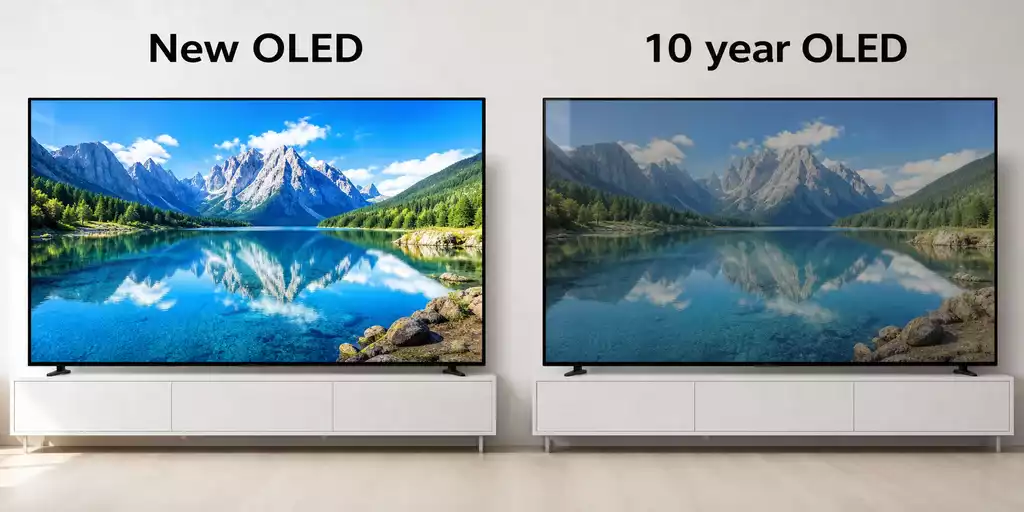
Modern OLED displays are typically designed to provide tens of thousands of hours of operation. However, their actual service life can vary considerably depending on several factors, including brightness, usage patterns, and operating temperature.
Brightness has a direct impact on panel longevity. The higher the display brightness, the faster the organic materials in the pixels gradually degrade. Usage time also matters: a TV that operates for 10 hours a day will naturally experience less wear than one used for 18–20 hours a day. The more intensively an OLED panel is used, the faster its characteristics may deteriorate.
Temperature is another important factor. OLED materials are sensitive to excessive heat, which can accelerate degradation. For this reason, OLED TVs should not be installed in poorly ventilated wall niches or other locations where heat cannot dissipate properly.
Under normal usage conditions, a modern OLED TV or monitor can operate for many years without a noticeable reduction in image quality. Over time, however, the organic pixels gradually lose efficiency, which can result in a gradual reduction in maximum brightness and other display characteristics.
One of the most well-known concerns with OLED technology is burn-in. This can occur when the same static elements—such as a TV channel logo, game interface, taskbar, or other fixed graphics—remain on the screen in the same position for extended periods. In such cases, the affected pixels can age faster than the surrounding pixels, leaving a persistent image.
Modern OLED displays incorporate various technologies designed to reduce the risk of burn-in and compensate for pixel aging. These include automatic brightness control, pixel shifting, screen refresh cycles, and pixel compensation algorithms.
However, one of the most important factors influencing OLED lifespan is the continuous development of the display materials themselves. Newer generations of OLED panels use improved organic materials and manufacturing technologies, resulting in significantly better durability, higher brightness, and greater resistance to image retention and burn-in than earlier generations.
OLED Display lifespan by years
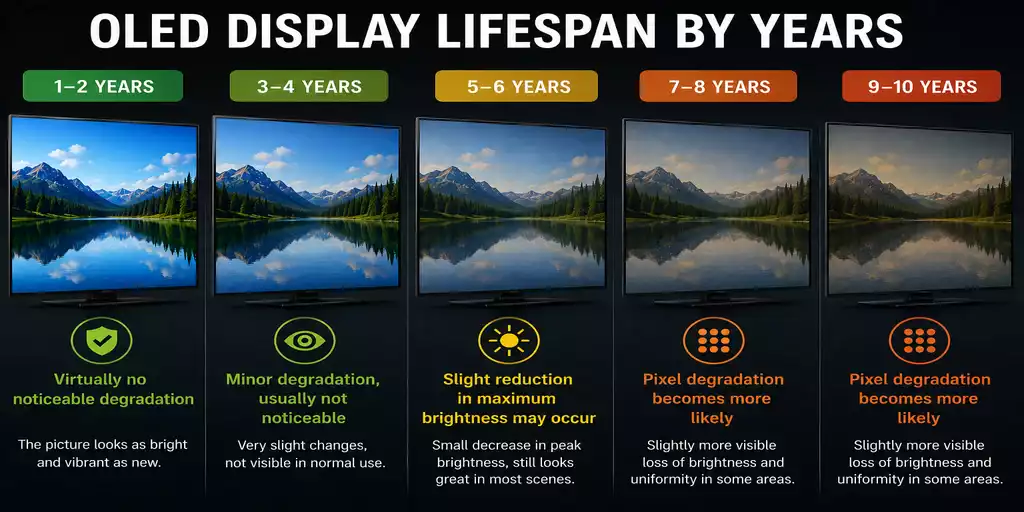
Experience shows that, on average, the lifespan of a modern OLED TV is about 7–10 years. For first-generation OLED TVs released in 2015–2017, the lifespan was slightly shorter; problems began to appear as early as 3–4 years in. The monitor’s lifespan will be slightly shorter if you use it intensively.
| Lifespan | OLED Display Condition |
|---|---|
| 1–2 years | Virtually no noticeable degradation |
| 3–4 years | Minor degradation, usually not noticeable |
| 5–6 years | Slight reduction in maximum brightness may occur |
| 7–8 years | Pixel degradation becomes more likely |
| 9–10 years | Reduced brightness and uniformity may become noticeable |
| 11–12 years | Significant degradation may occur with intensive use |
| 13–15 years | Display may still work, but image quality can be noticeably reduced |
| 15+ years | Lifespan depends strongly on usage conditions and panel condition |
How OLED manufacturers have extended Display Lifespan
OLED manufacturers have found several ways to extend the lifespan of their displays. The technologies used vary depending on the manufacturer.
One important development came from LG with its OLED evo panels. These panels use a layer of microscopic lenses that directs more of the light produced inside the display toward the viewer. This makes it possible to increase brightness without a corresponding increase in power consumption.
New OLED materials have also played an important role. Modern organic materials are more stable and can produce light for much longer before their performance begins to decrease.
The first generations of OLED displays had a major problem with blue subpixels. They degraded much faster than the red and green subpixels, which could eventually cause the screen to develop a reddish or yellowish tint.
This problem has been largely solved in modern OLED displays. Improvements in OLED materials and panel design have made newer generations much more resistant to degradation and have significantly increased their lifespan.