

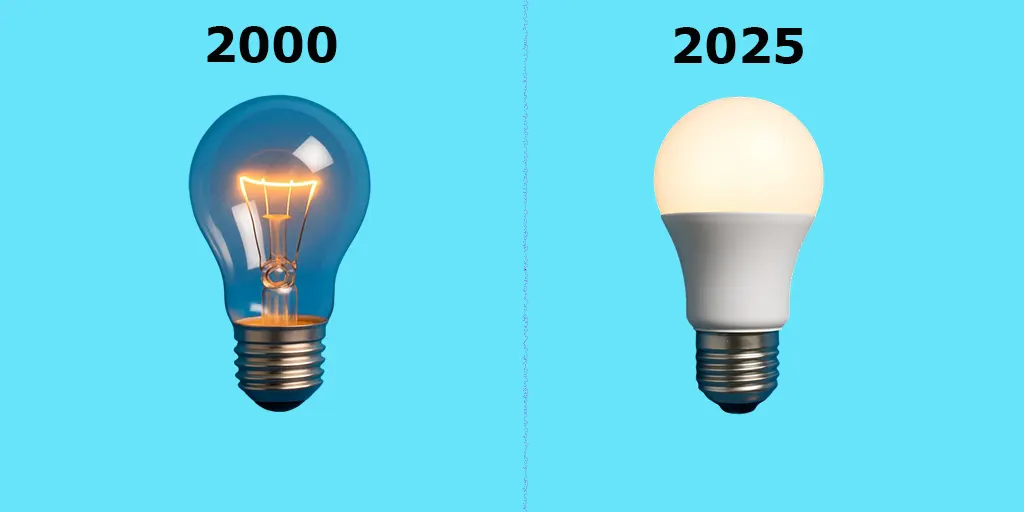
LED bulbs have become the most common choice for household lighting. They use considerably less electricity than incandescent bulbs and are available in many forms, from standard replacement bulbs and spotlights to ceiling fixtures, LED strips, and smart lamps.
One of the main advantages of LED lighting is its long service life. Most bulbs are rated for 10,000 to 20,000 hours, while some products have ratings above 20,000 hours. However, the number of hours shown by the manufacturer does not necessarily mean that the bulb will continue working perfectly for that entire period.
How many years does an LED bulb last?
The number of years depends on how long the lamp is used each day. For example, a bulb rated for 20,000 hours would correspond to approximately:
| Daily use | 20,000 hours |
|---|---|
| 3 hours per day | 18.3 years |
| 5 hours per day | 11 years |
| 8 hours per day | 6.8 years |
| 12 hours per day | 4.6 years |
These figures are simply a conversion of operating hours into years. Actual results can vary considerably between products.
An LED bulb contains more than just the LEDs themselves. It also has an electronic driver, capacitors, a circuit board, wiring, and other components. If one of these parts fails, the lamp can stop working even though the LEDs may still be functional.
Heat is particularly important. LEDs are much more efficient than incandescent bulbs, but they still produce heat that must be removed from the housing. When a bulb is installed in a poorly ventilated or enclosed fixture, the temperature inside can become quite high. Continuous exposure to excessive heat can shorten the life of the electronics and the LEDs.
The quality of the components also makes a difference. Two bulbs with the same 20,000-hour rating can have very different real-world reliability if they use different drivers, capacitors, LEDs, and cooling systems.
Does an LED bulb become dimmer over time?
An LED does not necessarily fail suddenly when it gets old. In many cases, the light output gradually decreases.
This process is called lumen depreciation. As the LED ages, it produces less light than it did when it was new. The lamp can continue operating even though its brightness has declined.
This is why the rated life of an LED product should not always be understood as the exact moment when it stops producing light. Lighting manufacturers can define useful life according to how well the product maintains its original light output.
Modern LED bulbs generally maintain their brightness well for thousands of hours. A significant loss of light after only a short period of use is more likely to indicate a problem with the product, excessive heat, or another unfavorable operating condition.
A lamp can also develop other symptoms before it fails completely. Flickering, intermittent operation, unusual heat, or a sudden loss of light can indicate a problem with the driver or another internal component.
LED bulbs compared with other types of lamps
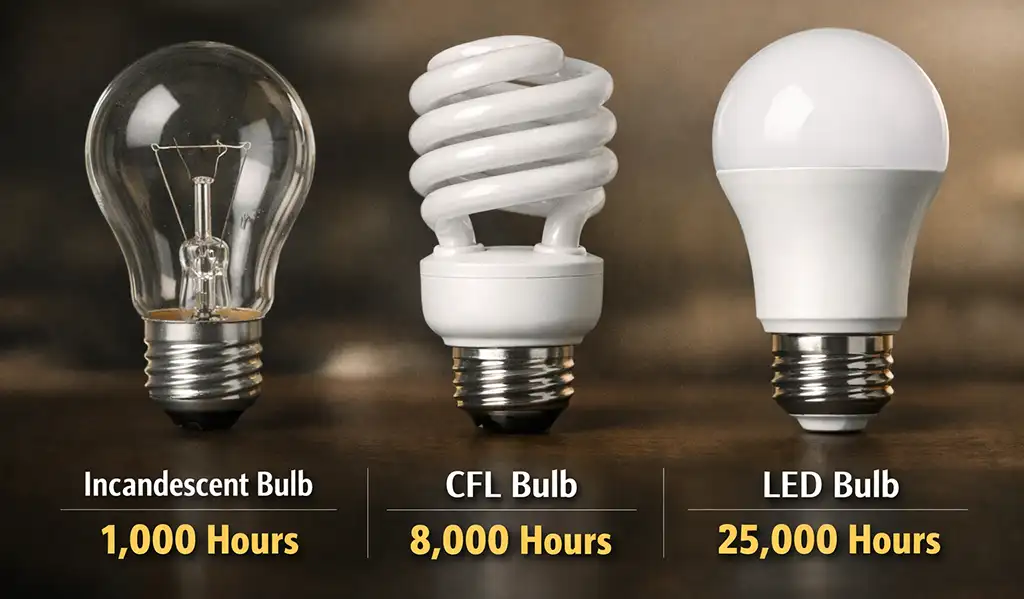
LED lighting has a considerably longer typical service life than traditional incandescent and halogen lamps.
| Lamp type | Typical rated life |
|---|---|
| Incandescent | About 1,000 hours |
| Halogen | About 2,000 hours |
| Compact fluorescent | About 6,000–15,000 hours |
| LED | About 10,000–20,000 hours or more |
These are typical ranges, and the rating of an individual product can be different.
LEDs also have an important advantage in energy consumption. For the same amount of light, an LED bulb generally requires far less electricity than an incandescent bulb. Combined with its long operating life, this makes LED lighting a practical replacement for older technologies.
In normal conditions, a well-made LED bulb can provide many years of use. Its real service life depends on the construction of the lamp, the reliability of its electronics, heat dissipation, electrical conditions, and the number of hours it operates each day. The figure printed on the package should therefore be viewed as a rated service life under specified conditions, rather than a guarantee that the bulb will operate without failure for exactly that number of hours.