
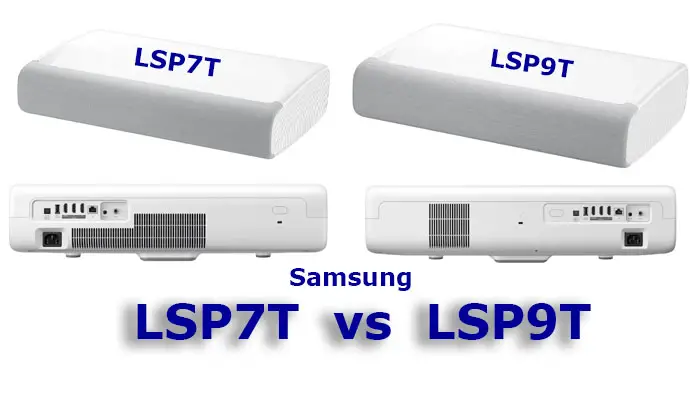
The Samsung The Premiere LSP7T and LSP9T are 4K ultra-short-throw laser projectors introduced in Samsung’s 2020 lineup. Both combine a projector, a Tizen-based Smart TV platform, built-in speakers and a TV tuner in a compact home theater device.
The LSP9T is the more advanced model. It features a triple-laser light source, higher brightness, better native contrast, a shorter throw ratio, a larger maximum image size and a more powerful sound system. The LSP7T, meanwhile, offers similar core functionality at a lower specification level.
Overview
Both models use DLP technology to produce 4K UHD images (3840 × 2160 pixels). Their ultra-short-throw design allows them to project a large picture from just a short distance from the wall, without ceiling installation. They have a similar minimalist appearance, with compact cabinets covered in premium Kvadrat fabric.
The LSP7T and LSP9T also feature Samsung’s Tizen Smart TV platform, built-in speakers, Wi-Fi, Bluetooth and support for voice assistants. This allows users to watch TV shows and movies without an external media player or sound system. For the best picture quality, a dedicated projection screen is recommended. A smooth wall coated with special projector screen paint can also be used, while an ordinary painted wall may reduce contrast and affect color reproduction.
Key differences
- Light source: The LSP7T uses a single laser, while the LSP9T uses a triple RGB laser system.
- Brightness: The LSP7T delivers 2,200 ANSI lumens, compared with 2,800 ANSI lumens on the LSP9T. This makes the LSP9T approximately 27% brighter.
- Native contrast: The LSP7T has a 1,000:1 contrast ratio, while the LSP9T offers 1,500:1, a 50% improvement.
- Dynamic contrast: Both models have a specified dynamic contrast ratio of 2,000,000:1.
- Throw ratio: The LSP7T has a 0.254:1 throw ratio, compared with 0.189:1 for the LSP9T. The latter can be positioned closer to the wall to produce an image of the same size.
- Image size: The LSP7T supports screen sizes from 90 to 120 inches, while the LSP9T supports 100 to 130 inches.
- Sound system: The LSP7T has a 30 W, 2.2-channel system. The LSP9T increases output to 40 W and uses a 4.2-channel configuration with Samsung Acoustic Beam technology.
- Power consumption: Maximum consumption is 320 W for the LSP7T and 410 W for the LSP9T. Typical consumption is 240 W and 270 W, respectively.
- Weight: The LSP7T weighs 9.1 kg, while the LSP9T weighs 11.5 kg.
What the two models have in common
Despite their differences in brightness, laser technology and sound, the LSP7T and LSP9T share most of their features. Both use DLP technology with native 4K UHD resolution (3840 × 2160 pixels), support HDR10+, HDR10 and HLG, and include Samsung’s UHD Processor, PurColor, Game Enhancer and Filmmaker Mode.
Both run Samsung’s Tizen operating system, with Universal Guide, TV Plus, voice assistant support, Tap View and OneRemote. Connectivity includes three HDMI ports (one with eARC), one USB port, Ethernet, 802.11ac Wi-Fi, Bluetooth, RS-232 (Ex-Link) and an optical digital audio output. Both also have digital and analog TV tuners, support Dolby Digital Plus, produce approximately 32 dB of operating noise and consume less than 0.5 W in standby mode. Available tuners and smart features may vary by region.
Full specifications
| Parameter | LSP7T | LSP9T |
|---|---|---|
| Picture | ||
| Projection technology | DLP, laser | DLP, triple laser |
| Light source | Single laser | Triple RGB laser |
| Native resolution | 3840 × 2160 (4K UHD) | 3840 × 2160 (4K UHD) |
| Brightness | 2,200 ANSI lumens | 2,800 ANSI lumens |
| Native contrast | 1,000:1 | 1,500:1 |
| Dynamic contrast | 2,000,000:1 | 2,000,000:1 |
| Throw ratio | 0.254:1 | 0.189:1 |
| Screen size | 90–120 inches | 100–130 inches |
| HDR formats | HDR10+, HDR10, HLG | HDR10+, HDR10, HLG |
| Light source life | Up to 20,000 hours | Up to 20,000 hours |
| Audio | ||
| Output power | 30 W | 40 W |
| Speaker configuration | 2.2 channels | 4.2 channels |
| Audio technologies | Dolby Digital Plus | Dolby Digital Plus, Acoustic Beam |
| Operating noise | 32 dB | 32 dB |
| Connections | ||
| HDMI | 3 (one with eARC) | 3 (one with eARC) |
| USB | 1 | 1 |
| Ethernet / Wi-Fi / Bluetooth | LAN, 802.11ac, Bluetooth | LAN, 802.11ac, Bluetooth |
| RS-232 (Ex-Link) | Yes | Yes (regional variation) |
| Optical audio output | Yes | Yes |
| TV tuners | Digital, analog | Digital, analog |
| Smart features | ||
| Operating system | Tizen | Tizen |
| Remote control | Samsung OneRemote (TM-1850A) | Samsung OneRemote (TM-1850A) |
| Power | ||
| Power supply | AC 100–240 V, 50/60 Hz | AC 100–240 V, 50/60 Hz |
| Maximum consumption | 320 W | 410 W |
| Typical consumption | 240 W | 270 W |
| Standby consumption | Under 0.5 W | Under 0.5 W |
Dimensions and weight
The LSP9T is larger and heavier than the LSP7T. It is approximately 1.8 cm wider and 2.5 cm deeper, and weighs 2.4 kg more. Its cabinet is also slightly taller.
All dimensions below are given as width × height × depth.
| Parameter | LSP7T | LSP9T |
|---|---|---|
| Projector dimensions | ||
| Body, cm | 53.2 × 13.27 × 34.2 | 55.0 × 14.1 × 36.7 |
| Body, inches | 20.94 × 5.22 × 13.46 | 21.65 × 5.55 × 14.45 |
| Packaging dimensions | ||
| Packaging, cm | 67.5 × 25.7 × 48.0 | 67.0 × 31.4 × 50.7 |
| Packaging, inches | 26.57 × 10.12 × 18.90 | 26.38 × 12.36 × 19.96 |
| Weight | ||
| Projector, kg / lb | 9.1 / 20.1 | 11.5 / 25.4 |
| With packaging, kg / lb | 11.9 / 26.2 | 15.0 / 33.1 |
| Image size | ||
| Diagonal, inches | 90–120 | 100–130 |
| Diagonal, cm | 229–305 | 254–330 |