

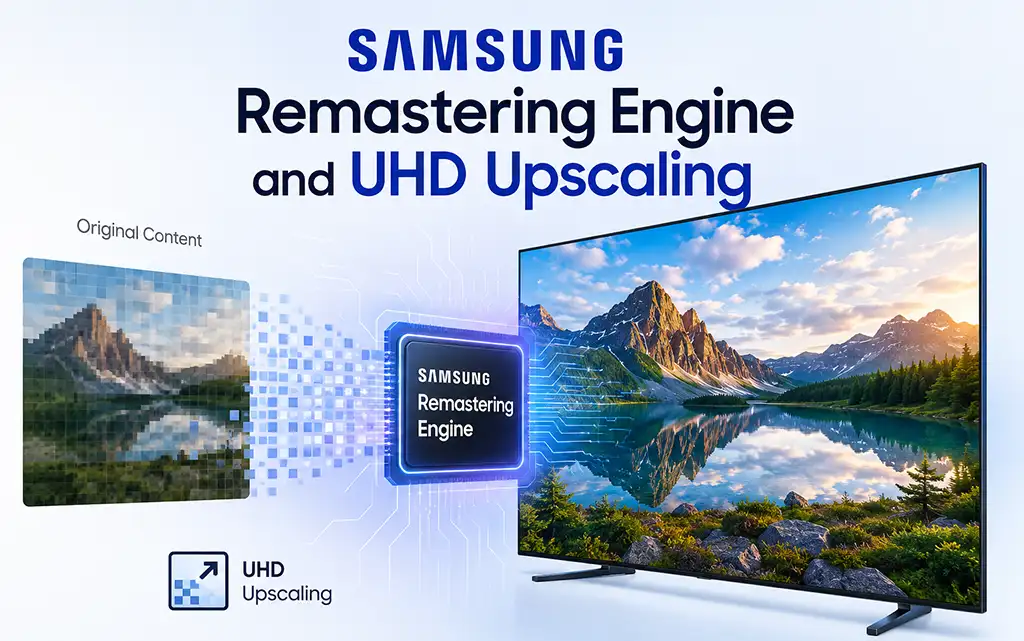
With the advent of 4K UHD TVs, manufacturers needed a way to display lower-resolution content across the entire screen. Without upscaling, lower-resolution images would occupy only part of the display or appear enlarged with reduced sharpness. This led to the development of various upscaling technologies designed to adapt Full HD and other lower-resolution video formats to UHD displays.
In 2015, Samsung introduced its Remastering Engine technology to improve the appearance of lower-resolution content on UHD TVs. However, the term Remastering Engine was not immediately clear to consumers. In 2016, Samsung replaced the term with the more straightforward UHD Upscaling. The new name directly combined the two key concepts — UHD and upscaling — making the purpose of the technology easier to understand.
The basic principle remained unchanged. The TV receives a lower-resolution image and processes it to match the higher resolution of the UHD display.
How Upscaling Works
Upscaling converts lower-resolution video into a format suitable for a higher-resolution display. It cannot restore details that were never present in the original video, but it can make the image appear sharper and smoother on a UHD screen.
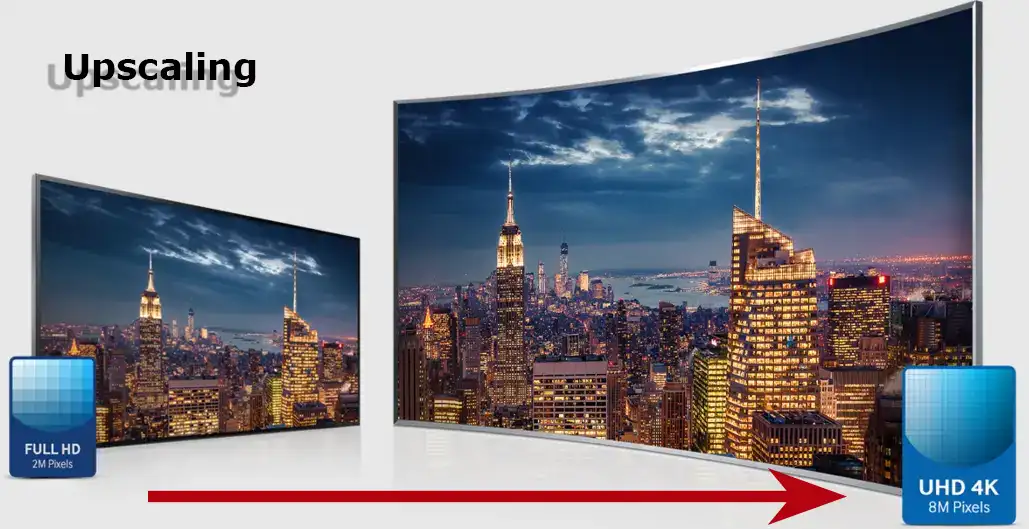
A Full HD image has a resolution of 1,920 × 1,080, or 2,073,600 pixels.
A UHD display has a resolution of 3,840 × 2,160, or 8,294,400 pixels.
Therefore, a UHD display contains four times as many pixels as a Full HD image.
When Full HD content is displayed on a UHD TV, the TV must generate additional pixels to fill the screen. This process is known as upscaling.
The simplest approach is to duplicate existing pixels, but this can produce blocky images, jagged edges, and visible artifacts. Modern TVs instead use image-processing algorithms that analyze the original pixels and their surrounding areas to calculate the values of the additional pixels.
The processor can also analyze edges, textures, contrast, and other image characteristics to improve the result. In other words, modern upscaling is not simply enlarging an image — it combines resolution conversion with image enhancement.
As a result, upscaled content can have smoother transitions, sharper edges, and fewer visible artifacts than content enlarged through simple pixel duplication.
The Role of Modern Processors
When UHD TVs first appeared, their processors were much less powerful than those used in modern televisions. Today’s TV processors can perform significantly more complex image analysis and processing. Scaling algorithms are also built directly into the TV’s processing system, allowing the television to automatically convert lower-resolution content to match the resolution of the display.
These processing capabilities help reduce artifacts that can occur when low-resolution content is displayed on a high-resolution panel and can improve the overall appearance of the image.
As artificial intelligence became increasingly important in consumer electronics marketing, Samsung and other TV manufacturers began using the term AI Upscaling for newer image-processing technologies. The term can be somewhat misleading because the actual scaling is performed by the TV’s processor using dedicated algorithms stored in its system.
However, AI-based models can participate in the process. For example, they can help identify the type of content being displayed — such as sports, nature, or people — and determine which image-processing algorithms are most appropriate for that type of scene.
Samsung currently describes its technology as AI Upscaling, explaining it with the phrase: “AI Upscaling uses formulas based on artificial intelligence.”
Remastering Engine, UHD Upscaling, and AI Upscaling
Samsung’s terminology has changed over time, but these technologies share the same basic purpose — processing lower-resolution content so that it can be displayed more effectively on a higher-resolution screen.
Remastering Engine was an early term Samsung used with its UHD TVs to describe image processing designed to improve lower-resolution content.
UHD Upscaling was introduced as a clearer and more direct name, immediately indicating that the technology was used to adapt lower-resolution content to UHD displays.
AI Upscaling is Samsung’s newer terminology, reflecting the growing use of artificial intelligence and machine-learning technologies in modern image processing.