

Last updated: October 2026
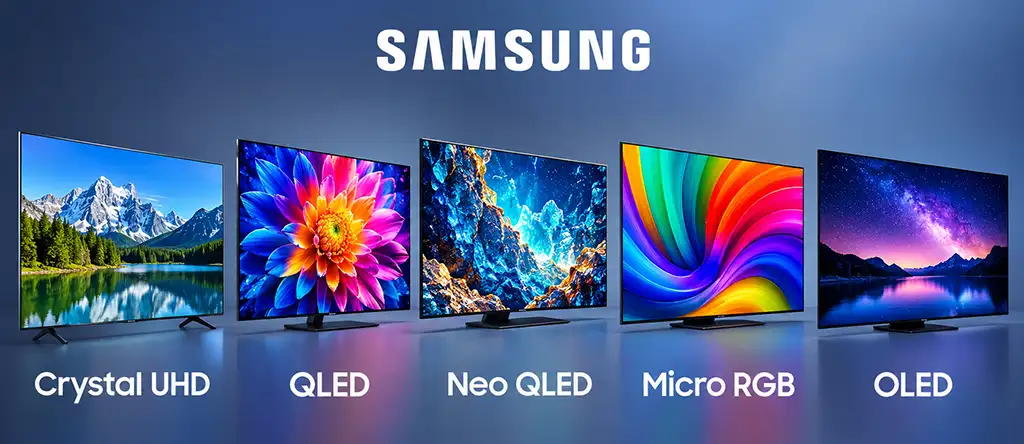
Samsung manufactures TVs under a wide variety of names: Crystal UHD, QLED, Neo QLED, Mini LED, OLED, Micro RGB, and The Frame. Some of these names reflect the screen technology, others the design, and there are also lines categorized by intended use. This guide explains what each Samsung TV line actually is, how it has changed since 2018, and which line is best suited for different types of buyers.
- Crystal UHD is the budget line: a standard 4K LCD TV with a basic backlight.
- QLED adds a quantum dot layer to an LCD TV for better color and brightness at a mid-range price.
- Neo QLED combines quantum dots with a Mini LED backlight and precise local dimming.
- Micro RGB is Samsung’s newest top LCD tier (2026), built on red, green and blue micro LEDs.
- OLED screens light each pixel individually, which gives the deepest black and the best contrast in a dark room.
Samsung TV lines
| Line | How the picture is made | Best for | Example model codes |
|---|---|---|---|
| Crystal UHD | 4K LCD with a basic LED backlight | Tight budgets, bedrooms, second TVs | U8000 series |
| QLED | LCD with a quantum dot layer | Value-minded buyers who want better color | Q6, Q7, Q8 series |
| Mini LED | LCD with a Mini LED backlight | An affordable step into local dimming | M70, M80 series |
| Neo QLED | Mini LED backlight + quantum dots | Bright rooms, sports, HDR | QN70, QN80, QN90 series |
| Micro RGB | LCD with red, green and blue micro LED backlight | Flagship color and brightness | R85, R90, R95 series |
| OLED | Self-lit pixels | Dark rooms, movies, gaming | S85, S90, S95 series |
| Lifestyle | Design-focused TVs and displays | Rooms where looks matter | The Frame, The Serif, The Terrace |
Which Samsung TV should you buy?
| If you want… | Look at |
|---|---|
| The lowest price | Crystal UHD |
| A better picture on a mid-range budget | QLED or Mini LED |
| A bright-room TV for sports, HDR and family viewing | Neo QLED |
| The best picture Samsung offers in a bright room | Micro RGB |
| The best picture for movies in a dim room | OLED |
| A TV that doubles as décor | The Frame |
Within one line, a higher series number usually means better hardware. For HDR formats, see our guide to HDR10, HDR10+, HLG and Dolby Vision, and for Samsung’s picture-quality scoring, read about the PQI Picture Quality Index.
Crystal UHD, the budget 4K line
Crystal UHD TVs are standard 4K LCD TVs equipped with inexpensive panels and minimal or no local dimming. The name “Crystal” refers to the Samsung Crystal Processor. It is not a special processor, just a marketing name for the chip.
You get a 4K picture, Samsung’s Tizen smart platform and the lowest prices in Samsung’s lineup, with screen sizes ranging from 43 to 98 inches. However, the price difference between the 85-inch and 98-inch models is about $800, because manufacturing such large panels is more expensive.
You also lose deep blacks, a wide color gamut and vibrant HDR. Due to the simple backlighting (see our guide to backlight types), dark scenes appear grayer than on QLED, Neo QLED or OLED TVs, and there is no quantum dot layer to enhance colors. These panels may also show fairly large areas of backlight bleed that are visible in the dark.
Choose a TV from this lineup if you need a simple TV for everyday use, such as watching streaming services and the news, or a second TV for the bedroom or kitchen. If you mainly watch movies in a dark room or place a high value on HDR and gaming, consider QLED models or higher.
QLED, Quantum Dots for Better Color Reproduction
QLED TVs are LCD TVs with a layer of quantum dots positioned in front of the backlight. This layer converts the backlight’s light into purer red and green light, making colors appear more vibrant and the picture brighter than on Crystal UHD series TVs. Quantum dots improve color reproduction only. The image itself is still formed by the liquid crystal layer, just like on any LCD TV.
You get a wider color gamut, higher brightness, and better HDR support. Some models use dual LED backlighting, which adjusts the backlight’s color temperature to match the image.
It’s worth noting that Samsung is scaling back this lineup; only time will tell if it will be phased out entirely.
Neo QLED and Mini LED, Local Dimming
Neo QLED retains the quantum dot layer, but the backlight has been replaced by thousands of tiny mini-LEDs, divided into numerous dimming zones. The TV can dim only those areas that are supposed to be dark, while maintaining the brightness of the light areas. Samsung claims that its Neo QLED models use a blue backlight with a genuine quantum dot layer and are certified as “Real QLED” by TÜV Rheinland.
You get deeper blacks than with QLED, less light bleed around bright objects on a dark background, and much higher peak brightness for HDR. Top-tier models are equipped with more powerful processors, and some feature an anti-glare screen coating that helps when watching in a brightly lit room. That’s why Neo QLED is the go-to choice for watching sports, daytime viewing, and gaming on a well-lit screen.
Keep in mind that Neo QLED is still an LCD TV. It can’t match the perfect black of OLED, and a large number of dimming zones alone doesn’t guarantee a perfect picture.
Samsung also offers models with Mini LED technology (the M series). Samsung does not explicitly state that these TVs use quantum dot displays, but the display quality is quite high since the TVs feature true 10-bit panels. Model names vary by region, and in some markets, Samsung TVs with Mini LED technology are still called Neo QLED.
Previously, Neo QLED was also available in 8K versions, but Samsung no longer manufactures them, as production of 8K panels has been discontinued due to low demand. If you see an 8K Neo QLED for sale, it is either leftover stock from last season or a used TV.
Micro RGB, Samsung’s line of premium LCD TVs
Micro RGB technology replaces blue mini-LEDs with individually controllable red, green, and blue micro-LEDs. Since the backlight directly generates colored light, the TV can adjust color and brightness more precisely than with backlights that must convert blue light through a layer of quantum dots. Samsung claims that its top-of-the-line models cover virtually the entire BT.2020 wide color gamut—the standard used for HDR.
In Samsung’s current lineup, Micro RGB technology ranks above Neo QLED. A 130-inch TV was announced in early 2026, but as of October, it had not yet gone on sale because display manufacturers were unable to ramp up production of such displays.
Micro RGB remains an LCD technology. It cannot match the perfect black of OLED, and it has the highest price among Samsung’s LCD lines, so it’s best suited for large screens in well-lit rooms, where its brightness and color reproduction are most noticeable.
OLED, Perfect Black
On an OLED screen, each pixel generates light independently and can be completely turned off, giving you the deepest black and the highest contrast of any Samsung lineup. Since there is no backlight, there is no “bleed” effect around bright objects, and image quality is maintained at wide viewing angles—which is convenient when several people are watching TV from different locations.
Samsung manufactures its own QD-OLED displays in the RGB format, but LG’s WOLED panels are also used, so check which type of panel is installed in a specific model if you prefer a particular technology. It’s worth noting that only LG and Samsung produce large OLED panels for TVs.
The main advantages are perfect blacks, superb contrast, wide viewing angles, and fast response times—features particularly valued by gamers. The drawbacks include lower peak brightness compared to top-tier Neo QLED or Micro RGB models, as well as the risk of “image retention” if static images—such as channel logos or game interfaces—remain on the screen for an extended period. Modern OLED TVs are equipped with protection features, but it’s still recommended to rotate the content.
Choose this model if you mainly watch movies in dim lighting or want the most responsive screen for gaming.
Lifestyle TVs
Samsung also sells TVs chosen not only for their picture quality but also for their design. They’re meant to blend into your interior decor rather than look like a black screen on the wall. Most of them use QLED or Neo QLED panels, so the picture quality is similar to models in those lines, but part of the price goes toward the design.
- The Frame model looks like a framed painting and displays works of art or your own photos when you’re not watching TV.
- The Serif model has a shape reminiscent of furniture and stands on legs.
- The Sero model features a rotating screen that switches between horizontal and vertical orientations.
- The Terrace model is an outdoor TV, brighter than a standard TV and designed for a covered porch or patio.
This lineup also includes projectors and portable screens, such as The Premiere and The Movingstyle. The Premiere projectors use laser projection and an optical system, but they require special screens, like those in a movie theater, and dark rooms; The Movingstyle is more of a market test for touchscreen TVs than a new series. Model codes, sizes, and differences by year of release are listed in our guide to Samsung Lifestyle TVs.

I have Q60B . Can you tell me how to record a show for future viewing and how set my favorites. Thank you for your help, I am using the samsung remote.Thank you for your help.